
Why Industrial PLCs Lose Programs Despite Working Hardware: Root Causes and Solutions
Unexpected program loss in a Programmable Logic Controller (PLC) is rarely a mystery. Usually, it stems from memory limitations, power instability, or neglected maintenance. In high-stakes industries like chemical processing or pharmaceuticals, losing control logic can halt production lines instantly. Furthermore, it creates significant safety risks and leads to expensive batch scrap. Understanding these mechanics is essential for maintaining a resilient factory automation system.
The Vulnerability of Battery-Backed RAM in Legacy Control Systems
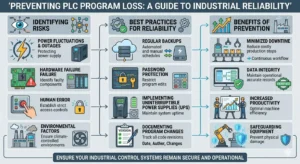
Many legacy industrial automation systems rely on battery-backed RAM to store critical logic. When the backup battery voltage drops below a specific threshold, the program may vanish during a power cycle. Consequently, operators face long restart times while they scramble to reload software. Modern systems often utilize non-volatile EEPROM or Flash memory to eliminate this dependency. However, engineers must remember that Flash memory has finite write cycles; therefore, excessive online edits can eventually degrade the hardware.
Power Quality and Its Hidden Impact on Memory Integrity
PLC CPUs remain highly sensitive to voltage fluctuations and electrical noise. A brief undervoltage event might not trigger a full hardware shutdown. Nevertheless, it can interrupt internal memory operations and cause partial program corruption. In heavy manufacturing environments, shared power lines with large motors or welders often cause these transients. Without proper isolation, these “dirty” power signals lead to random faults that are notoriously difficult to diagnose, increasing your Mean Time To Repair (MTTR).
Firmware Mismatches and Communication Interruptions
Errors often occur during online modifications or data exchanges with SCADA and DCS platforms. If the network connection drops during a write operation, the PLC may end up with missing logic blocks. Moreover, using mismatched firmware versions between the engineering software and the CPU hardware creates instability. As a result, the PLC might enter a “Stop” or “Fault” mode unexpectedly. Ensuring stable Ethernet/IP or Modbus TCP communication is vital for maintaining logic consistency across the industrial network.
Strategic Maintenance for Long-Term System Reliability
- ✅ Proactive Battery Management: Replace backup batteries every 12 to 24 months, regardless of alarm status. Always perform this while the PLC is powered on to preserve the RAM.
- ⚙️ Voltage Conditioning: Install industrial-grade UPS systems and Surge Protection Devices (SPD). These tools provide clean power and prevent memory corruption during spikes.
- 🔧 Advanced Backup Protocols: Store offline backups in multiple secure locations. Use clear version control naming conventions, such as “Project_V1.2_2026-04-17,” to ensure rapid recovery.
PLC Pioneer’s Expert Commentary: A Shift Toward Non-Volatile Memory
“In my years of field experience, the most common failure isn’t the hardware itself, but the lack of an updated backup. Many plants run for years without refreshing their project files. When a battery eventually fails, they realize their only backup is a decade out of date. Today, I strongly recommend migrating to PLCs that utilize SD cards or onboard Flash for permanent storage. This shift virtually eliminates the ‘forgotten battery’ syndrome that plagues older industrial facilities.” — PLC Pioneer
Frequently Asked Questions
Q: My PLC battery light is not on, but the program still disappeared. Why?
Internal capacitor failure or extreme electrical noise can sometimes bypass the battery alarm. Additionally, if the PLC remained unpowered for an extended duration, even a ‘good’ battery might not have sustained the RAM through high-frequency power transients.
Q: Can I convert my RAM-based PLC to use non-volatile memory?
Most mid-to-high-end legacy PLCs support optional EEPROM or Flash memory modules. By installing these and configuring the “Load on Power Up” parameters, you can ensure the hardware automatically restores the program even if the battery fails.
Q: Is an industrial UPS different from a standard office UPS?
Yes. Industrial UPS units are designed for higher temperatures and provide better “double-conversion” online protection. This ensures the output voltage remains a perfect sine wave, protecting sensitive PLC memory from the harmonics found on factory floors.
Solution Scenario: The Critical Batch Process
Consider a pharmaceutical mixing station where a power dip occurs. Without a non-volatile backup, the PLC loses its position in the sequence, ruining a $50,000 batch. By upgrading to a modern CPU with an industrial SD card backup, the system resumes exactly where it left off once power returns. This simple hardware choice provides immediate ROI by preventing a single failed batch.
If your facility is still relying on aging hardware or if you need to secure your production uptime with modern control components, our team can help you find the right upgrade path.
Explore our full range of PLC, DCS, and automation hardware at: PLC Pioneer Limited