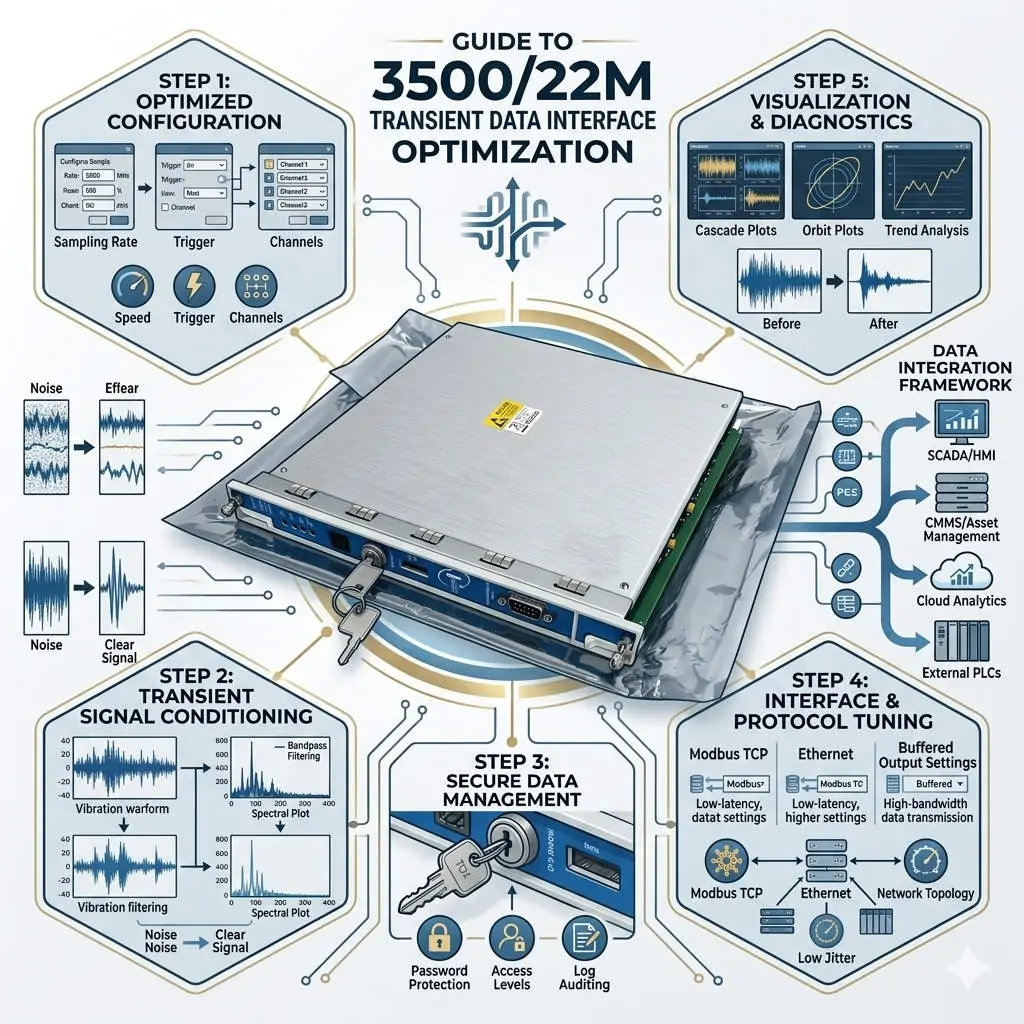
Optimizing Bently Nevada 3500/22M TDI: Eliminating Data Loss in Condition Monitoring
The Bently Nevada 3500/22M Transient Data Interface (TDI) serves as the primary gateway for machinery protection systems. It bridges critical hardware data with high-level diagnostic software like System 1. However, data loss—often called packet loss—can severely compromise vibration diagnostics and predictive maintenance accuracy. In high-stakes industries like oil and gas, missing even a brief data window can mask early-stage bearing wear or shaft misalignment.
Maximizing Network Bandwidth for High-Channel Systems
The 3500/22M uses standard Ethernet TCP/IP protocols to transmit massive amounts of vibration data. Systems with high channel counts often face bandwidth bottlenecks during simultaneous data requests. As a result, incomplete datasets may appear in your condition monitoring platform. At PLC Pioneer, we recommend implementing dedicated VLANs to isolate condition monitoring traffic from general DCS or office network data. This prioritization ensures that high-priority waveform data reaches the server without interference.
Managing Buffer Capacity During Machine Trip Events
During transient events like turbine startups or emergency shutdowns, the TDI must buffer and transmit bursts of high-resolution data. If the host software polling frequency is too low, the internal buffer may overflow. This leads to partial event logs that make root cause analysis (RCA) difficult. Operators should align software polling strategies with machine dynamics. For example, high-speed centrifugal compressors require tighter polling intervals compared to slow-moving balance-of-plant equipment.
Ensuring Firmware Stability and Protocol Alignment
Compatibility mismatches between TDI firmware and host software often trigger intermittent communication dropouts. Such instability can cause session resets, resulting in “gaps” in your historical trend data. Engineers must verify firmware versions against official Bently Nevada release notes. Furthermore, adhering to IEEE 802.3 Ethernet standards ensures long-term protocol stability. Regular audits of your 3500 rack configuration can prevent these subtle software-driven failures.
Protecting Infrastructure through Grounding and Power Quality
Industrial environments are notorious for Electromagnetic Interference (EMI) that disrupts digital signals. Routing Ethernet cables near high-voltage lines often introduces noise into the 3500/22M communication path. To mitigate this, always use shielded industrial Ethernet cables (STP) and ground the shielding at one end to prevent ground loops. Additionally, unstable rack power can cause the TDI to reset unexpectedly. Installing an industrial-grade UPS provides the necessary voltage stability to maintain continuous data streams.
Strategic Maintenance for Long-Term Data Continuity
Effective commissioning requires more than just hardware installation. Standardizing firmware across all 3500 racks in a plant simplifies troubleshooting and spare parts management. Before performing any firmware upgrades, always document your current configuration and create backups. Controlled reboot tests after any change verify that data continuity remains intact. These proactive steps reduce the risk of accidental data loss during critical operation windows.
Technical Implementation & Expert Best Practices
- ✅ Network Isolation: Segment TDI traffic into a dedicated VLAN to avoid network congestion.
- ⚙️ Shielding Standards: Maintain at least 30 cm of separation between communication and power cables.
- 🔧 Power Security: Use surge suppressors compliant with IEC 61000-4 standards for the 3500 power supply.
- 📊 Version Control: Audit firmware annually to ensure compatibility with your condition monitoring software updates.
PLC Pioneer’s Expert Commentary
“In my years of field experience, the 3500/22M is rarely the source of hardware failure. Instead, most data issues stem from ‘system noise’—either literal electrical noise or metaphorical network congestion. As we move toward IIoT and centralized remote monitoring, the TDI’s role as a robust data bridge becomes even more vital. Don’t let poor network hygiene undermine your multi-million dollar machinery protection investment.” — PLC Pioneer
Frequently Asked Questions
Q: How do I identify a network-related data drop versus a hardware fault?
Check the TDI system LEDs and software communication logs. If the ‘OK’ LED remains steady but System 1 shows ‘Communication Failure,’ the issue usually lies in the network switch or VLAN configuration rather than the module itself.
Q: Can the 3500/22M support modern IIoT integration?
Yes, but successful integration depends on your communication bridge. While the TDI provides the raw data, you may need an OPC UA gateway or the latest System 1 version to push this data into cloud-based analytics platforms securely.
Q: What is the most common mistake during a brownfield TDI upgrade?
The most common error is ignoring the backplane compatibility. Ensure the rack interface module and the internal bus firmware are aligned, as older racks may require a full system update to support all 22M enhanced features.
Application Scenario: Chemical Plant Turbine Protection
A major chemical plant experienced intermittent data gaps during steam turbine startups. Analysis revealed that the TDI shared a network switch with high-bandwidth surveillance cameras. By moving the 3500/22M to a dedicated industrial switch and adjusting the polling rate in System 1, the plant eliminated packet loss. This allowed the maintenance team to capture a critical vibration resonance event, preventing a potential shaft failure.
If you need to optimize your machinery protection system or require high-quality Bently Nevada components to ensure data integrity, our technical team is ready to assist.
Explore our full range of industrial monitoring solutions: PLC Pioneer Limited