
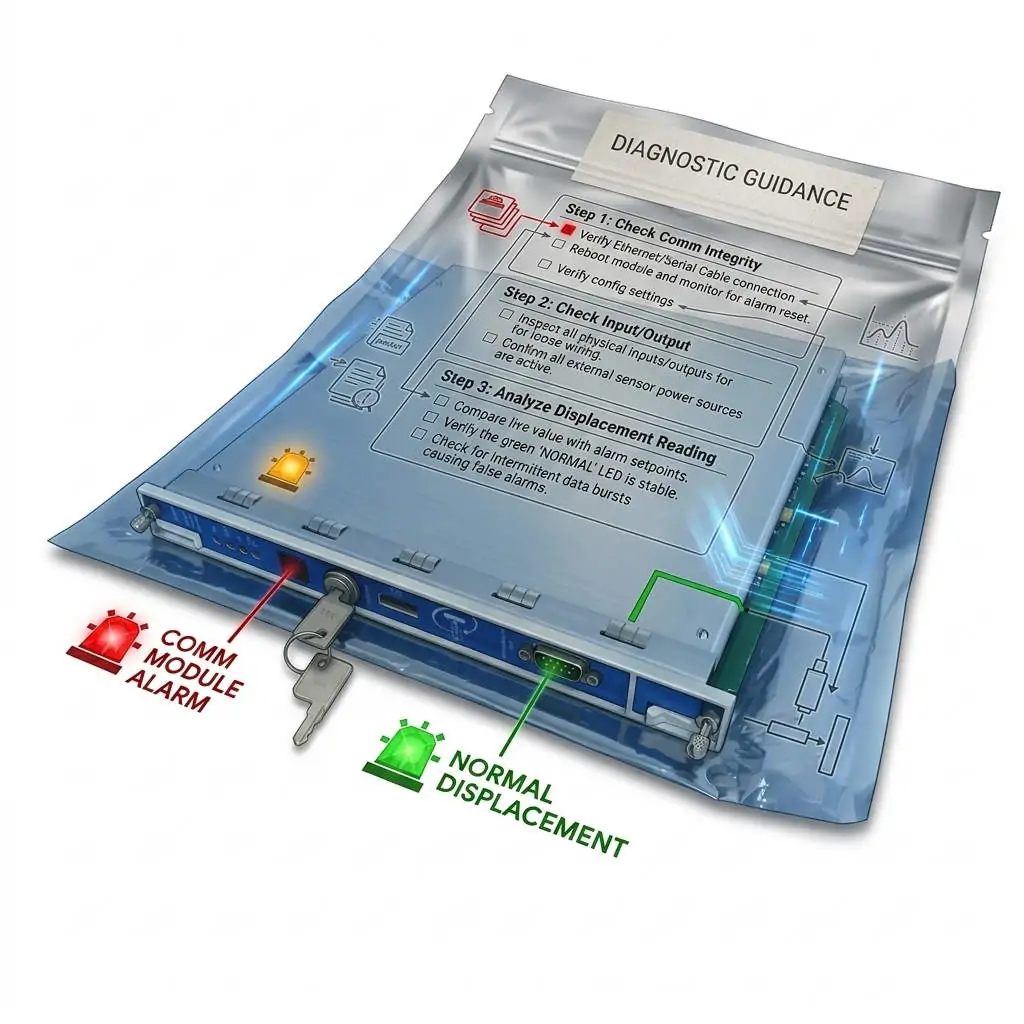
Troubleshooting Communication Module Alarms with Stable Displacement Readings
In the world of industrial machinery protection, communication modules serve as the critical gateway between monitoring racks and control systems like DCS or PLC. Occasionally, a module triggers an alarm even when mechanical displacement readings appear perfectly normal. This scenario usually points to a breakdown in data transmission integrity rather than a physical machinery fault. Consequently, understanding how to diagnose these signals prevents costly, unnecessary shutdowns in high-stakes sectors like oil, gas, and power generation.
The Impact of Communication Protocol Integrity
Communication alarms often stem from underlying issues such as packet loss, CRC errors, or exceeded timeout thresholds. While the displacement sensors function correctly, intermittent data gaps can confuse your DCS. As a result, the system might trigger a false trip or lose vital historical trending data. In systems like Bently Nevada, we often see mismatched polling rates between the DCS and the module. This mismatch overloads the buffer, causing the system to flag an error despite healthy sensor inputs.
Optimizing Scan Rates and Buffer Performance
Every communication module operates within specific refresh rates and buffer limits. If a host PLC or DCS requests data faster than the module can process, it creates a bottleneck. Consequently, the module may report a fault while the local hardware continues to read valid displacement values. Engineers frequently set high-frequency polling during initial commissioning but fail to adjust it later. This oversight often leads to long-term communication instability and recurring “phantom” alarms.
Mitigating Environmental Interference and EMI
Communication modules exhibit much higher sensitivity to electromagnetic interference (EMI) than standard analog channels. EMI can corrupt digital data packets without visibly distorting the analog front-end signals. Therefore, you might observe a communication alarm alongside perfectly steady vibration or displacement data. For instance, improper shielding or shared grounding with high-power motors often triggers sporadic alarms during equipment startup in petrochemical environments.
Essential Maintenance for Reliable Data Transmission
- ✅ Verify Grounding: Ensure you use single-point grounding for all communication cables to prevent loops.
- ⚙️ Cable Routing: Avoid running sensitive communication lines parallel to high-voltage power cables.
- 🔧 Inspect Hardware: Regularly reseat modules and check backplane connectors for oxidation or vibration-induced wear.
- 📊 Traffic Simulation: During commissioning, simulate full network load to identify issues that only appear under high traffic.
PLC Pioneer’s Industry Perspective
“I have observed that over 60% of ‘faulty’ communication modules returned from the field actually have no hardware defects. Most issues arise from poor network hygiene or mismatched polling cycles. In the era of Industry 4.0, maintaining the ‘digital pipe’ is just as critical as maintaining the physical sensor. I recommend performing a network traffic analysis before ever condemning a piece of hardware.” — PLC Pioneer
Buyer’s Guide: Evaluation and Compatibility
Is a communication alarm proof of a hardware failure?
Not necessarily. Most alarms relate to configuration errors, EMI, or improper polling thresholds. You should only replace the module after verifying signal integrity and grounding practices. Often, a firmware update or a shielding adjustment solves the problem permanently.
How do I ensure backward compatibility with legacy systems?
Most modern modules support older racks, but protocol versions like Modbus RTU vs. TCP must match exactly. Furthermore, firmware differences might alter register mapping. Therefore, always confirm the specific firmware requirements with your supplier before attempting a field deployment.
Frequently Asked Questions
Q: Why does my alarm disappear when the plant is idle?
This is a classic sign of EMI. When large motors or VFDs are off, the electrical noise floor drops. You likely have a shielding issue or a cable too close to a power source that only manifests during active production.
Q: What is the ideal polling rate for a standard industrial rack?
While it varies by manufacturer, a rate of 500ms to 1s is generally sufficient for supervisory monitoring. Forcing a 100ms rate on a non-critical communication module often leads to buffer overflows and unnecessary system stress.
Q: Can a loose backplane connector cause intermittent data errors?
Yes, especially in high-vibration environments like compressor decks. Micro-vibrations can cause momentary contact loss, which the module interprets as a communication timeout or a hardware fault.
Practical Solution Scenario: The Petrochemical Plant Case
In a recent project, a centrifugal compressor rack reported frequent communication errors despite stable displacement. After an on-site audit, we discovered that the shield was grounded at both ends, creating a ground loop. By moving to a single-point ground and increasing the DCS polling interval from 200ms to 500ms, the alarms ceased completely, saving the client an estimated $50,000 in potential downtime.
For more technical insights and high-quality automation components to keep your systems running smoothly, explore our extensive inventory today.
Discover more at our official site: PLC Pioneer Limited