
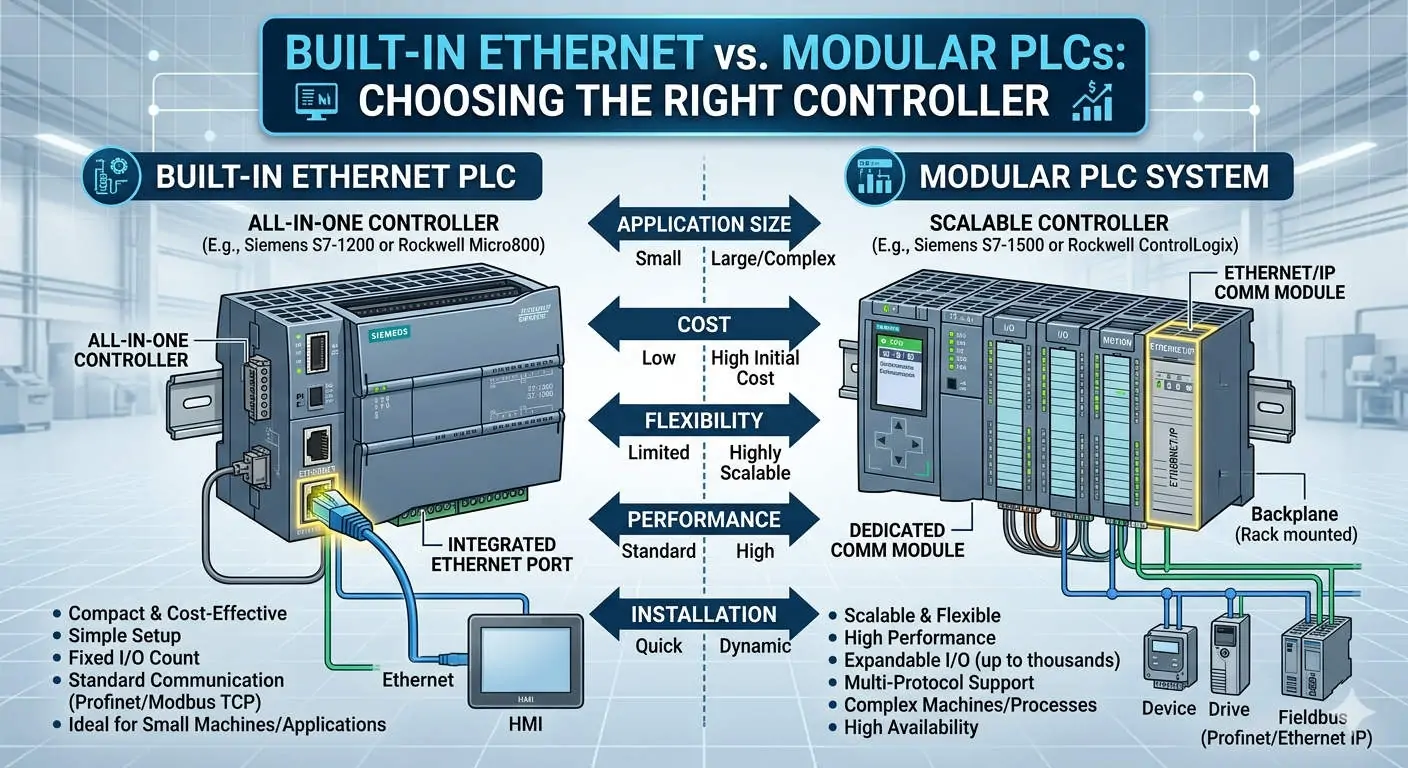
Built-in Ethernet vs. Communication Modules: Selecting the Ideal PLC Architecture
In modern industrial automation, the communication capability of a PLC determines how effectively it integrates into higher-level SCADA or MES environments. Engineers often face a critical choice: should they use a PLC with built-in Ethernet or opt for a modular communication design? While integrated ports simplify commissioning, modular configurations offer the specialized flexibility required for complex or legacy industrial networks.

Strategic Protocol Compatibility and Integration
Integrated Ethernet ports typically support standard industrial protocols such as Modbus TCP, EtherNet/IP, or PROFINET. These allow for immediate connection to HMIs and other controllers. However, modular PLCs allow engineers to select specific modules for niche protocols like Profibus DP or CANopen. Therefore, built-in ports favor rapid deployment, whereas add-on modules excel in brownfield projects that must support aging infrastructure.
Optimizing CPU Processing and Network Performance
In compact PLCs, the main CPU often handles both logic execution and communication tasks. Consequently, high-frequency data polling from a SCADA system can inadvertently increase the logic scan time. Modular PLCs solve this by offloading communication processing to dedicated hardware. Based on my experience at PLC Pioneer, this separation is vital for high-speed packaging lines where millisecond-level determinism is non-negotiable.
Scalability and Modern Network Architecture
Integrated Ethernet solutions generally suit fixed systems with limited expansion needs. In contrast, modular systems enable advanced architectures such as network redundancy and multi-protocol gateways. Moreover, modularity allows for physical network segmentation, which enhances cybersecurity by isolating the control layer from the enterprise IT network. While the initial investment is higher, modular designs provide a more future-proof foundation for factory automation.
Critical Maintenance for Industrial Environments
Field conditions significantly impact communication reliability. Many cost-effective PLCs lack robust surge protection on their onboard ports. As a result, engineers should install external surge suppressors in lightning-prone areas. Furthermore, in high-EMI environments like steel mills, using shielded STP cables or moving to fiber optic modules is essential to prevent data corruption. Always ensure proper grounding to protect sensitive communication chipsets from damage.
Mechanical Integrity and Field Reliability
High-vibration environments pose a unique risk to modular PLC systems. If communication modules are not secured with locking clips, intermittent connection loss can occur. These “ghost faults” are notoriously difficult to diagnose in the field. I always recommend periodic inspections of the backplane connectors. Stable mechanical mounting often prevents the unexpected downtime that software patches cannot fix.
PLC Selection Quick-Reference Checklist
- ✅ Choose Built-in Ethernet if: Your project uses standard protocols, requires a compact footprint, and has a limited budget.
- ⚙️ Choose Modular Communication if: You need to bridge to legacy fieldbuses or require high-performance network redundancy.
- 🔧 Hardware Protection: Always utilize industrial-grade shielded CAT5e/6 cables and ensure the DIN rail is properly grounded.
- 📊 Traffic Management: Separate your I/O traffic from supervisory data to maintain consistent machine cycle times.
PLC Pioneer’s Expert Commentary
“I often see engineers choose built-in Ethernet solely based on upfront cost. However, from a lifecycle perspective, this can be a trap. If your facility plans to implement AI-driven analytics or expanded IIoT monitoring next year, the fixed bandwidth of an integrated port may become a bottleneck. At PLC Pioneer, we advocate for modularity whenever the production roadmap suggests even a 20% growth in data points. It is far cheaper to add a module than to replace a central processor.” — PLC Pioneer
Frequently Asked Questions
Q: Can excessive SCADA polling actually crash a PLC with built-in Ethernet?
It rarely crashes the CPU entirely, but it can significantly “stretch” the scan time. This latency can cause timing errors in high-speed logic. If your polling frequency is high, a dedicated communication module is the safer engineering choice.
Q: Is it possible to use both built-in ports and modules simultaneously?
Yes, many mid-to-high-end PLCs support this. This is an excellent way to use the built-in port for local HMI access while using dedicated modules for high-speed I/O or remote telemetry.
Q: How do I verify protocol compatibility before purchasing?
Never rely solely on a brochure. Check for the specific Conformance Class (e.g., PROFINET CC-B) and firmware version requirements. In my experience, a quick interoperability test in the lab saves weeks of troubleshooting during commissioning.
Application Scenario: Retrofitting a Chemical Plant
In a recent retrofit, we integrated a new PLC into a plant still running on Profibus DP. By choosing a modular PLC, we utilized one module for the legacy field devices and the built-in Ethernet for the new SCADA system. This hybrid approach allowed the plant to modernize its data collection without the massive expense of replacing hundreds of existing sensors and actuators.
Whether you need to simplify your control panel or build a complex, multi-layered network, selecting the right hardware is the first step toward reliability. Explore our deep-dive technical guides and find the right components for your next project.
Discover more industrial solutions at: PLC Pioneer Limited