
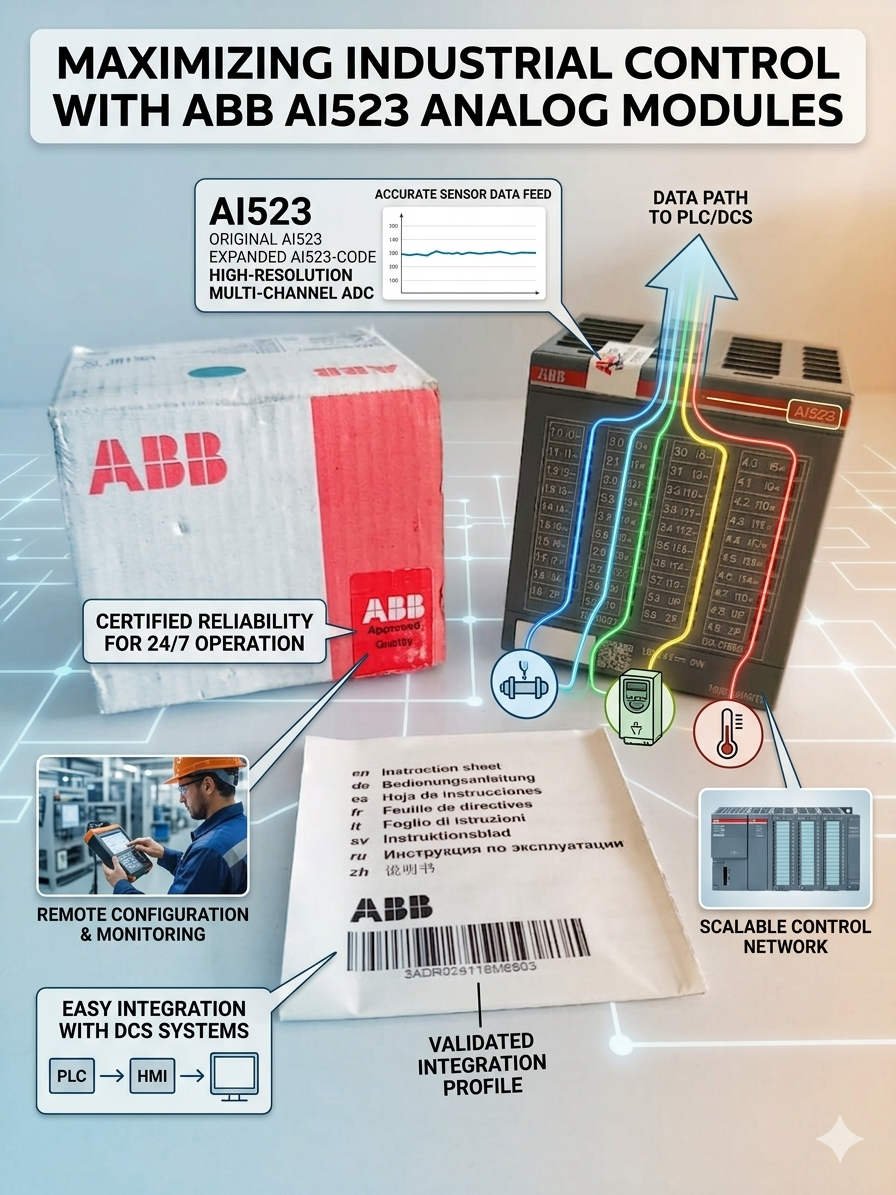
Demystifying the ABB AI523: Is its A/D Resolution 12-bit or 16-bit?
Engineers often debate the necessity of high-resolution analog inputs in industrial automation. Regarding the ABB AI523 analog input module, the technical reality is clear: it utilizes a 12-bit A/D conversion resolution. This architecture translates process signals into 4,096 discrete digital values. While some modern modules offer 16-bit depth, the AI523 remains a cornerstone in PLC and DCS environments due to its deterministic performance and industrial-grade stability.
Understanding the Balance Between Precision and Process Stability
In high-stakes industries like petrochemicals and power generation, reliability outweighs laboratory precision. A 12-bit resolution provides a granularity of approximately 0.024% of the full scale. For standard variables such as pressure, flow, and tank levels, this precision far exceeds the mechanical accuracy of most field transmitters. Consequently, the AI523 delivers stable closed-loop control without the “signal jitter” often associated with overly sensitive high-resolution converters.
The Technical Advantage of 12-bit Quantization in Harsh Environments
Why does 12-bit remain relevant in 2026? Industrial sites are notoriously “noisy” due to Variable Frequency Drives (VFDs) and high-current motor starters. High-resolution 16-bit modules often amplify low-level electromagnetic interference (EMI). However, the 12-bit architecture of the AI523 acts as a natural buffer. It provides a more predictable digital representation of the process, ensuring that your PID control loops react to real physical changes rather than electrical noise.
Strategic Integration with Legacy ABB Control Architectures
The AI523 excels in brownfield modernization projects. Many legacy systems, such as Advant and Master architectures, were engineered for deterministic scan cycles. Introducing a higher-resolution module can sometimes increase CPU overhead or require significant recalibration of existing control strategies. Therefore, maintaining the 12-bit standard ensures seamless compatibility and prevents unwanted shifts in alarm thresholds or loop tuning parameters.
Optimizing Signal Integrity through Proper Installation
Field experience suggests that grounding quality impacts accuracy more than bit-depth. To ensure the AI523 performs at its peak, engineers must prioritize shield grounding. In my experience at PLC Pioneer, we recommend single-point grounding for analog cables to prevent ground loops. Furthermore, keeping signal wires separate from high-voltage power lines remains the most effective way to maintain a high signal-to-noise ratio in any factory automation setup.
Maintenance Protocols for Long-Term Reliability
Industrial environments subject hardware to thermal cycling and oxidation. To maintain the accuracy of your AI523 modules, implement a routine calibration check during annual shutdowns. Injecting precise 4-20 mA signals allows you to identify any offset drift. Moreover, inspecting terminal blocks for corrosion is vital. Many reported “module failures” are actually the result of increased resistance at the physical connection point rather than electronic degradation.
—
Technical Implementation & Maintenance Checklist
- ✅ Verify Scaling: Ensure the controller software maps 4-20mA signals to the 0-4095 digital range correctly.
- ⚙️ Shield Grounding: Use shielded twisted-pair cables and ground the shield at the cabinet end only.
- 🔧 Surge Protection: Add external suppressors for transmitters located in outdoor tank farms or remote areas.
- 📊 Firmware Audit: Check backplane compatibility before replacing legacy modules with newer hardware versions.
—
PLC Pioneer’s Expert Commentary
“The obsession with 16-bit resolution is often a distraction in process automation. In most industrial loops, the field instrument itself is the accuracy bottleneck. The ABB AI523 succeeds because it prioritizes availability and noise immunity. It is a ‘workhorse’ module designed for the reality of the plant floor, not the clean air of a lab. When reliability is your primary KPI, the AI523 is a mathematically sound and operationally superior choice.” — PLC Pioneer
Technical FAQ
Q: Will upgrading to a 16-bit module improve my PID control loop performance?
Rarely. If your field sensor has an accuracy of 0.5%, the extra bits only provide a more detailed view of the sensor’s error and electrical noise. Stick with 12-bit for standard process loops to maintain control stability.
Q: How do I handle signal fluctuations on my AI523 input channels?
Before blaming the module, check for common-mode voltage issues. Implementing a signal isolator or verifying the common ground reference often resolves “drifting” values that appear to be module faults.
Q: Is the AI523 suitable for high-speed turbine monitoring?
For basic vibration feedback, yes. However, for high-frequency spectral analysis, you might require specialized high-speed sampling modules. For standard auxiliary turbine data, the AI523 is more than sufficient.
—
Application Scenario: Chemical Dosing Control
In a recent chemical plant retrofit, the customer insisted on 16-bit modules for a dosing system. However, high-frequency noise from nearby pumps caused the valves to “hunt” constantly. By reverting to the 12-bit ABB AI architecture and implementing proper signal filtering, the control loop stabilized immediately. This proves that deterministic acquisition is often more valuable than high-density quantization.
Looking for reliable ABB components or need technical advice on legacy system migration? Explore our comprehensive inventory of tested industrial hardware.
Discover more technical insights and hardware solutions at our official site: PLC Pioneer Limited