Emerson DeltaV SE5009: Understanding Fuse Protection and Alarm Diagnostics
In the world of Emerson DeltaV systems, the SE5009 serves as a critical component for system-level I/O protection. Field engineers often ask: “Does the control system automatically generate an alarm when a channel fuse blows?” This is a vital question for maintaining plant uptime and ensuring rapid fault response.
The Core Value of Channel-Level Fault Isolation
The primary value of the SE5009 lies in its ability to provide granular fault isolation. Instead of a single short circuit taking down an entire 24VDC power bus, the SE5009 restricts the failure to a single channel. This design is crucial for continuous processes in oil, gas, and pharmaceutical industries. For instance, a shorted solenoid valve should not paralyze an entire Digital Output (DO) card. By isolating faults, maintenance teams can pinpoint issues without interrupting the global DCS operation.
Technical Insights into Fuse Failure Detection
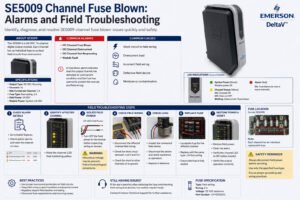
The SE5009 typically functions as a passive protection element. Consequently, it may not generate a specific “Fuse Blown” hardware alarm by itself. Instead, the DeltaV system identifies the failure through secondary symptoms. If your I/O card supports Line Monitoring, the controller may report an “Open Circuit” or “Field Power Loss.” However, standard DO modules might simply show no physical action at the field device. Engineers must configure specific diagnostic logic to ensure these events do not go unnoticed in the HMI.
Impact of Channel Isolation on Production Continuity
Industrial environments prioritize stability above all else. The SE5009 ensures that a single point of failure—such as an actuator malfunction—does not trigger an unplanned shutdown. In continuous distillation or hydrocracking units, this isolation prevents false interlocks. Based on PLC Pioneer field experience, upgrading to hardware with integrated diagnostic feedback is often more valuable than simply increasing processing speed. It directly affects your MTTR (Mean Time To Repair).
Maintenance Best Practices for Protection Components
Maintaining these systems requires strict adherence to engineering standards. First, never replace a blown fuse with one of a higher rating. This risk leads to permanent MOSFET damage on the I/O card or overheated PCB traces. Second, in high-vibration areas like compressor decks, terminal looseness is a common culprit. We recommend annual thermal imaging to detect high-resistance hot spots. Finally, for outdoor solenoids or long-distance cabling, always supplement the SE5009 with external surge protectors to meet IEC 61000 EMC standards.
PLC Pioneer’s Expert Commentary
“I have observed many projects where the SE5009 was installed, yet operators remained blind to fuse failures because ‘Line Monitoring’ was disabled in the software. In modern industrial automation, the hardware is only as good as the diagnostic configuration. Do not assume the system will ‘just know’ a fuse is gone; verify your SOE (Sequence of Events) settings during the FAT phase.” — PLC Pioneer
- ✅ Diagnostic Verification: Always test “Open Circuit” detection during commissioning.
- ⚙️ Environmental Protection: Use RC Snubbers for inductive loads to prevent nuisance fuse blowing.
- 🔧 Hardware Compatibility: Confirm if your terminal block type supports active fuse monitoring.
Frequently Asked Questions (FAQ)
Q1: Why does my SE5009 fuse blow frequently even without a dead short?
This often occurs due to inrush currents from inductive loads like large contactors. Check if you have installed flyback diodes or surge absorbers. Thermal fatigue from loose wiring in high-vibration zones can also cause premature failure.
Q2: Can I monitor fuse status without high-end diagnostic I/O cards?
Yes, you can implement “Smart Marshalling” by using fuses with built-in LED indicators or by wiring a dry contact from a fuse-monitor relay back to a spare Digital Input channel.
Q3: How does the SE5009 handle lightning-induced surges?
While the fuse provides overcurrent protection, it is too slow for transient surges. You must install dedicated DIN-rail surge protectors to prevent high-voltage spikes from bypassing the fuse and destroying the I/O module electronics.
Application Scenario: Chemical Batch Reactor
In a chemical batch process, the loss of a single feed valve can ruin an entire production lot. By using the SE5009 with enabled Line Monitoring, the operator receives an immediate “Channel Fault” alert. This allows for a manual bypass or an orderly pause before the batch reaches a critical state, saving thousands of dollars in wasted raw materials.
Optimizing your industrial control system requires the right balance of hardware protection and software intelligence. For high-quality automation components and expert technical support, we invite you to explore our solutions.
Visit our official resource center for more insights: PLC Pioneer Limited