

Optimizing Signal Integrity for Honeywell FC-TSDI-1624: A Professional Guide to Terminal Reliability
The Honeywell FC-TSDI-1624 digital input module stands as a cornerstone in modern Distributed Control Systems (DCS). However, its reliability in critical environments like petrochemical plants depends heavily on installation quality. While the module excels in high-density I/O tasks, signal integrity remains vulnerable to environmental stressors. As a content manager at PLC Pioneer, I have observed that most “hardware failures” are actually wiring issues. Therefore, understanding the mechanical nuances of terminal connections is essential for plant uptime.
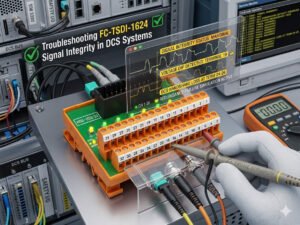
Mechanical Dynamics: Comparing Screw and Spring-Clamp Terminals
Terminal connection technology directly influences long-term stability. Screw terminals offer exceptional mechanical retention but require precise torque application. Conversely, spring-clamp designs provide a maintenance-free alternative that naturally resists vibration. However, improper wire preparation in either system increases contact resistance. Over time, this resistance causes signal drift or intermittent faults that disrupt industrial automation workflows.
Digital Input Sensitivity and False State Detection
The FC-TSDI-1624 processes low-level switching signals, making it highly sensitive to micro-fluctuations in contact quality. Even a minor increase in resistance can trigger a false “off” state in dry contact or NAMUR-type loops. In hazardous area applications, such errors are not just inconvenient; they are safety risks. Consequently, technicians must treat the terminal block as a high-precision component rather than a simple connector.
Environmental Stressors and Material Degradation
Industrial environments subject modules to extreme temperature cycles and corrosive gases like H₂S. These factors accelerate the oxidation of contact points. Furthermore, thermal expansion can loosen conductors, particularly when mixing solid and stranded wires. To mitigate this, engineers should adhere to IEC 60068 standards for environmental testing. Utilizing tin-plated conductors can significantly reduce galvanic corrosion in high-humidity zones.
Best Practices for Field Installation and Maintenance
Preventing contact failure starts with disciplined field practices. My recommendation at PLC Pioneer is to always use ferrules for stranded wiring. This simple step creates a uniform contact surface and prevents fraying. For high-vibration areas near compressors or turbines, we suggest the following technical measures:
- ✅ Apply Torque Seals: Use visual markers after tightening screws to identify loosening during routine inspections.
- ⚙️ Implement Scheduled Maintenance: Re-torque terminal connections every 6 to 12 months to compensate for metal fatigue.
- 🔧 Environmental Sealing: Use IP54+ rated enclosures and conformal coatings to shield contact points from chemical attack.
Strategic Procurement: Assessing Replacement Needs
When evaluating the FC-TSDI-1624 for a retrofit, verify its compatibility with existing Honeywell Field Termination Assemblies (FTA). While the module is robust, high-vibration or corrosive environments may necessitate specialized upgrades. Always consider the total cost of ownership, including potential downtime caused by inferior wiring components. For legacy systems, ensuring backward compatibility with baseplates is a critical step before finalizing your purchase.
PLC Pioneer’s Expert Commentary
“In the world of industrial automation, the smallest screw often dictates the reliability of the largest system. The FC-TSDI-1624 is a testament to Honeywell’s engineering, but it requires a ‘Precision First’ mindset during deployment. We often see clients over-spend on software while under-investing in physical layer integrity. Focus on your ferrules and torque settings; your DCS will thank you.” — PLC Pioneer
Frequently Asked Questions
Q: Why does my DCS report a module fault when the FC-TSDI-1624 indicators look normal?
This is often caused by “chatter” in the wiring. If the contact is loose, the signal toggles faster than the human eye can see, but the DCS CPU registers it as a channel error. Check your terminal tightness first.
Q: Can I use the FC-TSDI-1624 in offshore environments?
Yes, but you must use salt-spray resistant enclosures. We also recommend applying a non-conductive anti-corrosion grease to the terminal pins to prevent salt-air ingress.
Q: Is there a significant difference between solid and stranded wire for this module?
Stranded wire is more flexible but prone to “splaying” under screw pressure. If you don’t use ferrules, solid wire is technically more stable, though harder to route in high-density cabinets.
Solution Scenario: Compressor Station Reliability
A midstream gas plant experienced recurring trips on their compressor input loops. After replacing the FC-TSDI-1624 modules twice with no improvement, a PLC Pioneer audit found that engine vibration was loosening the screw terminals every 90 days. By switching to spring-clamp terminal blocks and installing vibration isolators on the cabinet, the plant achieved 18 months of uninterrupted operation.
For high-quality industrial automation parts and expert technical support, ensure your facility is equipped with genuine components. Explore our extensive inventory of Honeywell and other leading DCS modules today.
Visit our official resource center for more technical insights: PLC Pioneer Limited