
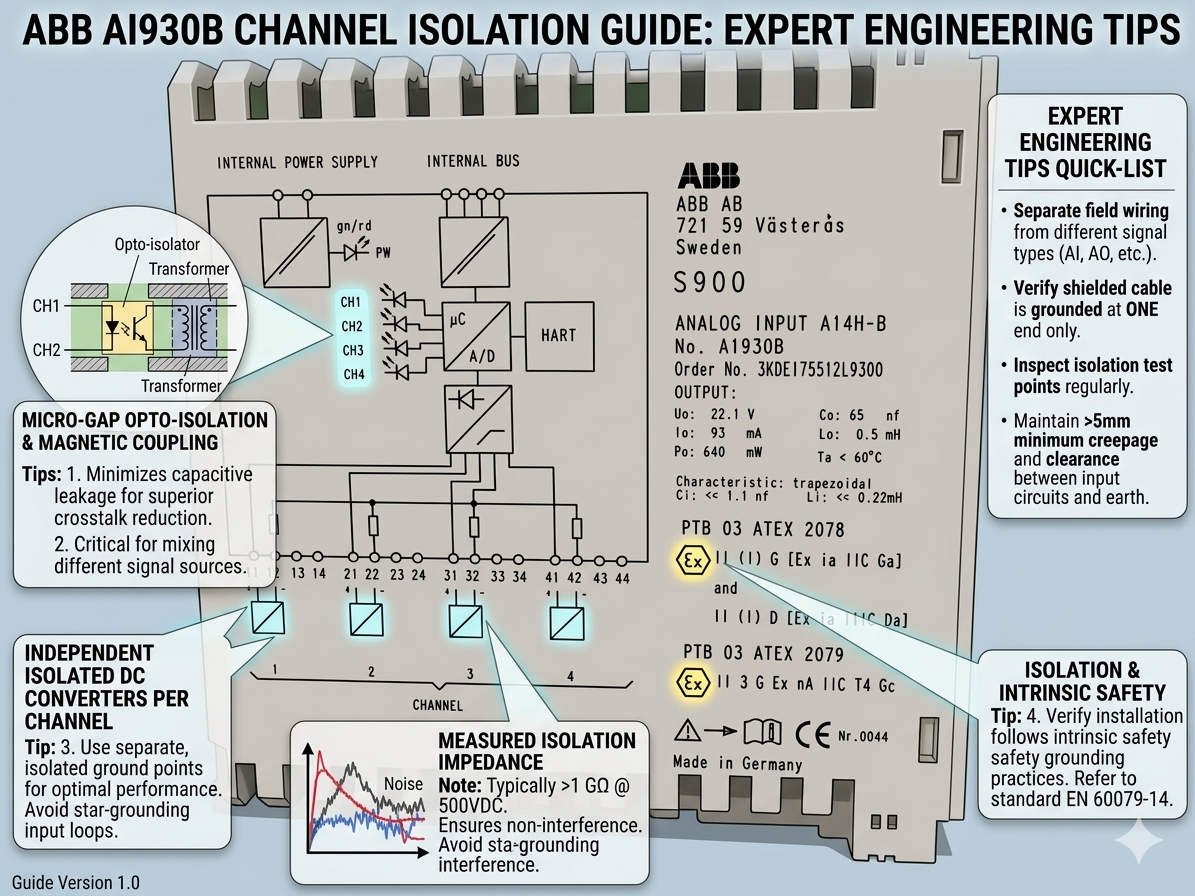
ABB AI930B Engineering Guide: Understanding Channel Isolation and DCS Stability
In the demanding world of industrial automation, the ABB AI930B stands as a cornerstone for analog signal acquisition within Distributed Control Systems (DCS). However, engineers often ask: “Does each channel possess electrical isolation?” Understanding the internal architecture of this module is vital for maintaining signal integrity and preventing hardware failure in high-stakes environments like oil refineries or power plants.
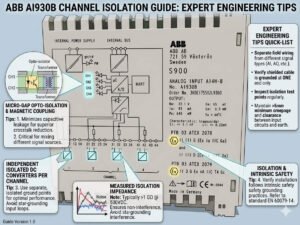
Deconstructing the AI930B Group Isolation Architecture
The ABB AI930B utilizes a group isolation design rather than individual galvanic isolation for every channel. While the module effectively isolates the field signals from the system backplane and power domain, the individual input channels share a common electrical reference. This design choice optimizes the balance between high-density channel counts and thermal management within the DCS cabinet. Consequently, engineers must plan their grounding philosophy carefully to avoid common-mode interference.
Strategic Advantages in Large-Scale Process Automation
For large-scale factory automation, the AI930B offers significant benefits in terms of spatial efficiency and cost-to-performance ratio. By centralizing the reference point for a group of 4–20 mA transmitters, the module reduces heat generation and hardware complexity. In my professional view at PLC Pioneer, this architecture excels in “marshalling” environments where instruments share a unified grounding zone. Moreover, it simplifies loop-checking procedures during commissioning, as technicians can verify multiple signals against a single reference point.
Mitigating Ground Potential Risks in Field Wiring
Because the channels are not individually isolated, ground potential differences pose a genuine technical risk. For instance, sensors located in distant plant areas may have different electrical potentials. If connected to the same AI930B module, these differences can manifest as signal drift or intermittent spikes. Therefore, we recommend grouping sensors by physical proximity and grounding zone. If you must monitor high-risk signals, such as those from offshore platforms or turbine systems, adding external DIN-rail signal isolators is a proven best practice to protect your DCS hardware.
Combatting Common-Mode Noise from High-Power Equipment
Industrial environments are saturated with electromagnetic noise from Variable Frequency Drives (VFDs) and large motor starters. While the AI930B maintains industrial-grade EMC protection, improper shielding remains the primary cause of signal instability. To ensure maximum precision, engineers should terminate cable shields at only one end. Furthermore, physically separating analog signal cables from high-voltage power lines prevents inductive coupling, which is critical for the low-level precision required in fine chemical and pharmaceutical applications.
Installation Best Practices for Long-Term Reliability
- ✅ Group by Zone: Only wire instruments from the same grounding area into a single AI930B module.
- ⚙️ Shielding Discipline: Maintain shield continuity through junction boxes and avoid multiple ground points.
- 🔧 External Protection: Use external loop isolators for long-distance field wiring to block surges.
- 📊 Compatibility Audit: Verify module firmware and backplane versions before performing brownfield upgrades.
PLC Pioneer’s Expert Commentary
“While some engineers prefer the total safety of channel-to-channel isolation, the AI930B provides a robust, industrial-standard solution when deployed with proper grounding discipline. In my experience, most ‘module failures’ are actually symptoms of poor cabinet layout or improper shield management. In 2026, as systems become more interconnected, the focus must shift from simply buying hardware to designing the entire signal loop for resilience.” — PLC Pioneer
Frequently Asked Questions (FAQ)
Q: What happens if one field device develops a ground fault on a shared-reference module?
On an AI930B, a significant ground fault on one channel can potentially destabilize the readings of other channels within the same group. This is the primary trade-off of group isolation; however, this risk is easily mitigated by using proper surge protection and isolating high-risk field instruments.
Q: Is the AI930B suitable for high-vibration or high-EMI areas like turbine control?
Yes, provided you use shielded, twisted-pair cabling and dedicated instrument grounding bars. For extremely high-noise environments, we strongly suggest placing the module inside an IEC-compliant, RFI-shielded cabinet and utilizing external signal conditioners to act as a buffer.
Q: Can I hot-swap the AI930B during active plant operations?
Hot-swapping is generally supported by the ABB S900 I/O family, but you must verify that your specific controller firmware and Field Termination Unit (FTU) configurations support this action. Always check the ‘active’ status LEDs before removal to avoid triggering a system-wide trip.
Solutions Scenario: Tank Farm Monitoring
In a typical refinery project, we encountered significant signal noise on tank level sensors. The root cause was a ground loop between the tank loading station and the control room. By grouping the AI930B inputs by local “zones” and adding external isolators for the most distant tanks, we eliminated the noise and improved measurement accuracy by 1.2%. This demonstrates that while the AI930B is powerful, successful integration depends on site-specific engineering.
If you need to source authentic ABB modules or require expert consultation on industrial signal integrity, explore our comprehensive inventory and technical resources.
For technical specifications and hardware support, visit our resource center: PLC Pioneer Limited