
Effective Strategies to Mitigate VFD Interference on Industrial Communication Cables
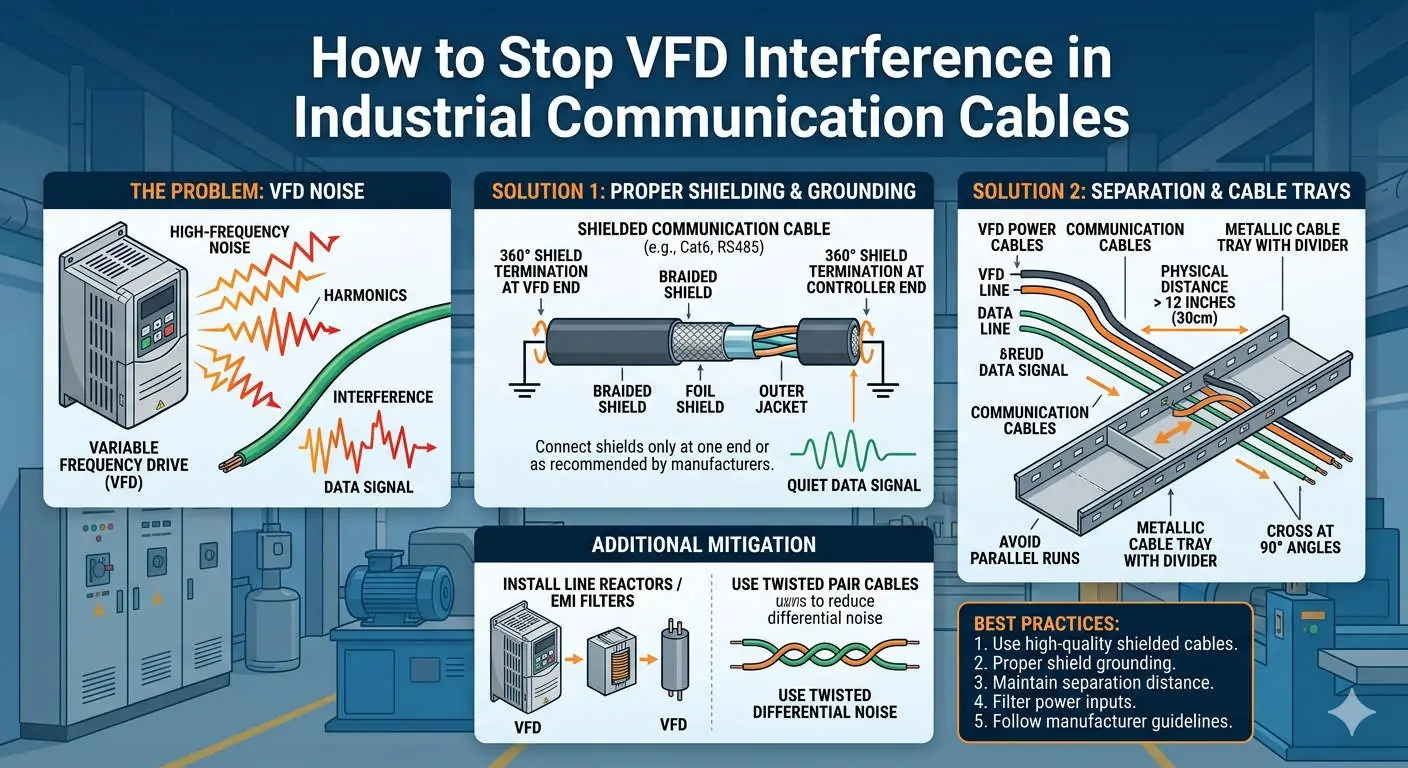
Variable Frequency Drives (VFDs) serve as the backbone of modern motor control. However, they also act as significant sources of electromagnetic interference (EMI). This electrical noise often disrupts critical signals in PLC, DCS, and SCADA systems. Engineers must prioritize mitigation to ensure stable data transmission and prevent costly, unexpected downtime in automated facilities.

Understanding Shielding Effectiveness and Grounding Dynamics
Shielded cables represent your primary defense against VFD-induced noise. For maximum protection, select cables with at least 85% shield coverage. However, the method of grounding often dictates the actual performance of the shield. While grounding both ends effectively dissipates high-frequency noise, it can occasionally create ground loops in low-frequency analog circuits. Therefore, technicians must evaluate the specific frequency environment before finalizing the grounding strategy.
Protocol Immunity: RS-485 versus Industrial Ethernet
Different communication protocols offer varying levels of resistance to electromagnetic noise. RS-485 utilizes differential signaling, which inherently provides strong immunity in harsh industrial environments. In contrast, Industrial Ethernet protocols like PROFINET offer higher bandwidth but remain sensitive to poor shielding. As a result, selecting the appropriate cable category and protocol is essential for maintaining real-time control loop integrity.
Strategic Cable Routing and Physical Separation
Installation topology significantly influences EMI suppression levels. According to IEC 61800-3 standards, maintaining a 20–30 cm gap between power and signal lines is vital. Continuous exposure to high-energy EMI can degrade cable insulation over time. Consequently, disciplined routing protects both the signal quality and the long-term health of your communication modules.
Best Practices for Physical Installation and Tray Management
A frequent error in factory automation involves running signal cables parallel to VFD output leads in the same tray. To avoid capacitive coupling, always utilize separate, dedicated cable trays for power and data. If these paths must intersect, ensure they cross at a 90-degree angle. This simple geometric adjustment can reduce interference by over 80% in many retrofit scenarios.
Advanced Grounding and High-Frequency Noise Dissipation
Standard “pigtail” grounding often fails at higher frequencies because it adds unnecessary inductance. Instead, use 360-degree shield grounding clamps to provide a low-impedance path for noise. Moreover, always verify that grounding bars are free of paint or oxidation. Clean contact points are often the difference between a successful commissioning and persistent intermittent faults.
The Role of EMI Filters and Ferrite Cores
When baseline shielding proves insufficient, hardware additions become necessary. Installing EMI/RFI filters on the VFD input and output stages can trap noise at the source. Additionally, placing ferrite cores on communication lines near the entry point helps suppress high-frequency spikes. These components are particularly effective against the fast-switching noise generated by modern IGBT power transistors.
- ✅ Verify Shielding: Use braided + foil shielding for high-noise zones.
- ⚙️ Check Grounding: Replace pigtails with 360° clamps to improve dissipation.
- 🔧 Monitor Routing: Maintain 30cm separation between VFD output and PLC I/O.
PLC Pioneer’s Expert Commentary
“In my years of field experience, I’ve found that 90% of ‘ghost’ communication errors are actually physical layer issues caused by VFDs. Many engineers try to solve these through software timing adjustments. However, a hardware-first approach—focusing on grounding and shielding—is much more sustainable. As VFDs move toward higher switching frequencies (SiC technology), electromagnetic compatibility (EMC) will become the single most important factor in system reliability.” — PLC Pioneer
Frequently Asked Questions
Q: Can I use standard Cat5e cables near high-power VFDs?
Standard UTP (Unshielded Twisted Pair) Cat5e is highly susceptible to EMI. In a VFD environment, you should only use industrial-grade STP (Shielded Twisted Pair) or SFTP cables. Using non-shielded cables near drives almost guarantees packet loss and communication timeouts.
Q: When is it time to switch from copper to fiber optics?
If your cable run exceeds 100 meters or passes through an area with massive EMI (like a multi-drive cabinet), fiber is the best choice. Fiber optics are entirely immune to electrical noise and provide the ultimate “peace of mind” for critical process safety.
Q: Will a ferrite core fix a poorly grounded system?
No. A ferrite core is a supplementary tool to suppress high-frequency transients. It cannot compensate for a missing or high-impedance safety ground. Always fix the grounding infrastructure before relying on ferrite beads.
Application Scenario: Chemical Plant Retrofit
During a recent project involving multiple 200kW VFDs, a DCS system suffered from constant “Module Not Responding” errors. The original installer had bundled the Modbus cables with the motor leads. By installing 360° grounding clamps and rerouting the data cables into an isolated conduit, the error rate dropped to zero. This demonstrates that physical layer discipline is often more effective than expensive software filters.
Optimizing your automation system requires high-quality components designed for harsh environments. For professional-grade hardware and expert advice on system integration, visit our resource center.
Explore our technical guides and hardware solutions: PLC Pioneer Limited