Strategic Tag Naming: The Foundation of Reliable Industrial Automation Systems
In large-scale industrial automation, tag naming conventions represent more than just documentation. They directly influence system reliability, troubleshooting speed, and long-term maintainability. Industries such as oil and gas or pharmaceuticals manage thousands of I/O points across PLC and DCS layers. Therefore, inconsistent naming often leads to misinterpretation, delayed fault isolation, and significant operational risks.

Encoding Hierarchy for Scalable System Design
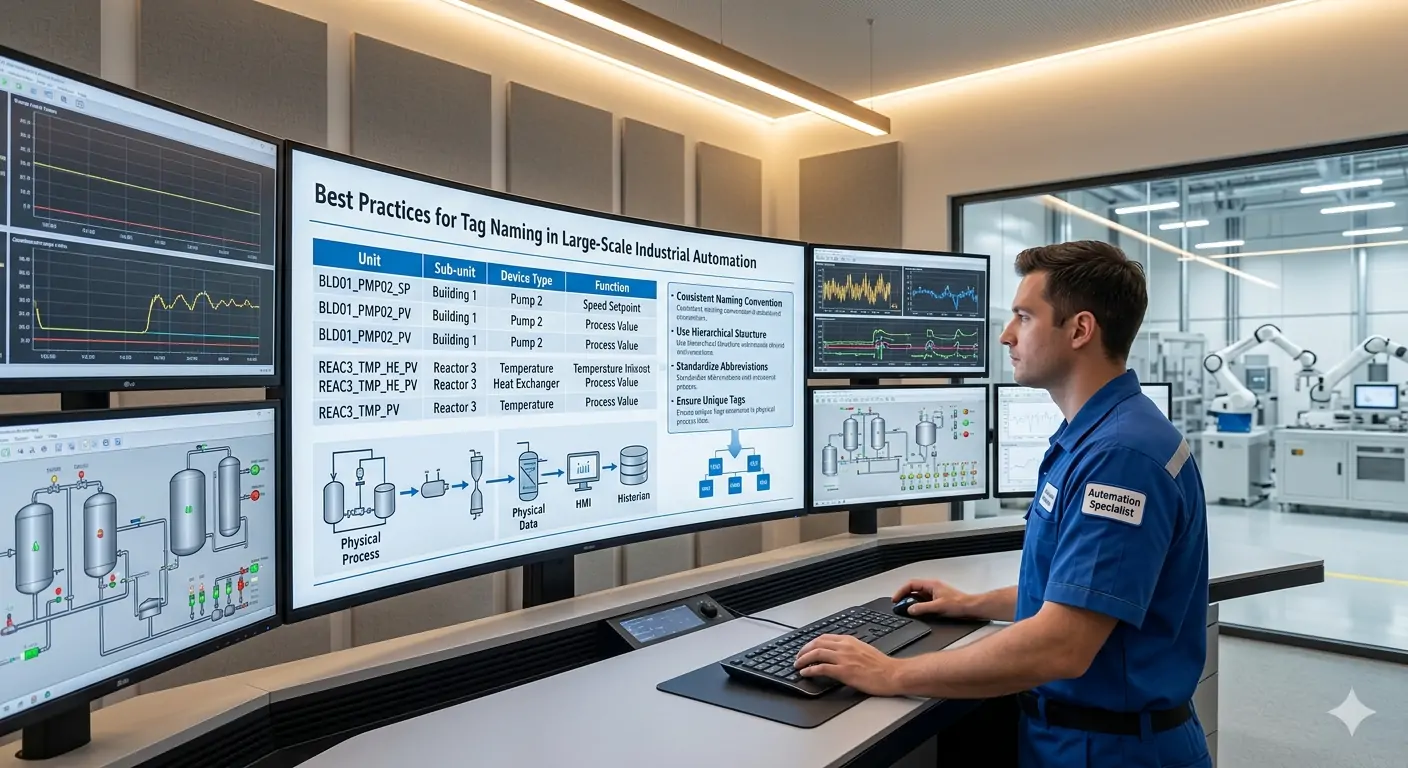
A tag name functions as a coded hierarchy rather than a simple label. In systems exceeding 10,000 tags, poor structures create database inefficiencies and massive engineering overhead. For example, a structured tag like PLANT1_UNIT3_PUMP02_RUN_FB enables faster filtering in SCADA and HMI environments. From my professional experience at PLC Pioneer, projects lacking hierarchical naming often see a 20% to 30% increase in commissioning time due to manual cross-referencing.
Enhancing Alarm Management and Operator Response
Tag naming directly impacts how quickly an operator understands an emergency. A generic tag like ALM001 provides no context, whereas UNIT2_TANK5_LEVEL_HH identifies the location and condition immediately. Aligning with ISA-18.2 alarm management principles reduces cognitive load on staff. In fact, a refinery upgrade project proved that clear naming reduced average operator response times by 15% during simulated fault scenarios.
Ensuring Protocol Integration and Data Consistency
Modern control systems must integrate various protocols like Modbus, OPC UA, and Profinet. Engineers must ensure tag names comply with character limits and syntax rules across all layers. Some legacy PLCs restrict names to 16 characters, while OPC UA allows longer, structured strings. Failure to standardize these names often results in mapping errors, data loss in historians, and increased engineering costs during commissioning.
Standardization During the Design Phase
Successful teams establish naming standards long before commissioning begins. You should define these rules during the Functional Design Specification (FDS) stage. Aligning PLC programmers, SCADA engineers, and instrumentation teams early prevents last-minute renaming. In the field, late-stage changes frequently break PLC-HMI links and historian bindings, leading to expensive project delays.
Utilizing Automation Tools for Precision
Manual tag entry in large projects inevitably leads to human error. I recommend using Excel-based templates or specialized engineering validation scripts. These tools check for format compliance, duplicate tags, and invalid characters automatically. In a recent pharmaceutical project, automated validation reduced tag-related errors by over 40%, ensuring a smoother handover to the client.
Planning for Future Expansion and Maintenance
Avoid cryptic abbreviations that only the original developer understands. Maintenance technicians often troubleshoot systems without full documentation nearby. Clear and readable names drastically reduce downtime. Furthermore, you should reserve naming space for future equipment. For example, naming units 1 through 10 even if only five exist today prevents hard-coded numbering traps during future plant expansions.
Technical Implementation & Best Practices
- ✅ Early Definition: Finalize your naming convention during the I/O list development phase.
- ⚙️ Character Compliance: Avoid spaces and special characters to ensure cross-protocol compatibility.
- 🔧 Contextual Alerts: Ensure alarm tags follow the “Location-Equipment-Attribute-State” logic.
- 📊 Validation Scripts: Use automated tools to audit tag databases for duplicates or syntax errors.
PLC Pioneer’s Expert Commentary
“A disciplined tag naming convention is a low-cost investment that yields high operational returns. Many engineers treat naming as an afterthought, but in a crisis, a clear tag name is the difference between a five-minute fix and a four-hour shutdown. As we move toward Industry 4.0, structured data becomes the fuel for AI and advanced analytics. If your tags are a mess, your digital transformation will be too.” — PLC Pioneer
Frequently Asked Questions
Q: How do I know if my current naming system requires an overhaul?
If your operators frequently ask for clarification on alarm messages, or if engineers spend hours cross-referencing PDFs to find a single signal, your system is inadequate. A high-performing system should allow a technician to understand a signal’s purpose within seconds of reading the tag.
Q: Can I implement a new naming standard on an existing live system?
Renaming tags in a running plant is risky. Instead, I recommend implementing an “Alias” layer or a mapping middleware like OPC UA. This allows you to present a modern, standardized view to the SCADA and MES layers without breaking the logic inside the legacy PLCs.
Q: Does tag length affect PLC performance?
In most modern hardware, the impact is negligible. However, in older controllers, excessively long tag strings can consume limited memory or increase communication latency. Always check your specific hardware’s documentation for “symbol table” or “data block” limitations before finalizing a convention.
Application Scenario: Pharmaceutical Batch Tracking
In a pharmaceutical facility, a standardized naming convention allowed for seamless integration between the PLC layer and the Batch Reporting system. Because every temperature probe followed the AREA_LINE_EQUIP_TEMP format, the reporting software could automatically generate compliance audits without manual data mapping. This saved the quality assurance team hundreds of hours annually.
Efficient automation starts with intelligent design and high-quality hardware. If you need assistance selecting the right components or designing a scalable control architecture, our experts are ready to help.
Explore our technical resources and premium automation hardware: PLC Pioneer Limited