
Mastering FX3GA PLC Analog Integration: Overcoming Legacy Hardware Compatibility Challenges
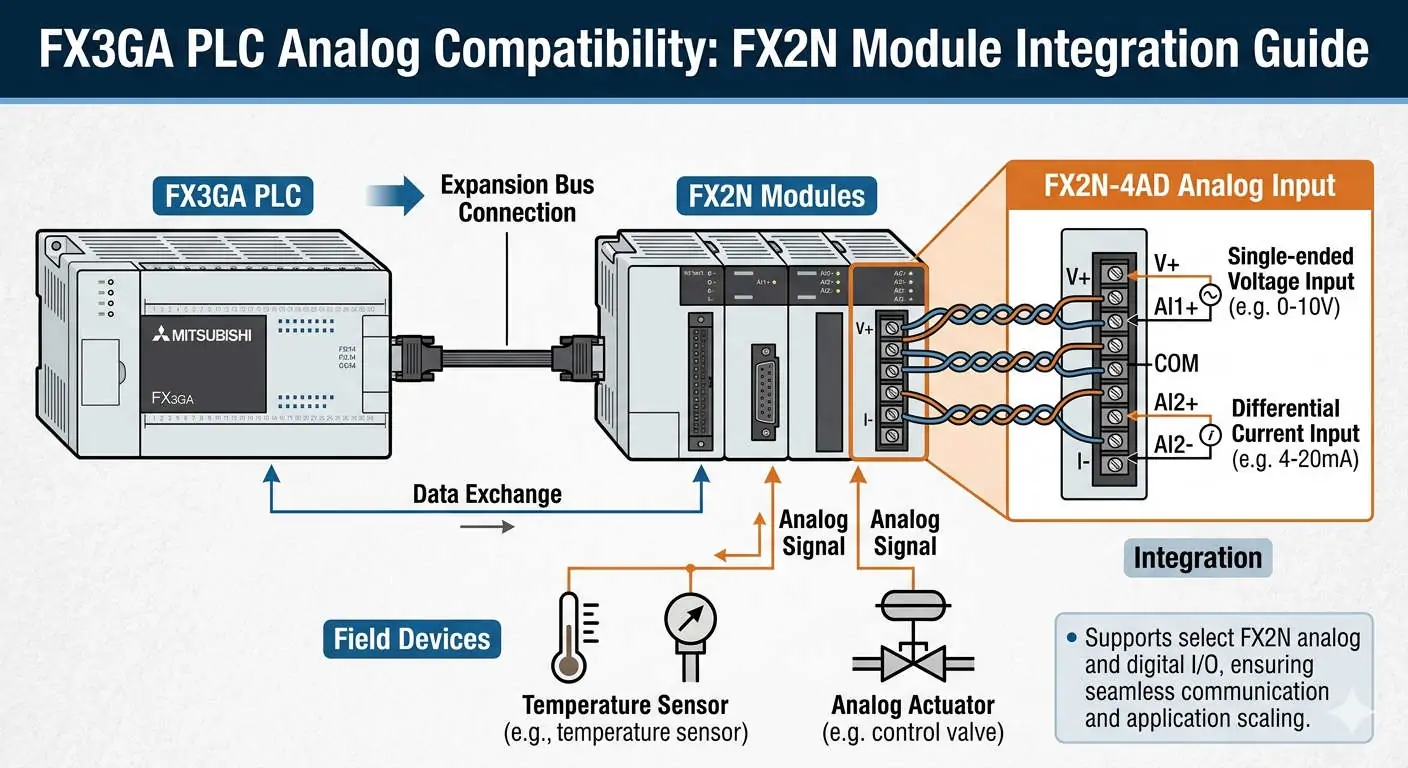
Field engineers often face a critical hurdle during brownfield upgrades: the FX3GA controller does not natively support FX2N analog modules. This limitation represents a significant integration pitfall in industrial automation projects. Therefore, understanding the specific hardware boundaries is essential for maintaining system stability and avoiding costly commissioning delays.
Strategic Expansion for Factory Automation Projects
In sectors like food processing and chemical dosing, analog signals (4–20 mA or 0–10 V) are vital for precision. However, many users incorrectly assume they can reuse legacy FX2N I/O to save costs. Unfortunately, the FX3GA utilizes a simplified expansion bus designed exclusively for newer ADP modules. As a result, attempting to connect an FX2N-4AD directly will cause immediate CPU recognition errors.
Optimizing Analog Signal Processing Performance
To achieve reliable control, engineers must utilize left-side adapter modules such as the FX3G-4AD-ADP. These components provide 12-bit resolution and stable conversion cycles of approximately 10–20 ms per channel. In my professional view at PLC Pioneer, these specifications are excellent for standard PID loops in temperature or flow control. Nevertheless, you must account for the limited channel density compared to the high-performance FX3U series.
Scalability Constraints in Modern Control Systems
The FX3GA platform typically restricts expansion to only two ADP modules. This capacity works well for small-scale machinery but fails in complex multi-loop process control environments. If your project requires high-density analog points or extensive SCADA integration, you should consider upgrading. Platforms like the iQ-F (FX5U) or FX3U offer far better long-term scalability for evolving factory requirements.
Practical Field Installation and Noise Mitigation
Experienced technicians know that forced wiring adaptations often lead to unstable readings or communication faults. Always adhere to the following technical standards to ensure 99.9% uptime:
- ✅ Shielding Integrity: Always use shielded twisted-pair cables for low-level analog signals to prevent EMI interference.
- ⚙️ Single-Point Grounding: Ground your cable shields at one end only to eliminate ground loops that distort sensor data.
- 🔧 Mechanical Security: Use DIN rail end clamps to secure side-mounted ADP modules against mechanical vibration.
Strategic Procurement: When to Replace vs. Upgrade
From an engineering perspective, forcing compatibility on the FX3GA often costs more in labor than purchasing new hardware. If your existing system demands more than four analog channels, the most cost-effective path is a platform upgrade. Transitioning to a modern PLC ecosystem ensures compliance with current industrial automation standards and reduces the “technical debt” of obsolete components.
PLC Pioneer’s Expert Commentary
“In the field, I often see engineers waste days trying to bridge the gap between FX2N modules and FX3GA controllers. It is a losing battle. The FX3GA is a fantastic entry-level controller, but it is not a ‘universal’ replacement. To build a truly resilient system, you must respect the hardware ecosystem. Aligning your controller platform with the correct expansion modules is the only way to guarantee reliability in high-vibration or electrically noisy environments.” — PLC Pioneer
Technical FAQ for Field Engineers
Q: Is there any official adapter to connect FX2N blocks to an FX3GA?
No, Mitsubishi does not provide a direct bridge for this specific configuration. The FX3GA bus architecture is physically and logically incompatible with the older FX2N expansion block interface. You must use the FX3G-ADP series for analog tasks.
Q: How do I handle signal fluctuations in inverter-heavy environments?
In environments with high VFD noise, we recommend adding external noise filters to the PLC power line. Additionally, ensure that your analog signal cables are physically separated from high-voltage power lines by at least 20cm to minimize inductive coupling.
Q: Why does my FX3GA fail to see the left-side ADP module?
This is usually caused by a missing expansion board (like the FX3G-CNV-ADP) or a firmware mismatch. The ADP modules require a specific communication board to interface with the main CPU. Always verify that the physical connection pins are seated perfectly before powering up.
Application Scenario: Chemical Dosing Systems
In a recent water treatment project, a client attempted to use legacy FX2N modules for pH monitoring. After constant communication drops, they switched to the FX3G-4AD-ADP setup. The result was a 25% improvement in signal stability and zero downtime during the following six months of operation. This proves that proper module selection is the foundation of industrial reliability.
If you are planning a system migration or need to source verified hardware for your next automation project, our team is ready to provide technical support and procurement solutions.
Access our full catalog of industrial components and technical datasheets: PLC Pioneer Limited