
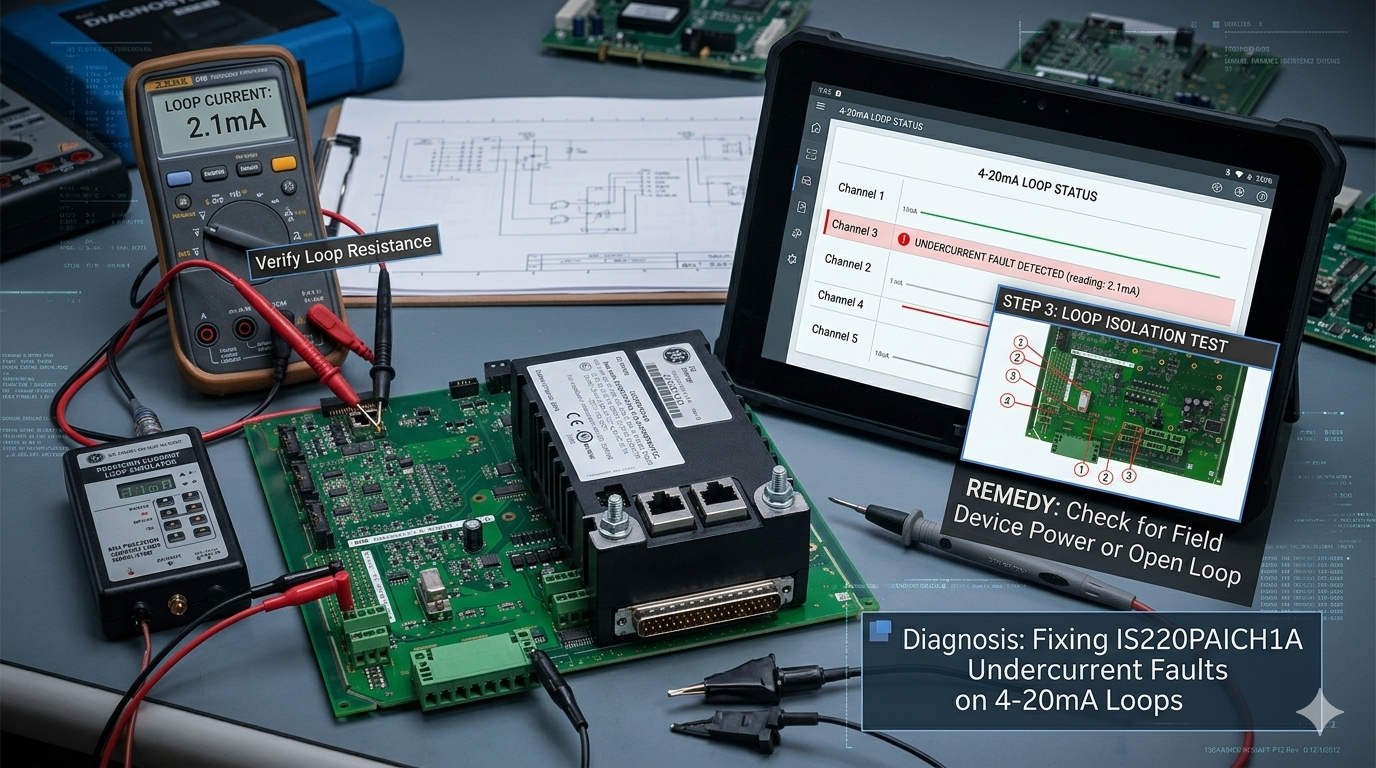
Troubleshooting the IS220PAICH1A Undercurrent Fault: Loop Failure or Broken Wire?
In heavy industries like oil and gas, petrochemical processing, and power generation, control systems rely heavily on 4-20 mA current loops. When a GE Mark VIe or EX2100 system triggers an “Undercurrent Fault” on the IS220PAICH1A analog input pack, engineers often rush to replace the transmitter. However, field experience shows that this alarm does not automatically mean a physical wire break. Misinterpreting this diagnostic leads to unnecessary instrument replacement, prolonged downtime, and elevated Mean Time to Repair (MTTR).

The Operational Impact of Undercurrent Diagnostics in DCS Environments
Distributed Control Systems (DCS) monitor critical parameters such as steam turbine pressure, fuel flow, and valve positions via these analog channels. A sudden undercurrent alarm can cause the control logic to initiate a safety trip or fallback sequence. Therefore, accurately identifying whether the fault stems from a broken cable, a power deficit, or a software mismatch is vital. Fast and precise diagnosis protects factory automation assets and prevents expensive, unscheduled generation outages.
Decoding Current Thresholds: Translating Milliamps into Field Realities
The IS220PAICH1A module evaluates incoming loop current against predefined low-end safety thresholds. Most industrial architectures align with the NAMUR NE43 standard, which defines specific current levels for sensor failures. An absolute open circuit or a complete loss of transmitter power drops the loop current to exactly 0 mA. Conversely, a reading between 1.0 mA and 3.6 mA typically indicates a failing transmitter or excessive loop resistance rather than a severed cable.
Furthermore, an instrument configured for fail-low diagnostics will intentionally drop its output to roughly 3.5 mA during an internal error. If field technicians do not check the transmitter display, they might misdiagnose the healthy wiring harness as broken. Consequently, understanding these distinct current zones prevents teams from wasting time isolating perfectly functional cables.
Calculating the Voltage Margin: The Hidden Loop Power Deficit
Adequate compliance voltage is the foundation of a stable 4-20 mA current loop. Many automation engineers overlook the cumulative voltage drops across barriers, isolators, and long cable runs. A typical field transmitter requires a minimum operating voltage of 12V DC to 18V DC. If a safety barrier drops 6V and the internal burden resistor drops another 5V, the remaining voltage margin might become dangerously narrow.
As a result, the loop current can collapse intermittently under heavy load or high ambient temperatures. This issue frequently causes multiple channels to report undercurrent faults simultaneously during peak factory operations. To resolve this, technicians should measure the voltage directly across the transmitter terminals while the loop is fully active.
Software and Control Logic Alignment within Mark VIe ToolboxST
Sometimes, a physically flawless control loop triggers recurring alarms due to engineering database errors. Within the Mark VIe ToolboxST configuration software, a technician might accidentally set an input channel to a 0-20 mA range instead of 4-20 mA. This scaling mismatch forces the system to interpret a normal 4 mA low-process signal as an undercurrent anomaly. Therefore, checking the software configuration parameters should always precede physical hardware teardowns.
—
Loop Integrity Diagnostics & Preventative Maintenance Checklist
- ✅ Verify Real Loop Current: Connect a calibrated digital multimeter in series with the loop to check if the current is exactly 0 mA or floating above 1 mA.
- ⚙️ Execute Signal Simulation: Inject a steady 12 mA reference signal using a loop calibrator directly into the terminal board to verify the physical health of the IS220PAICH1A card.
- 🔧 Inspect High-Vibration Terminals: Re-torque terminal block screws on gas turbine skids regularly to eliminate vibration-induced contact resistance and ferrule oxidation.
- ⚡ Enforce Surge Protection: Install dedicated surge suppressors on long outdoor cable runs to shield vulnerable analog packs from lightning-induced transient overvoltages.
—
PLC Pioneer’s Expert Field Insights
“Throughout my years managing turbine control upgrades, I have noticed that over 60 percent of IS220PAICH1A undercurrent alarms are caused by simple field installation issues rather than component degradation. Swapping out a costly input pack without validating the loop voltage margin is a common, expensive mistake. In modern control systems, maintaining a single-point shield grounding strategy is paramount to avoiding ground loops that mimic undercurrent conditions.” — PLC Pioneer
Industrial Automation Frequently Asked Questions
Q: How can I definitively prove that an IS220PAICH1A channel is dead and requires replacement?
First, disconnect the field wiring and hook up a physical loop simulator to the suspect channel. Inject a standard 4-20 mA signal while monitoring the live values in your control software. If the software still reads an undercurrent error despite a verified 12 mA hardware injection, the onboard channel circuitry or the input pack itself is likely damaged.
Q: What causes an analog input loop to work perfectly during commissioning but fail months later?
This phenomenon usually points to environmental temperature changes or expanding terminal corrosion. As ambient temperatures rise, copper wire resistance increases, which further reduces your available voltage margin. Additionally, thermal expansion can loosen terminal screws in high-vibration zones, converting a solid connection into an intermittent open circuit.
Q: Can I use older Mark VI terminal boards directly with the newer IS220PAICH1A input pack?
Direct compatibility depends on the specific terminal board model, firmware revision, and application database structure. While the physical connectors may match, older boards often utilize different signal conditioning or loop power distributions. Always cross-reference the official hardware manual before performing a live component swap to prevent scaling errors or nuisance faults.
—
Real-World Application Scenario: Preventing a Gas Turbine Trip
Consider a power generation plant where a critical gas turbine compressor inlet pressure loop begins flickering with random undercurrent alarms. Instead of shutting down the unit to replace the transmitter, the maintenance team performs a rapid series verification. They find a stable loop current of 3.4 mA, indicating that the transmitter has entered a fail-low diagnostic state due to a blocked sensing line. By clearing the impulse line restriction rather than replacing the sensor, the team saves hours of downtime and avoids a major financial loss.
If you need high-fidelity hardware components to stabilize your automation network or require reliable replacement parts to eliminate recurring system faults, look no further than our comprehensive catalog. We provide industry-tested solutions designed to optimize your turbine control and instrumentation infrastructure.
Discover expert technical guides and premium industrial spares today: PLC Pioneer Limited