The Three Telemetries: Mastering Remote Monitoring in Modern Power Distribution
In the evolving landscape of industrial automation, the “Three Telemetries”—Telemetry, Teleindication, and Telecontrol—serve as the vital organs of any robust SCADA system. These functions resolve two major operational hurdles: the lack of real-time visibility and delayed fault response. By digitizing substation assets, power utilities and petrochemical plants can achieve centralized supervision and enhanced grid reliability.
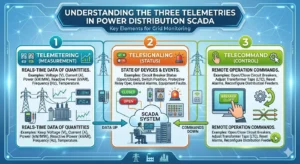
Breaking Down Telemetry, Teleindication, and Telecontrol
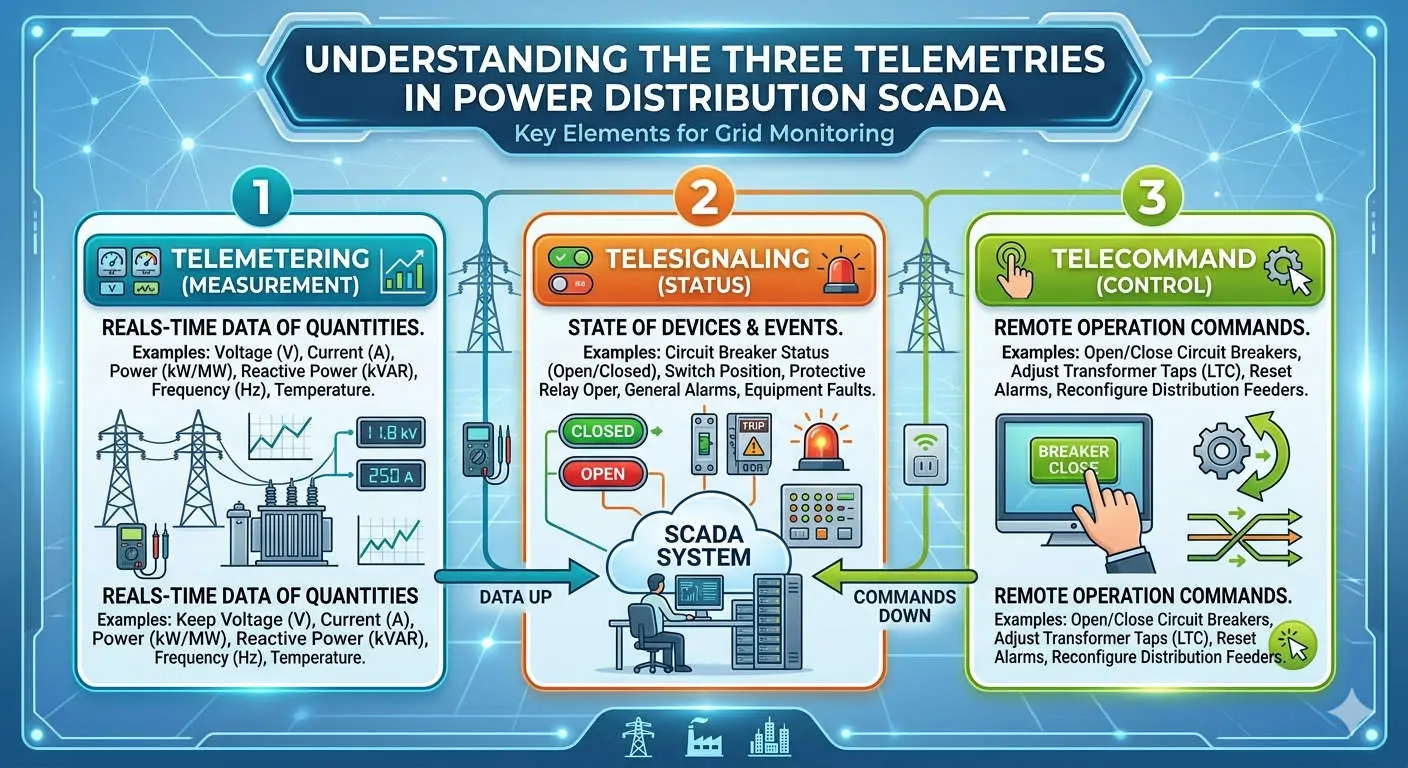
To understand modern grid management, one must distinguish between these three core functions. Telemetry refers to the measurement of continuous variables like voltage, current, and power. Teleindication captures binary states, such as whether a circuit breaker is open or closed. Finally, Telecontrol allows operators to send remote commands to switchgear. Together, they provide the “eyes, ears, and hands” for remote operators.
Optimizing Communication Latency and Response Timing
Communication latency remains a critical factor in system performance. For Telemetry, a refresh rate slower than two seconds can lead to inaccurate load balancing decisions. More importantly, Telecontrol requires sub-second execution to isolate faults effectively. At PLC Pioneer, we have observed that even a 500ms delay can significantly expand the scope of a power outage during critical failure scenarios.
Environmental Resilience and Electromagnetic Compatibility (EMC)
Power distribution environments are notoriously harsh. Switching operations often generate massive electromagnetic interference (EMI), which can corrupt Teleindication status signals. Equipment must adhere to IEC 61000 standards for EMC immunity and IEC 60255 for relay protection. Moreover, outdoor units must withstand temperatures exceeding 60°C to prevent hardware fatigue or logic errors during peak summer loads.
Navigating Protocols: IEC 60870-5-104 vs. IEC 61850
Protocol compatibility dictates how seamlessly field devices integrate into a SCADA network. IEC 60870-5-104 is the gold standard for TCP/IP-based power dispatch systems. Meanwhile, IEC 61850 offers high-speed GOOSE messaging for advanced protection logic. However, practitioners should be cautious; many “compatible” RTUs only offer basic mapping, which may limit long-term interoperability and Sequence of Events (SOE) accuracy.
Installation Best Practices for Signal Integrity
Maintaining signal integrity in high-noise switchyards requires disciplined wiring. Always use shielded twisted-pair cables for analog Telemetry signals to minimize induction. A frequent error in the field is grounding the shield at both ends, which creates ground loops. Instead, ensure single-point grounding to keep readings stable. Furthermore, installing external Surge Protective Devices (SPD) on communication ports is essential to survive lightning-induced surges.
Ensuring Safety through Select-Before-Operate (SBO) Logic
Telecontrol carries the highest operational risk. To prevent accidental switching, modern SCADA systems must implement “Select-Before-Operate” (SBO) logic. This protocol requires the hardware to confirm the selection of a specific breaker before the execution command is sent. At PLC Pioneer, we recommend rigorous simulation of abnormal states during commissioning to verify that software interlocks remain foolproof under pressure.
Technical Essentials Checklist
- ✅ Priority Tagging: Use VLANs or priority tags to separate critical GOOSE traffic from standard monitoring data.
- ⚙️ SOE Precision: Ensure RTUs support 1ms time-stamping for accurate post-fault analysis (Sequence of Events).
- 🔧 Grounding Discipline: Verify single-point shield termination to prevent circulating currents in Telemetry loops.
- 📊 Protocol Mapping: Confirm your gateway supports full logical node modeling rather than simple register mapping.
PLC Pioneer’s Expert Commentary
“In my years of overseeing grid automation, I have found that the ‘Three Telemetries’ are often treated as simple checkboxes. However, the real challenge lies in the ‘Telecontrol Return Check’ and cybersecurity. As we move toward 2026, the integration of encrypted IEC 104 protocols is no longer optional—it is a baseline for protecting critical infrastructure from remote interference.” — PLC Pioneer
Frequently Asked Questions
Q: Why does my SCADA show a ‘status flicker’ on Teleindication signals?
This is usually caused by EMI or poor debounce settings in the RTU. We suggest checking the shield continuity and increasing the software filtering time to ensure transient noise isn’t interpreted as a state change.
Q: Can I use standard Modbus for high-voltage Telecontrol?
Technically yes, but it is not recommended. Modbus lacks native SBO (Select-Before-Operate) mechanisms and event-driven reporting. For high-voltage assets, protocols like IEC 104 or DNP3 provide much better security and reliability.
Q: What is the benefit of fiber optics over copper for these signals?
Fiber optics provide total immunity to electromagnetic interference and lightning surges. In large switchyards, using fiber for the communication backbone is the best way to ensure Telemetry accuracy and equipment longevity.
Application Scenario: Remote Fault Isolation
Consider a distributed feeder network during a localized short circuit. Through Teleindication, the SCADA system instantly identifies the tripped breaker. The operator analyzes Telemetry data to ensure the alternate path isn’t overloaded and then uses Telecontrol to reroute power. This remote intervention reduces what used to be a two-hour manual process to under five minutes.
If you need to source high-reliability RTUs, protocol gateways, or industrial communication modules for your distribution project, visit our specialized catalog for expert-grade hardware solutions.
Explore our full range of automation components and technical guides: PLC Pioneer Limited