
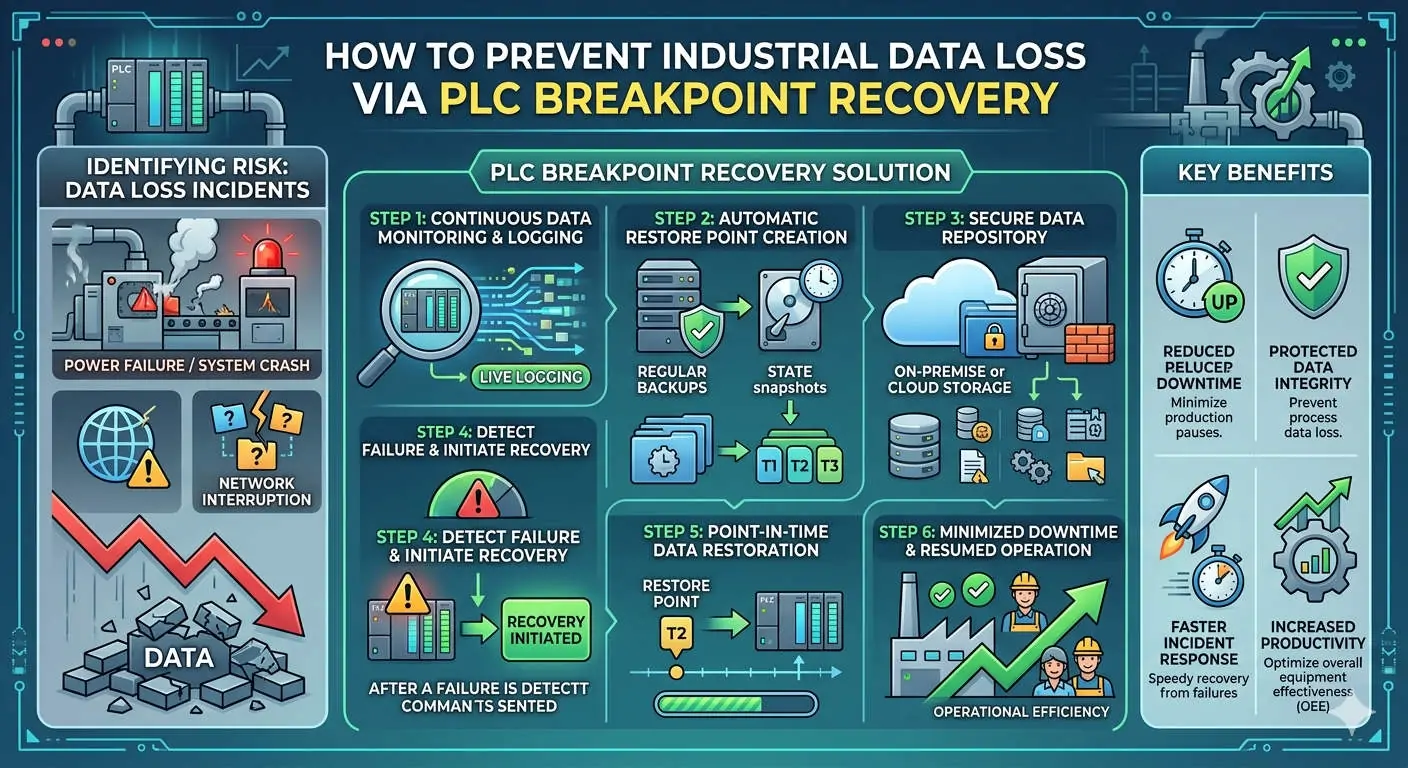
Ensuring Data Continuity: The Role of Breakpoint Resume in PLC Systems
In modern industrial automation, data is as critical as the physical product. Implementing a breakpoint resume (data recovery) mechanism directly solves the risk of data loss during network outages or power failures. For sectors like pharmaceuticals and chemical processing, missing data ruins traceability and compromises regulatory compliance. A robust resume strategy ensures that historical data flows seamlessly from the PLC to SCADA or MES platforms without gaps or duplication.
Optimizing Retentive Memory and Buffering Capacity
A PLC’s ability to recover data depends entirely on its retentive memory design. Engineers must calculate the required buffer size based on sampling rates and potential downtime duration. For instance, in batch production, insufficient local storage can lead to incomplete records, failing standards like FDA 21 CFR Part 11. PLC Pioneer recommends using non-volatile memory (NVRAM) or high-speed Flash to keep data intact even if the main power source fails.
Leveraging Protocol-Level Acknowledgment Mechanisms
The choice of communication protocol defines the reliability of your data recovery. Protocols like OPC UA and MQTT provide native support for session recovery and data buffering through acknowledgment (ACK) signals. In contrast, legacy protocols such as Modbus RTU lack these features. When working with older systems, engineers should implement custom sequence IDs and handshake logic to manually track which data blocks the upper-level system has successfully received.
Synchronizing Scan Cycles with Data Logging Intervals
Misalignment between the PLC scan cycle and the logging interval often causes data inconsistency. If your logging speed exceeds the logic execution time, the system may record duplicate values or skip critical events. As a result, PLC Pioneer advises aligning your logging intervals as integer multiples of the CPU scan time. Utilizing timed Organization Blocks (OBs) ensures deterministic data capture, providing a clean dataset for historical analysis.
Best Practices for Field Installation and Power Integrity
Hardware stability is the foundation of any software-based resume logic. Sudden power drops are a leading cause of data corruption in the field. To mitigate this, always deploy PLCs with capacitor-backed memory or utilize an external UPS. Furthermore, network health is paramount. In high-interference environments, use shielded CAT6 cables and managed industrial switches with Ring Redundancy (MRP/RSTP) to ensure the network recovers quickly enough for the resume logic to trigger.
Strategic Data Block Structuring for Reliable Retransmission
Effective resume logic requires a structured approach to PLC data blocks. Each record should contain an incremental sequence number, a synchronized NTP timestamp, and a transmission status flag. This structure allows SCADA or MES systems to detect missing packets automatically. Consequently, the upper-level system can request a retransmission starting from the exact point of the interruption, ensuring a 100% complete historical record.
- ✅ Memory Calculation: Buffer Size ≥ (Sampling Rate × Max Downtime × Data Size).
- ⚙️ Protocol Choice: Prioritize OPC UA for built-in session recovery.
- 🔧 Hardware Shielding: Use CAT6 STP cables to prevent packet loss near VFDs.
- 📊 Deterministic Capture: Use interrupt tasks to prevent logic-induced data gaps.
PLC Pioneer’s Expert Commentary
“In my years of field experience, I have seen ‘Data Continuity’ treated as an afterthought until an audit fails. Breakpoint resume is not just a software feature; it is an insurance policy for your production integrity. In 2026, as we push toward Industry 4.0, moving from simple cyclic polling to intelligent, buffered data transmission is the only way to build a truly resilient factory architecture.” — PLC Pioneer
Frequently Asked Questions (FAQ)
Q: How can I verify if my existing PLC supports breakpoint resume?
Review your PLC’s technical specifications for “Retentive Data Area” and “File System Support.” If your hardware lacks dedicated storage or modern protocol drivers (like MQTT or OPC UA), you may need to integrate an edge gateway to handle the buffering logic externally.
Q: Does adding resume logic affect the PLC’s scan time performance?
Yes, custom buffering logic consumes CPU cycles. To prevent high latency, only buffer critical process variables rather than every I/O point. Use optimized data blocks (DBs) to reduce the overhead on the PLC processor.
Q: Can breakpoint resume work over wireless or remote telemetry links?
Absolutely. In fact, it is essential for wireless links where signal stability is unpredictable. Using MQTT with Quality of Service (QoS) Level 1 or 2 is the industry standard for ensuring data arrives at the broker despite intermittent connectivity.
Application Scenario: Pharmaceutical Batch Recovery
During a recent retrofit in a pharmaceutical facility, a network switch failure caused a 15-minute outage. Because the system utilized a PLC Pioneer breakpoint resume strategy, the PLC continued to log critical temperature and pressure data to its internal SD card. Once the network was restored, the SCADA system detected the gap, requested the missing 15 minutes of data, and successfully reconstructed the batch report for compliance approval.
If you are planning to enhance your system’s data integrity or need robust hardware capable of advanced data logging, explore our specialized solutions today.
Find the right components for your next project here: PLC Pioneer Limited