
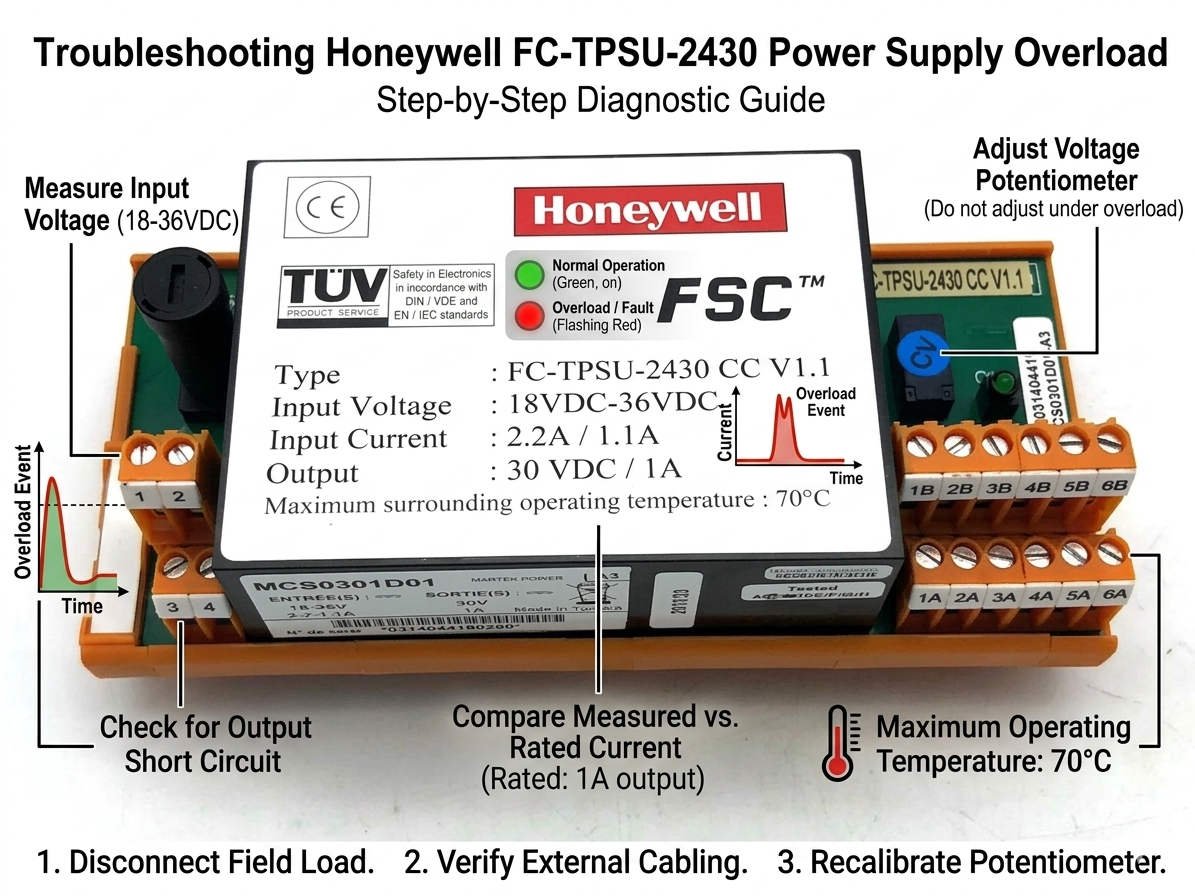
Troubleshooting the Honeywell FC-TPSU-2430: Resolving Hidden Overload Alarms
The Honeywell FC-TPSU-2430 power supply unit stands as a cornerstone for critical safety and control systems. It delivers a stable 24V DC output to industries like oil & gas and chemical processing. However, an “Overload” alarm often appears without any obvious increase in equipment load. This signal typically indicates an underlying abnormality rather than simple power consumption. Addressing these issues early protects your downstream PLC and DCS modules from unexpected failure.
Dynamic Current Monitoring and Load Sensitivity
High-precision monitoring allows the FC-TPSU-2430 to detect minute fluctuations in current. Transient spikes often trigger alarms during the startup of aging solenoid valves or motors. Although steady-state measurements might look normal, these inrush currents exceed protection thresholds. Consequently, even a momentary fault can trip the system’s safety logic. We recommend using high-speed oscilloscopes to capture these micro-second peaks that standard meters miss.
Impact of Component Degradation on Voltage Stability
Voltage stability is vital for the integrity of I/O modules and safety systems. Internal components like capacitors naturally degrade after 3 to 5 years of continuous service. As voltage drops, the system compensates by drawing more current to maintain power levels. This behavior often results in a “phantom” overload alarm. In my experience at PLC Pioneer, preventative replacement of modules reaching their 5-year mark significantly reduces downtime in petrochemical facilities.
Thermal Derating in High-Temperature Environments
Internal thermal protection guards the PSU against catastrophic heat damage. However, high ambient temperatures in poorly ventilated cabinets reduce effective current capacity. A unit rated for full load at 25°C may derate significantly when temperatures hit 50°C. Therefore, the PSU might trigger an overload alarm even if the physical load remains unchanged. Proper spacing and heat dissipation are essential for maintaining rated performance.
Best Practices for Field Installation and Maintenance
Effective maintenance starts with identifying intermittent loads that cycle unexpectedly. Relay coils and heaters often hide their peak draws during routine inspections. In addition, loose or oxidized terminals increase resistance and generate localized heat. This thermal stress causes voltage drops and forces the PSU to work harder. We suggest using spring-clamp terminals in high-vibration areas to ensure consistent connectivity over time.
- ✅ Verify Airflow: Ensure at least 50mm of clearance around the PSU for natural convection.
- ⚙️ Terminal Inspection: Regularly check for discoloration on wires, which indicates overheating.
- 🔧 Current Logging: Deploy a data logger for 24 hours to capture transient current spikes.
- 📊 Load Profiling: Document the startup current of all field devices connected to the 24V rail.
Strategic Analysis of Cabinet Thermal Management
Improving cabinet ventilation often solves persistent alarms more effectively than replacing hardware. Modern industrial automation cabinets frequently house high-density components that generate significant heat. Adding DIN-rail fans or increasing the gap between power modules can lower internal temperatures by 10°C or more. This simple adjustment often restores the PSU to its full operating capacity without further investment.
Expert Commentary by PLC Pioneer
“The Honeywell FC-TPSU-2430 is a robust piece of engineering, but it is often blamed for external system flaws. In the field, we find that ‘Overload’ alarms are frequently symptoms of field device insulation failure or micro-leakage. Don’t just replace the PSU; investigate the health of your field network. A holistic approach to power integrity is what separates elite maintenance teams from reactive ones.” — PLC Pioneer
Industrial Automation FAQ
Does a red LED on the FC-TPSU-2430 always require a unit replacement?
Not necessarily. The red indicator often signifies a temporary fault like a short circuit in field wiring or an over-temperature condition. Reset the unit after cooling and checking for external shorts before concluding the hardware is dead.
How does “inrush current” affect safety system PSUs differently than standard ones?
Safety-rated PSUs like the FC-TPSU-2430 have tighter trip curves to protect sensitive SIL-rated logic. While a standard PSU might ignore a 120% spike for a second, a safety PSU may alarm immediately to prevent voltage dips that could reset a safety controller.
Can I parallel multiple FC-TPSU-2430 units for higher current?
Yes, but you must use redundancy modules or ensure the units support active current sharing. Without proper load-balancing hardware, one unit will carry the bulk of the load, overheat, and fail prematurely, leading to a cascading system shutdown.
Application Scenario: Refinery Power Stabilization
A major refinery experienced weekly “Overload” trips on their Honeywell Safety Manager system. After replacing the PSU twice, the issue persisted. Our investigation found that an aging fire-and-gas detector was intermittently shorting due to moisture ingress. By isolating the field loop and replacing the detector, the FC-TPSU-2430 returned to stable operation, proving that the PSU was simply doing its job by alerting the team to a field fault.
For more technical specifications or to source genuine Honeywell automation hardware, please visit our comprehensive catalog.
Explore our full range of industrial power solutions: PLC Pioneer Limited