
Optimizing System Uptime with Honeywell FC-RUSIO-3224 Short-Circuit Protection
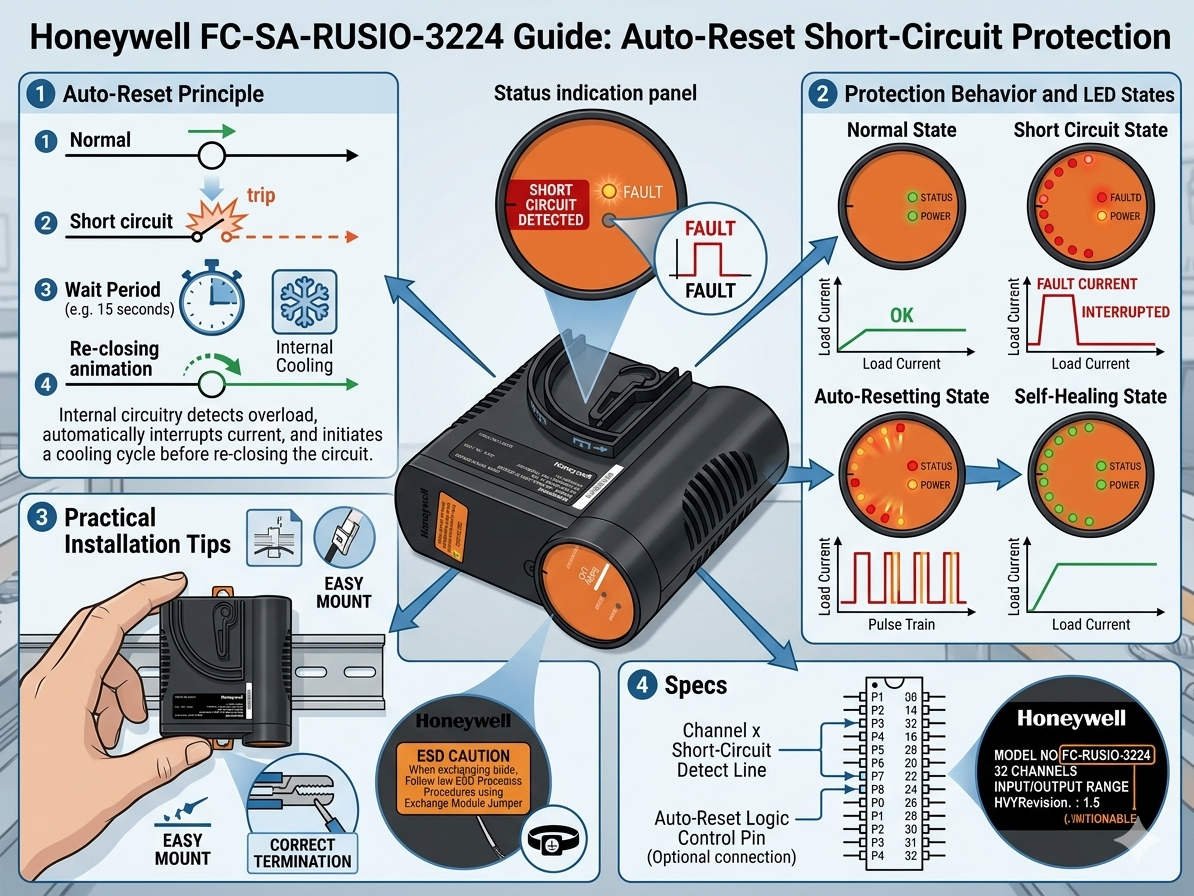
In the high-stakes world of industrial automation, unplanned downtime serves as the primary enemy of profitability. The Honeywell FC-RUSIO-3224 Universal I/O module addresses this challenge through a sophisticated short-circuit protection system. By integrating an auto-reset mechanism, this module prevents permanent hardware damage while ensuring continuous operation in mission-critical environments. Consequently, facilities in the oil & gas and chemical sectors can maintain high availability even during field wiring faults.
Technical Precision: Rapid Short-Circuit Detection and Response
The FC-RUSIO-3224 utilizes advanced circuitry to monitor channel current in real-time. When a fault occurs, the module reacts within milliseconds to isolate the compromised channel. This rapid intervention prevents heat accumulation, which often leads to catastrophic failures in adjacent components. Furthermore, the isolation logic ensures that a single wiring error does not jeopardize the entire I/O cabinet’s integrity.
Electronic Current Limiting vs. Traditional Fusing
Traditional protection relies on physical fuses that require manual replacement after a trip. However, the FC-RUSIO-3224 employs an electronic current-limiting circuit combined with thermal monitoring. Once the system detects that the fault is cleared, the channel restores power automatically. This self-recovery feature significantly reduces the Mean Time to Repair (MTTR) and eliminates the need for on-site maintenance crews in remote or unmanned installations.
Individual Channel Isolation Enhances Control Loop Reliability
Every channel on the FC-RUSIO-3224 operates with its own defined protection threshold. This granular design improves the reliability of individual control loops within a Distributed Control System (DCS). By preventing fault propagation, the module extends its operational lifespan and minimizes cumulative thermal stress on the internal semiconductors. As a result, the system remains robust under demanding industrial conditions.
Strategic Installation: Preventing Intermittent Wiring Faults
Field experience suggests that most short-circuit events stem from poor cable termination rather than device failure. Therefore, engineers should prioritize high-quality wiring practices to maximize module performance. For instance, using ferrules for stranded wires and maintaining proper bending radii can prevent insulation breakdown. Moreover, separating signal cables from high-power lines reduces electromagnetic interference that could trigger nuisance trips.
The Importance of External Surge Protection (SPD)
While the FC-RUSIO-3224 excels at handling short circuits, it is not a primary lightning protection device. In environments prone to electrical surges, installing external Surge Protection Devices (SPD) is essential. Adhering to the IEC 60364 standard for grounding ensures that the module remains shielded from high-voltage transients. Consequently, a layered protection strategy offers the highest level of equipment security.
—
Key Technical Features & Best Practices
- ✅ Auto-Recovery Logic: Restores output immediately after fault clearance without manual intervention.
- ⚙️ Millisecond Response: Ultra-fast isolation prevents cascading thermal damage in dense I/O layouts.
- 🔧 Reduced Maintenance: Eliminates the logistical burden of stocking and replacing physical fuses.
- 📊 Diagnostic Monitoring: System logs allow operators to identify recurring intermittent faults before they escalate.
—
PLC Pioneer’s Expert Commentary
“From my perspective, the transition from fuse-based I/O to electronic auto-reset modules like the FC-RUSIO-3224 represents a major leap in ‘Smart Maintenance.’ While the auto-reset feature is incredibly convenient, I urge engineers to use the diagnostic data it provides. If a channel resets frequently, it is a clear warning of cable degradation. Ignoring these signals defeats the purpose of a proactive maintenance strategy.” — PLC Pioneer
Frequently Asked Questions
Q: Does the auto-reset feature have a limit on how many times it can trip?
While the electronic circuit is designed for repeated cycles, persistent tripping causes thermal stress. It is best practice to investigate any channel that trips more than three times in a 24-hour period to prevent long-term fatigue of the silicon components.
Q: Can the FC-RUSIO-3224 replace legacy Honeywell fuse-based modules directly?
It is often compatible with modern Safety Manager or Experion architectures, but you must verify backplane power requirements. Electronic protection circuits may have slightly different impedance profiles compared to physical fuses, so always consult the latest Honeywell compatibility matrix.
Q: How does this module perform in SIL-rated safety loops?
The FC-RUSIO-3224 is frequently used in SIL-certified systems. Its ability to isolate faults without affecting the entire module is a key factor in achieving high Safe Failure Fraction (SFF) scores required for functional safety standards like IEC 61508.
—
Solution Scenario: Unmanned Offshore Platform
On an unmanned offshore gas platform, replacing a blown fuse requires mobilizing a helicopter and a technician—a process costing thousands of dollars. By deploying the FC-RUSIO-3224, a temporary wiring fault caused by salt-spray corrosion can be “cleared” remotely once the salt buildup is washed away or the cable is stabilized, allowing the process to resume without a single person setting foot on the platform.
Discover how high-quality I/O components can transform your facility’s reliability. For technical specifications and global sourcing of genuine Honeywell automation hardware, visit our resource center.
Explore our full range of industrial solutions: PLC Pioneer Limited