
Maximizing Solar ROI with GPS Clock Synchronization in PLC-Based PV Trackers
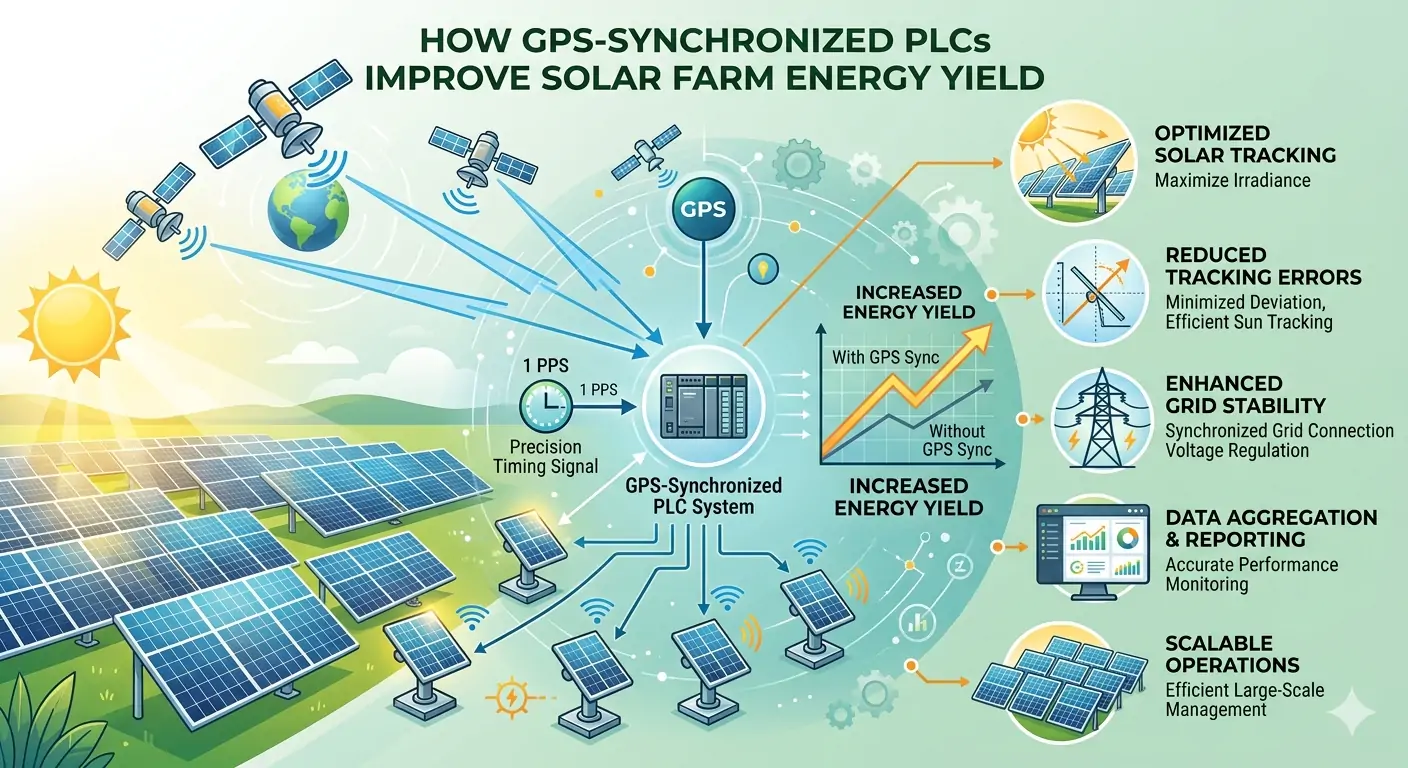
In large-scale photovoltaic (PV) installations, timing is everything. Precise sun-tracking requires thousands of distributed trackers to move in perfect harmony. However, standard internal clocks in industrial controllers often drift over time. Integrating a PLC with GPS clock synchronization solves this challenge by providing a universal time reference across the entire solar farm. This alignment ensures maximum sunlight capture and highly accurate data logging for performance analytics.
Precision Timing: Reducing Energy Loss through GPS Accuracy
High-precision GPS synchronization typically achieves accuracy levels within 100 nanoseconds. This precision is vital because even minor timing deviations can cause misaligned tracker angles during rapid weather shifts. For instance, passing clouds require coordinated adjustments to maintain optimal irradiance. In my professional experience at PLC Pioneer, I have observed that systems lacking GPS sync often suffer from inconsistent tilt angles during sunrise transitions, leading to measurable energy losses across multi-megawatt zones.
Protocol Interoperability and Grid Compliance
Modern utility-scale solar plants must adhere to strict grid interconnection standards like IEC 61850. GPS-enabled PLCs act as a communication bridge, distributing time via protocols such as NTP or IEEE 1588 PTP. This capability is essential for Sequence of Events (SOE) recording. Without a unified time base, correlating inverter data with tracker logs becomes nearly impossible. Consequently, choosing a PLC that can function as a “Grandmaster Clock” simplifies your network architecture and ensures audit-ready reporting.
Engineering for Harsh Outdoor Environments
Solar automation hardware faces extreme conditions, from desert heat reaching +70°C to intense electromagnetic interference (EMI). Reliable GPS-synchronized PLCs utilize Temperature-Compensated Crystal Oscillators (TCXO) to maintain stability when signals are weak. Furthermore, industrial-grade modules include built-in surge protection for antenna inputs. These features are critical because internal clock drift caused by thermal stress can compromise tracking logic and long-term mechanical reliability.
Strategic Installation and Antenna Protection
Proper GPS antenna placement is a frequent “make-or-break” factor in field commissioning. Obstructions from metallic structures or nearby power lines can degrade signal quality significantly. Therefore, engineers should always install antennas on a dedicated mast with a clear view of the sky. Additionally, following the IEC 62305 standard for lightning protection is mandatory. Using a high-quality Surge Protective Device (SPD) on the antenna line prevents lightning-induced transients from destroying the PLC’s communication port.
PLC Pioneer’s Expert Commentary
“While many developers rely on standard NTP servers, the transition to GPS-based synchronization is becoming a technical necessity for utility-scale PV projects in 2026. The ability to synchronize distributed assets to a sub-microsecond level doesn’t just improve tracking—it transforms your SCADA system into a high-fidelity diagnostic tool. My advice is to prioritize hardware with integrated GPS modules to reduce failure points in your control cabinet.” — PLC Pioneer
Technical Implementation Checklist
- ✅ Validate Hierarchy: Establish a single time master (GPS) to prevent conflicts between PLC and SCADA timestamps.
- ⚙️ Monitor Drift: Configure automated alarms in the HMI to trigger if time deviation exceeds 1 millisecond.
- 🔧 Verify Protocols: Ensure your PLC supports IEEE 1588 PTP for high-speed Ethernet-based synchronization.
- 📊 Shielding Standards: Use shielded cabling for antenna runs to mitigate EMI from high-power solar inverters.
Frequently Asked Questions
Q: Is GPS synchronization necessary for smaller rooftop solar arrays?
Usually, no. For systems under 1 MW, standard NTP synchronization via a local network is typically sufficient. GPS sync is primarily a requirement for large-scale utility projects where data correlation across miles of equipment is critical.
Q: How do I handle GPS signal loss during heavy storms?
Industrial PLCs are designed with “holdover” capabilities. A high-quality internal oscillator will maintain accurate timing for several hours or days until the GPS signal is restored, ensuring the trackers continue to follow the sun accurately.
Q: Can I retro-fit GPS sync into an existing Modbus-based system?
Yes. You can deploy a single GPS-enabled PLC as a “Time Master” and distribute the clock signal to legacy devices using NTP gateways or Modbus registers, though the accuracy will be limited by the network’s latency.
Solution Scenario: Utility-Scale Diagnostics
Consider a 50 MW solar farm experiencing intermittent tracker stalls. Without GPS sync, the logs from different rows might show the fault occurring at slightly different times. With GPS synchronization, the operator can see exactly how a voltage dip at the substation affected every tracker simultaneously. This level of insight reduces troubleshooting time from days to minutes.
To optimize your solar tracking project with the latest synchronized control hardware, explore our technical resources and specialized components.
View our full catalog of automation solutions: PLC Pioneer Limited