
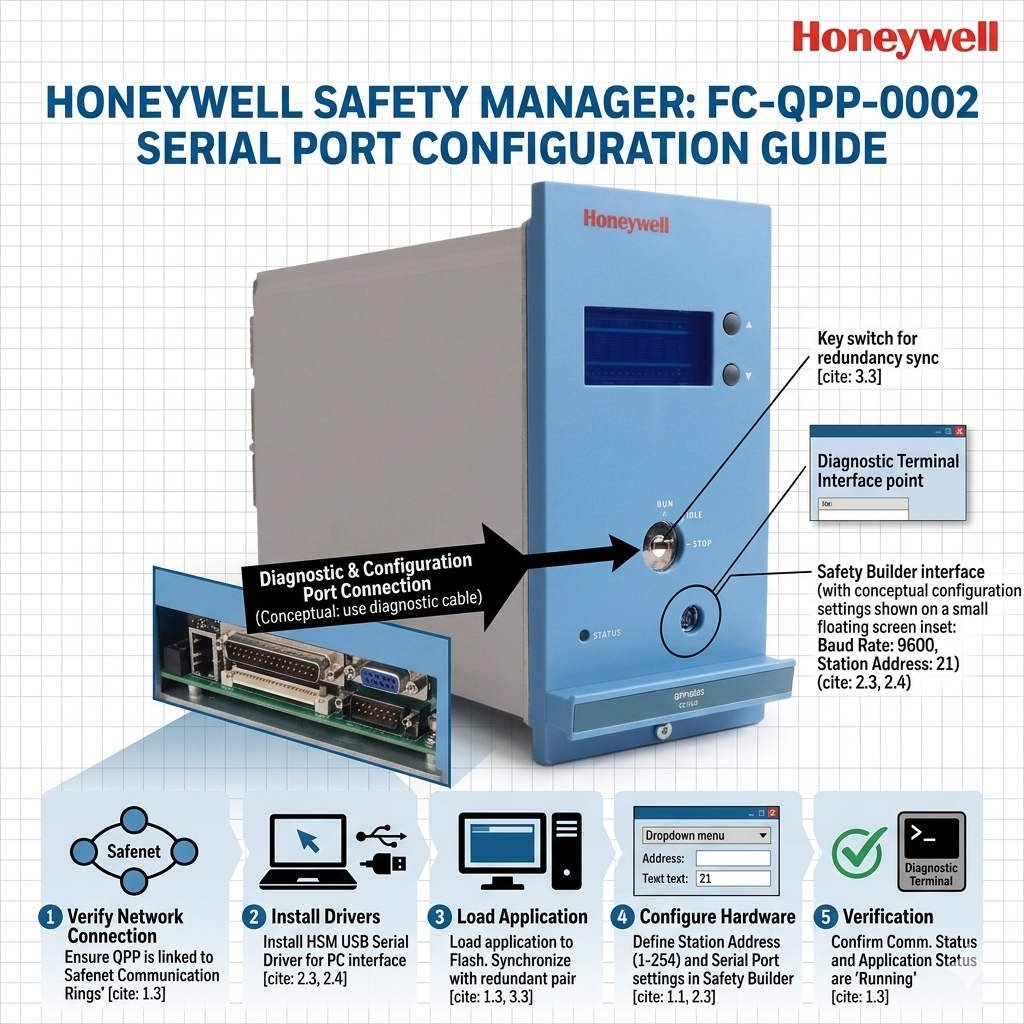
Mastering FC-QPP-0002 Station Address Configuration via Serial Port
Replacing a Honeywell FC-QPP-0002 module is only half the battle in industrial maintenance. Technicians must reconfigure the station address via the serial interface to ensure seamless control network integration. Neglecting this critical step often leads to communication collisions or missing nodes in your Distributed Control System (DCS). This guide outlines the professional procedure for a successful field replacement.
Proven Field Procedure for Module Addressing
Before integrating the new hardware, follow these essential steps to establish a reliable connection. Proper sequencing prevents common addressing errors that plague industrial automation projects.
- ✅ Physical Connection: Link your engineering workstation to the module’s configuration port using a high-quality RS-232 or RS-485 interface.
- ⚙️ Terminal Setup: Open your configuration tool or serial terminal. Standard parameters usually require 9600 or 19200 baud with 8N1 settings.
- 🔧 Mode Activation: Switch the module to configuration mode. This typically involves a specific command string or a hardware DIP switch toggle.
- 📝 Command Execution: Issue the addressing command, such as
SET NODE <address>, ensuring the value falls within the permitted network range. - 💾 Commit & Reboot: Save the new parameters to the non-volatile memory and perform a hard reboot to initialize the changes.
- 📊 Verification: Confirm that the DCS host recognizes the new node without latency or data errors.
Strategic Importance of Precise Node Addressing
In high-stakes industries like petrochemical manufacturing, deterministic communication is a fundamental requirement. The FC-QPP-0002 acts as a vital processing unit where timing and data integrity are paramount. Therefore, accurate addressing prevents unplanned downtime and maintains safety standards. Moreover, a well-configured network ensures that your industrial control systems operate at peak efficiency during demanding process cycles.
Technical Insights: Protocols and Memory Reliability
Modern factory automation relies on robust communication protocols. The FC-QPP-0002 typically utilizes proprietary Honeywell standards or Modbus RTU over serial links. However, an address mismatch can drastically increase scan cycle times. Furthermore, the module stores configuration data in EEPROM. If power fluctuations occur during the “write” phase, the memory may corrupt, causing the module to revert to factory defaults. As a result, stable power is non-negotiable during commissioning.
Expert Installation and Maintenance Tips
Based on extensive field experience at PLC Pioneer, we recommend isolating the module during initial setup. In multi-drop RS-485 environments, duplicate addresses can cause the entire bus to fail. In addition, always verify hardware vs. software priority. Some modules prioritize physical DIP switches over digital commands. Consequently, your software changes might not take effect if the switches remain in their default positions.
Author Commentary: The PLC Pioneer Perspective
“While modern systems move toward plug-and-play Ethernet, the reliability of serial-based modules like the FC-QPP-0002 remains a cornerstone of legacy DCS infrastructure. I often see technicians rush the ‘Save to Flash’ step, leading to mysterious node losses after a power cycle. My advice: always perform a triple-check on grounding and shielding to prevent EMI from corrupting your serial packets.” — PLC Pioneer
Buyer’s Guide and Troubleshooting FAQ
Q: How can I distinguish between a hardware fault and an addressing error?
If the module powers up but fails to talk, isolate it from the network and attempt a direct serial ping. If it responds in isolation, you likely have an address conflict or a baud rate mismatch rather than a hardware failure.
Q: Does the FC-QPP-0002 support all legacy Honeywell protocols?
Most versions are backward compatible; however, firmware alignment is crucial. Always verify the firmware revision against your existing system documentation before procurement to avoid integration hurdles.
Q: What is the best way to prevent data corruption during configuration?
Always use a dedicated Industrial PC or a laptop with a stabilized power supply. In my experience, using a UPS during the configuration process eliminates the risk of EEPROM corruption during the critical write cycle.
Application Scenario: Pharmaceutical Batch Control
In a pharmaceutical environment, a module replacement must be fast and flawless to maintain batch traceability. By pre-configuring the FC-QPP-0002 station address in a workshop environment before field installation, teams can reduce the MTTR (Mean Time To Repair) by over 40%. This proactive approach ensures that data integrity remains intact throughout the batch production process.
For more technical insights or to source high-quality Honeywell automation components, visit our dedicated resource center. We provide the technical expertise and hardware reliability you need for complex DCS environments.
Explore more solutions at: PLC Pioneer Limited