Operating HACH LXV404.99.00222 at -20°C: Engineering Risks and Thermal Solutions
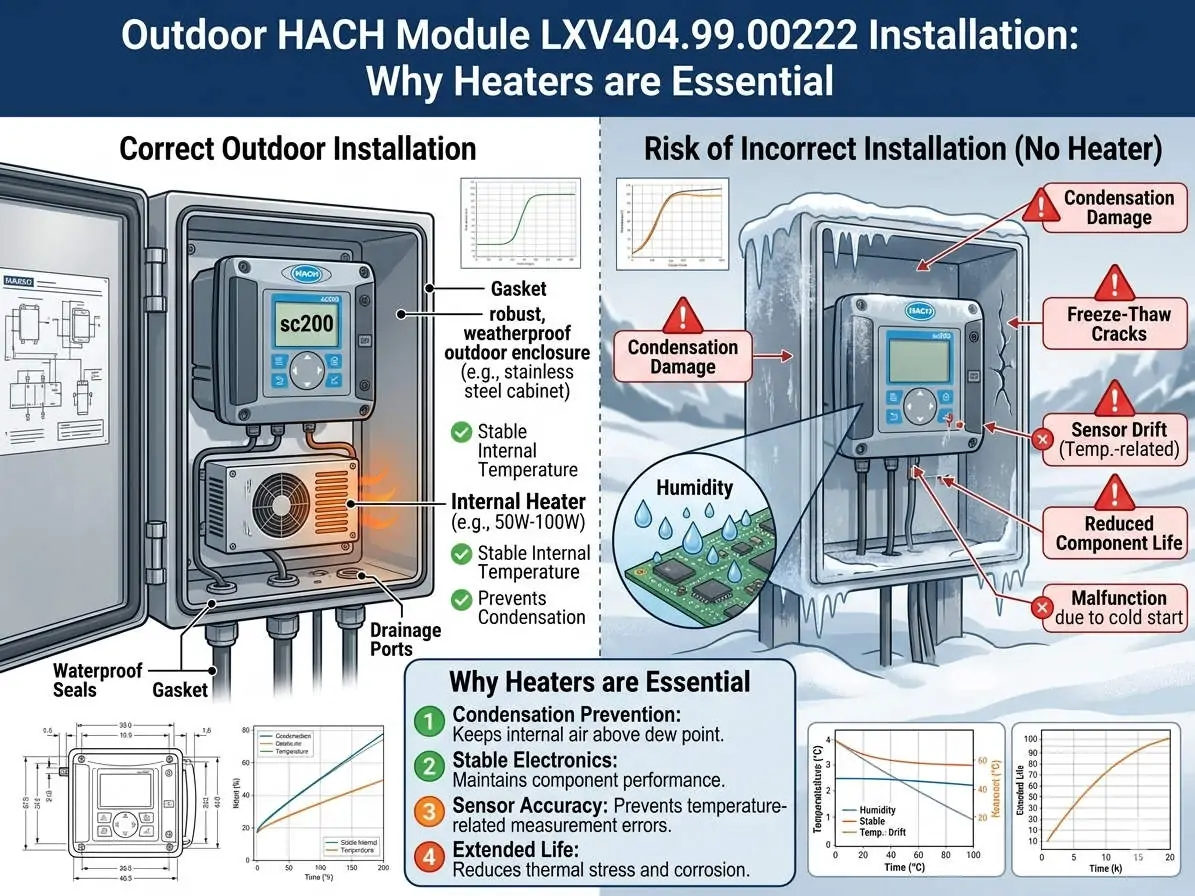
Deploying sensitive water analysis modules like the LXV404.99.00222 in extreme sub-zero environments requires more than just checking a datasheet. From a field engineering perspective, continuous operation at -20°C without thermal protection poses significant risks to system integrity. While industrial automation components often boast wide storage ranges, operational reality in outdoor wastewater or chemical processing plants demands a robust environmental strategy.
The Strategic Value of the LXV404.99.00222 in Process Control
The LXV404.99.00222 serves as a critical junction for signal acquisition in complex industrial water analysis. Its primary role involves ensuring that data from sensors reaches the PLC or DCS without interference. In harsh outdoor monitoring stations, the reliability of this module directly influences regulatory compliance and dosing accuracy. Consequently, maintaining its stable performance is essential for preventing costly discharge violations.
Environmental Temperature Challenges for Industrial Hardware
Most industrial transmitters maintain a nominal operational range, yet -20°C pushes many components to their physical limits. At these temperatures, LCD interfaces often become sluggish or fail entirely. Moreover, internal electrolytic capacitors and mechanical seals degrade rapidly. In my experience at PLC Pioneer, I have observed that intermittent signal loss often stems from cold-induced connector contraction rather than internal circuit failure. Therefore, relying on “nominal” limits without a safety buffer is a risky engineering decision.
Managing Signal Drift and Internal Condensation
Temperature fluctuations between day and night create a high risk of condensation inside instrument enclosures. Moisture ingress can lead to analog signal drift or catastrophic short circuits. Even in digital communication setups like Modbus or HACH digital buses, internal frost can cause data packet loss and repeated retries. This instability is particularly dangerous in pharmaceutical dosing systems, where even a slight measurement lag results in significant chemical imbalances.
Material Fatigue and Ingress Protection Vulnerability
Extreme cold alters the physical properties of sealing materials. At -20°C, standard rubber seals lose their elasticity and become brittle. As a result, cable glands may fail to maintain their IP65 or IP67 ratings during thaw cycles. This vulnerability allows meltwater to penetrate the housing, leading to internal corrosion. Regular maintenance checks become insufficient if the hardware cannot withstand the fundamental mechanical stress caused by thermal expansion and contraction.
Field-Proven Maintenance Protocols for Cold Climates
To ensure long-term reliability in outdoor automation projects, engineers should prioritize active thermal management. Implementation of the following steps can drastically reduce winter failure rates:
- ✅ Active Heating: Install a thermostatically controlled 30W-50W heater within the enclosure to maintain a stable internal climate.
- ⚙️ Cable Optimization: Replace standard PVC cabling with low-temperature rated PUR or silicone alternatives to prevent cracking.
- 🔧 Moisture Control: Utilize breathable cable glands and industrial-grade desiccants to mitigate the effects of humidity and freeze-thaw cycles.
- ⚡ Surge Protection: Ensure compliance with IEC 61643 by installing external surge protection devices (SPD) to guard against winter storm interference.
PLC Pioneer’s Technical Commentary
“In the world of industrial automation, ‘can operate’ and ‘should operate’ are two very different concepts. While a device might power on at -20°C, the cumulative stress on its circuitry significantly shortens its MTBF (Mean Time Between Failures). For critical infrastructure in oil, gas, or municipal wastewater, I always recommend designing for environmental redundancy. A small investment in a heated enclosure is negligible compared to the cost of emergency downtime in the middle of winter.” — PLC Pioneer
Frequently Asked Questions
Q: Will skipping a heated enclosure void my equipment warranty?
While it depends on the specific manufacturer’s terms, many warranties do not cover damage caused by “environmental conditions exceeding standard operating practice.” If condensation or frost damage is found internally, the claim is often rejected. It is always safer to adhere to best-practice thermal protection.
Q: How do I choose between passive insulation and active heating?
Passive insulation only slows down temperature changes; it does not generate heat. If the ambient temperature remains at -20°C for extended periods, the internal temperature will eventually equalize. Active heating is mandatory for continuous outdoor operation in northern climates to keep the electronics above their “cold-start” threshold.
Q: What is the most common failure point for the LXV404.99.00222 in the cold?
The most common failures are physical: brittle cable jackets snapping under vibration and signal “ghosting” caused by moisture on the terminal blocks. These are environmental failures rather than logical ones, proving that the installation environment is as critical as the hardware itself.
Application Solution: Municipal Wastewater in Winter
In a recent project in a high-latitude region, we deployed LXV404.99.00222 modules inside double-walled insulated cabinets equipped with 40W heaters. Despite outdoor temperatures dropping to -25°C, the internal cabinet temperature remained a steady +5°C. This setup eliminated sensor communication timeouts and reduced manual inspection frequency by 60% during the winter months.
To find high-quality HACH components and reliable industrial automation hardware tailored for extreme conditions, visit our comprehensive catalog.
Explore professional automation solutions at: PLC Pioneer Limited