

Industrial Ethernet vs. RS485: Why Modern Control Systems are Making the Switch
For decades, RS485 serial communication served as the backbone of industrial automation. However, the rise of Industry 4.0 and smart manufacturing has exposed its bandwidth limitations. Today, Industrial Ethernet is rapidly becoming the standard. It eliminates data bottlenecks and enables real-time exchange across complex networks. In sectors like pharmaceuticals and petrochemicals, Ethernet bridges the gap between PLC, DCS, and SCADA layers effectively.
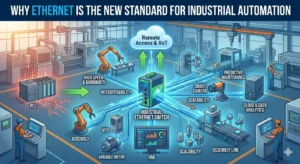
Revolutionizing Bandwidth and Data Throughput
Bandwidth remains the most significant advantage of Ethernet over legacy serial systems. While RS485 typically struggles at speeds below 10 Mbps, Industrial Ethernet provides 100 Mbps or higher. This capacity allows operators to transmit control signals, diagnostics, and high-definition video feeds simultaneously. Therefore, systems avoid the polling delays common in older packaging lines. High bandwidth ensures that critical process data reaches the controller without latency.
Scalability and Network Topology Resilience
RS485 usually relies on a daisy-chain topology. Unfortunately, a single loose wire can disable an entire segment. In contrast, Ethernet supports star, ring, and redundant topologies such as MRP (Media Redundancy Protocol). These structures isolate faults efficiently. If one device fails, the rest of the factory automation network remains operational. This reliability is vital for continuous processes in chemical plants where downtime costs thousands per hour.
The Edge of Protocol Compatibility and Standardization
Modern industrial automation thrives on interoperability. Ethernet enables standardized protocols like PROFINET, EtherNet/IP, and Modbus TCP. These protocols allow direct SCADA integration without expensive protocol converters. Moreover, they support advanced device discovery and remote configuration features. However, users must choose hardware carefully. Some low-cost Ethernet devices lack the determinism required for high-speed motion control or safety interlocking.
Expert Tips for Installation and EMI Shielding
High-EMI environments, such as those near Variable Frequency Drives (VFDs), present challenges for Ethernet. I always recommend using shielded industrial-grade Cat5e or Cat6 cables. Proper grounding at one end is essential to prevent intermittent packet loss. In my experience at PLC Pioneer, “mostly working” communication is often due to poor shielding. Solid physical infrastructure is the first step toward a stable control system.
Network Segmentation for Enhanced Performance
Flat networks often lead to congestion and security vulnerabilities. Therefore, engineers should use managed switches to implement VLANs. Separating critical control traffic from general office IT traffic prevents “broadcast storms.” During a recent commissioning project, I resolved significant SCADA delays simply by configuring a VLAN. This adjustment optimized data flow without requiring any additional hardware investment.
Protecting Infrastructure Against Environmental Surges
Ethernet ports are inherently more sensitive to voltage spikes than rugged RS485 transceivers. Industrial switches often feature built-in surge protection, but outdoor installations require extra care. Always install external Ethernet surge protectors for equipment located outside the main control room. After a thunderstorm, maintenance teams should inspect switch logs for partial failures. These subtle errors can degrade network performance over time if left unaddressed.
- ✅ Optimization Tip: Use managed switches to enable Quality of Service (QoS) for prioritized control traffic.
- ⚙️ Reliability Check: Implement ring redundancy to ensure zero-loss communication during a cable break.
- 🔧 Maintenance Rule: Standardize on industrial-grade RJ45 connectors to resist vibration and corrosion.
PLC Pioneer’s Expert Commentary
“As we move further into 2026, the debate between RS485 and Ethernet is largely settled by the need for data transparency. While RS485 is ‘reliable enough’ for simple tasks, it cannot support the analytical needs of modern MES or AI-driven maintenance. My advice to plant managers is simple: if you are expanding beyond 20 nodes, an Ethernet migration isn’t just an upgrade—it’s a necessity for survival.” — PLC Pioneer
Frequently Asked Questions
Is it worth converting old RS485 sensors to Ethernet?
If the sensors provide critical diagnostic data for your SCADA, yes. However, for simple digital inputs, a protocol gateway (Modbus RTU to TCP) is a cost-effective middle ground. Only replace the hardware if you require sub-millisecond response times.
How does Ethernet handle the ‘Single Point of Failure’ risk?
Unlike serial loops, switched Ethernet networks use redundancy protocols. If a switch or cable fails, the network automatically reroutes data through a backup path in milliseconds. This makes it far more robust than traditional bus architectures.
Can I use standard office Ethernet switches in a factory?
Technically, they work, but I strongly advise against it. Industrial switches are hardened against heat, vibration, and noise. They also offer the “determinism” required to ensure control packets arrive on time, which office hardware cannot guarantee.
Application Scenario: Pharmaceutical Batch Tracking
A pharmaceutical client recently transitioned from RS485 to a PROFINET-based Ethernet network. This change allowed them to integrate high-speed RFID scanners at every station. As a result, they achieved 100% real-time traceability for every batch. The increased bandwidth also enabled remote troubleshooting, reducing the need for on-site technician visits by 40%.
If you are planning to modernize your industrial network or need high-quality components to bridge your legacy systems, we are here to help.
Discover more technical insights and premium hardware at: PLC Pioneer Limited