Why Line-Driver Encoders Are Essential for Industrial Automation Reliability
The Core Challenge of Signal Integrity in Modern Factories
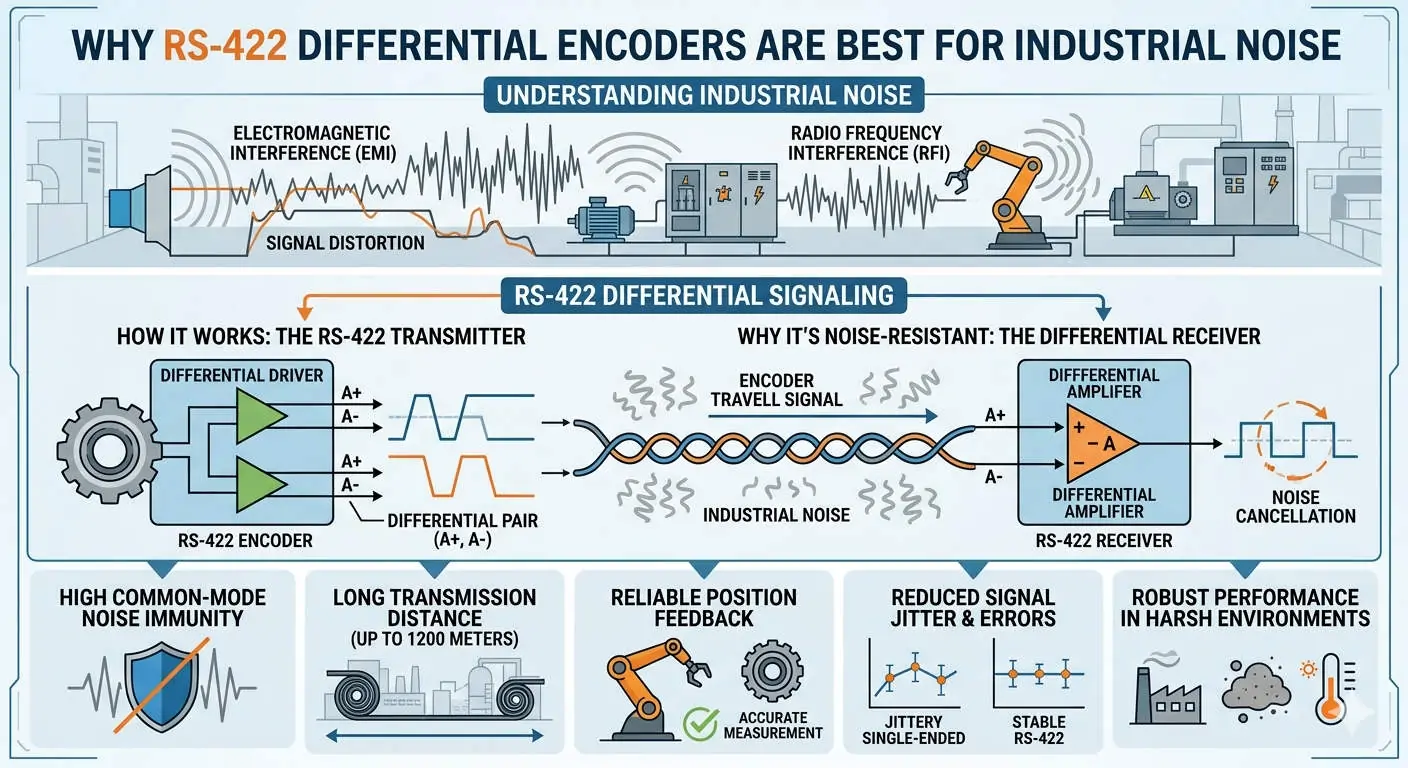
Differential line-driver encoder outputs provide the backbone for precise motion control in large-scale industrial automation. Petrochemical plants and pharmaceutical lines often face heavy electromagnetic interference (EMI). Standard single-ended signals frequently fail in these high-noise environments. Line-driver technology solves this by ensuring robust transmission over long distances. However, connecting these differential outputs directly to a standard PLC digital input (DI) is a common engineering mistake. Most standard DIs support 24V PNP/NPN signals rather than the RS-422 levels used by encoders.
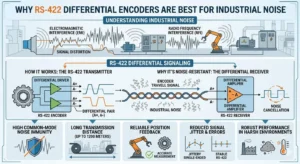
Technical Insights: The Power of RS-422 Differential Signaling
A line-driver encoder generates complementary signals such as A+/A-, B+/B-, and Z+/Z-. This differential method effectively cancels common-mode noise from motors and VFDs. In my experience at PLC Pioneer, using these signals is non-negotiable for high-speed precision. Without a compatible interface, systems often suffer from missed pulses or position drift. Therefore, you must use a dedicated high-speed counter (HSC) module or a signal converter. These components ensure the PLC accurately interprets every microsecond pulse from the hardware.
Matching Response Time with Encoder Frequency
Modern incremental encoders often output signals reaching the MHz range. Standard PLC digital inputs usually feature response times between 5ms and 20ms. This speed is far too slow for high-resolution feedback. As a result, the PLC scan cycle will skip critical pulses. This mismatch leads to inaccurate speed calculations and poor product quality. For successful factory automation, always verify that your input module matches the encoder’s pulse width. Dedicated motion control inputs are often the most reliable solution for real-time tracking.
Optimizing Transmission Distance and Cable Performance
Line-driver outputs excel at maintaining signal strength over distances exceeding 100 meters. Large industrial sites like steel mills rely on this long-distance stability. However, long cable runs increase the risk of signal attenuation and EMI coupling. Twisted-pair shielded cables are essential for preserving the differential advantage. Converting to a single-ended signal too early in the run reintroduces noise sensitivity. Maintaining the differential path as close to the PLC as possible ensures the highest system uptime.
Author Commentary: The Shift Toward Smarter Feedback
From the perspective of PLC Pioneer, we see a clear trend toward higher resolution and faster sampling. As industries move toward Industry 4.0, the “standard DI” approach is becoming obsolete for motion tasks. Many engineers now prefer integrated DCS solutions that handle RS-422 natively. This integration reduces the need for external converters, which are often points of failure. Investing in the right interface today prevents costly retrofits and erratic machine behavior tomorrow.
Best Practices for Installation and Grounding
- ✅ Interface Matching: Use an RS-422 to NPN/PNP converter if your PLC lacks differential inputs.
- ✅ Shielding Logic: Connect the cable shield to ground at the PLC side only to avoid ground loops.
- ✅ Cable Selection: Always utilize high-quality twisted-pair shielded cables (e.g., 2×2×0.2 mm²).
- ✅ Spatial Separation: Maintain 300mm clearance between encoder signals and motor power lines.
Industrial Solution Scenario: High-Speed Sorting
In a high-speed logistics hub, a conveyor encoder must track packages with millimeter precision. The VFDs driving the belts generate significant noise. By using a Bently Nevada or Allen-Bradley high-speed module with differential inputs, the system eliminates “ghost pulses.” This setup ensures the sorting arms trigger exactly when needed. Reliable counting reduces waste and maximizes the throughput of the entire control system.
Frequently Asked Questions (FAQ)
1. Can I use a voltage divider to connect a 5V line driver to a 24V PLC input?
This is not recommended. While it may solve the voltage level issue, a voltage divider does not provide the high-speed switching required. It also fails to utilize the noise-canceling benefits of differential signaling, likely leading to signal errors.
2. How does cable length affect my choice of encoder output?
If your run is under 10 meters in a low-noise area, an Open Collector or Push-Pull output might work. For anything over 20 meters or near high-power machinery, a line-driver is the only way to ensure reliable data transmission.
3. What is the most common symptom of a signal mismatch?
The most common sign is “position creep,” where the machine’s home position seems to shift slightly over time. This usually indicates the PLC is missing a small percentage of pulses due to slow input response or EMI noise.
Need expert advice on selecting the right modules for your system? Visit PLC Pioneer Limited to explore our range of high-performance automation components and technical guides.