Understanding Universal Automation: The Future of Hardware-Independent Industrial Control
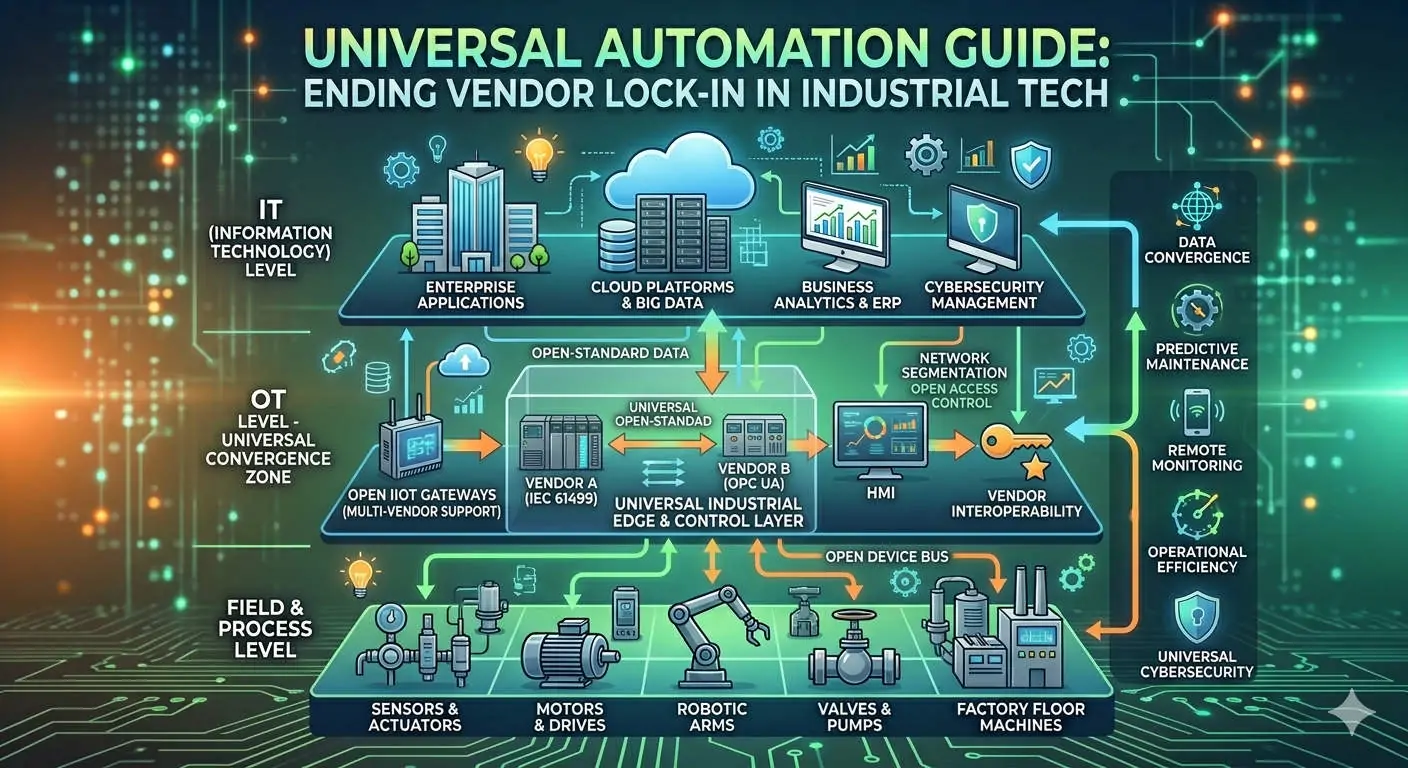
Universal Automation, often called Open Automation, represents a fundamental shift in industrial control systems. This paradigm decouples automation software from proprietary hardware platforms. Historically, vendors tightly bundled control logic with specific controllers. However, the emergence of the IEC 61499 standard now enables portable, vendor-neutral control logic. Consequently, engineers can execute the same application across diverse hardware environments without extensive rewriting.
The Strategic Value of Ending Vendor Lock-in
Traditional Distributed Control Systems (DCS) often trap operators in expensive, proprietary ecosystems. This “vendor lock-in” makes system expansions and migrations risky and costly. Universal Automation solves this by promoting application portability. Therefore, plant operators can reuse engineering assets across different brands. This flexibility proves vital for brownfield sites where mixing different hardware vendors is common. Moreover, it significantly lowers total cost of ownership over the plant’s lifecycle.
Technical Depth: The Impact of IEC 61499 Compliance
Unlike legacy IEC 61131-3 environments, IEC 61499 utilizes a distributed function block model. This standard allows logic to run seamlessly across any compliant runtime environment. As a result, engineering teams can develop and test logic in parallel, which shortens commissioning times. Furthermore, Original Equipment Manufacturers (OEMs) can deliver skids with pre-validated, portable code. PLC Pioneer observes that strict adherence to execution models is essential to avoid timing issues in multi-vendor setups.
Transitioning to Event-Driven Execution Models
Universal Automation platforms typically move away from the cyclic scan models of legacy PLCs. Instead, they utilize event-driven execution for faster processing. This approach improves response times for critical interlocks and process trips. Additionally, it reduces CPU overhead during stable operations. However, engineers must carefully manage event chains. Improper prioritization may lead to race conditions in high-speed or safety-critical loops. Therefore, robust design remains a top priority for system stability.
Standardizing Communication with OPC UA and MQTT
Most open automation architectures natively integrate with modern protocols like OPC UA and MQTT. These standards simplify the connection between the shop floor and IT layers. Consequently, operators can easily stream data to ERP systems or cloud analytics for predictive maintenance. This native support reduces the reliance on expensive proprietary gateways. Nevertheless, integration with legacy Honeywell or older DCS nodes may still require protocol conversion to bridge the gap between old and new tech.
Critical Installation and Maintenance Strategies
Integrating mixed-vendor systems requires a disciplined approach to networking and power. In brownfield projects, we recommend validating all interoperability in a staging environment first. Moreover, network performance is the backbone of distributed control. Therefore, engineers should use industrial managed switches with Quality of Service (QoS) enabled. Proper VLAN segmentation prevents broadcast storms from disrupting control traffic. Finally, ensure all edge nodes have external surge protection to prevent communication instability during power events.
PLC Pioneer Expert Commentary
The industrial world is moving toward software-defined everything. In my view at PLC Pioneer, Universal Automation is not just a trend; it is a necessity for the “Industry 4.0” era. While legacy vendors may resist this openness, the demand for agility is driving the market toward interoperability. Companies that adopt these standards early will gain a massive competitive edge in maintenance flexibility. However, do not underestimate the learning curve associated with moving from cyclic scans to event-based logic.
Universal Automation Best Practices Checklist
- ✅ Verify Runtime Compatibility: Ensure all controllers support the same IEC 61499 execution profile.
- ⚙️ Network Hardening: Use industrial-grade shielded cabling to maintain low-latency communication.
- 🔧 Phased Implementation: Begin migration with non-critical utility units to build team expertise.
- ✅ Standards Compliance: Prioritize hardware that supports open standards like OPC UA natively.
Frequently Asked Questions
Q: How does Universal Automation affect my existing DCS maintenance contract?
Initially, it may complicate support since you are using software from one vendor on hardware from another. However, it provides leverage during contract negotiations. You gain the freedom to choose hardware based on performance and availability rather than brand loyalty.
Q: Is the event-driven model safe for high-speed motion control?
Yes, but it requires a different design mindset. Unlike the predictable “tick” of a PLC scan, event-driven systems respond to changes. With proper task prioritization and deterministic networking (like TSN), these systems often outperform traditional PLCs in response speed.
: Can I run Universal Automation on standard Industrial PCs (IPCs)?
Absolutely. One of the greatest strengths of this paradigm is the ability to run control logic on high-performance IPCs or edge gateways. This allows for better integration of AI and advanced analytics directly at the control level.
Application Scenario: Modular Skid Integration
Consider a pharmaceutical plant adding a new centrifuge skid. In a proprietary world, the skid must match the plant’s DCS brand. With Universal Automation, the skid arrives with its own portable control logic. The plant engineers simply map the global variables to their existing network. This plug-and-produce capability reduces integration time from weeks to days.
Universal Automation is a strategic layer that extends your system’s capabilities. If you are planning a migration or looking to optimize your control architecture, we can help.
Discover more technical insights and hardware solutions at: PLC Pioneer Limited