Thermal Management for Remote I/O in Extreme Blast Furnace Environments
In blast furnace metallurgy, ambient temperatures near tapping yards and hot blast stoves frequently exceed the safety limits of standard industrial automation hardware. The critical challenge involves more than just deciding on air conditioning. Engineers must ensure long-term system reliability, signal integrity, and lifecycle stability under intense thermal stress. Proper cooling strategies prevent I/O module drift and communication faults, directly reducing unplanned downtime in steel plants.
Understanding Operating Temperature Limits for Remote I/O
Most standard remote I/O modules support a range between -20°C and +60°C, while specialized high-temperature variants reach +70°C. However, internal heat dissipation within an enclosure typically adds another 10°C to 20°C to the ambient temperature. When temperatures surpass these ratings, sensitive components like electrolytic capacitors and optocouplers degrade rapidly. Consequently, the Mean Time Between Failures (MTBF) drops significantly, risking sudden process control interruptions.
The Impact of Enclosure Design on Heat Dissipation
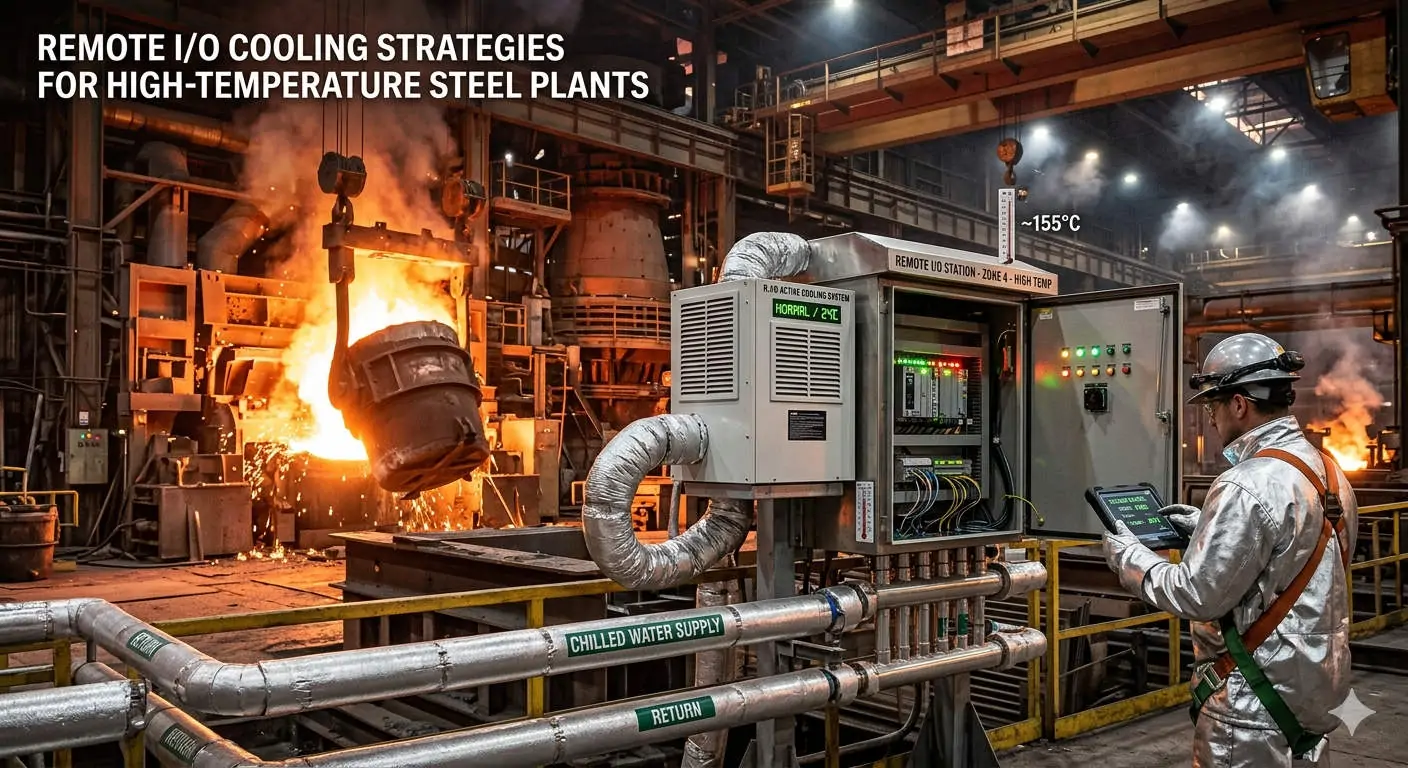
A fully loaded remote I/O rack can dissipate over 100W of heat. In the dusty and corrosive environments of a steel mill, engineers typically use sealed IP65 or IP66 cabinets to protect internal electronics. Because heat cannot escape these sealed units naturally, internal temperatures rise quickly even in moderate external conditions. Therefore, passive ventilation rarely suffices in metallurgical zones. A closed-loop cooling solution remains the preferred method to maintain enclosure integrity.
Choosing Between Open-Loop and Closed-Loop Cooling
Blast furnace areas contain conductive iron oxide dust, corrosive SO2/CO gases, and fluctuating humidity. Opening a cabinet for fan-based ventilation introduces these contaminants, leading to PCB tracking and short circuits. According to IEC 60529 standards, cooling methods must not compromise the protection rating of the enclosure. For this reason, industrial air conditioners with isolated air paths provide a superior defense compared to standard filtered fans.
Field-Proven Strategies for High-Heat Installations
Experience at PLC Pioneer suggests that if a cabinet sits within 15 meters of a furnace shell, an industrial enclosure air conditioner is mandatory. For zones where the ambient stays below 45°C, air-to-air heat exchangers offer a cost-effective alternative. Furthermore, technicians should use high-temperature rated cables (at least 105°C) to avoid insulation brittleness. Adding external surge protection devices (SPD) also mitigates risks from inductive spikes common in heavy industrial power grids.
Validating Thermal Performance During Commissioning
Relying on theoretical specifications often leads to failure. During the commissioning phase, we recommend installing temperature loggers inside the cabinet. Record the data across multiple production cycles, especially during peak tapping periods. This practice often uncovers hidden thermal peaks that standard assessments miss. Accurate data allows for precise adjustments to the cooling system before the plant enters full operation.
Technical Implementation Checklist
- ✅ Thermal Monitoring: Log internal cabinet temperatures during a full 24-hour production cycle.
- ⚙️ Environmental Sealing: Maintain IP54 or higher ratings using closed-loop industrial AC units.
- 🔧 Component Protection: Specify I/O modules with G3 conformal coating for corrosive gas resistance.
- 📊 Cable Management: Utilize 105°C rated wiring and maintain separation between signal and power lines.
PLC Pioneer’s Expert Commentary
“In my 15 years of field experience in the metallurgical sector, I have noticed a recurring pattern: companies that try to save on thermal management often pay ten times that amount in lost production. In a blast furnace environment, cooling for your DCS or PLC remote stations is not a luxury—it is a functional necessity. If you hesitate to invest in a robust enclosure air conditioner today, you are essentially scheduling a system failure for tomorrow.” — PLC Pioneer
Frequently Asked Questions
Q: Can high-temperature rated I/O modules replace the need for active cooling?
While modules rated for 70°C provide a better safety margin, they do not eliminate the need for cooling. Operating electronics at their upper limits permanently reduces their lifespan and can cause analog signal drifting, which affects process accuracy.
Q: What is the most common failure point for cooling systems in steel mills?
Filter clogging due to iron dust is the primary cause. This is why we advocate for closed-loop industrial air conditioners. They keep the dirty ambient air completely separate from the clean air inside the PLC cabinet.
Q: Is there a middle ground between passive cooling and expensive AC units?
Vortex coolers are an option if you have access to clean, dry compressed air. However, in most large-scale plants, the long-term energy cost of compressed air makes industrial AC units a more economical choice over a five-year period.
Application Scenario: Hot Blast Stove Monitoring
A major steel producer recently upgraded their hot blast stove control system. By replacing standard fans with NEMA 4X rated enclosure air conditioners and Honeywell high-temp I/O modules, they eliminated monthly communication dropouts. The integration of Bently Nevada vibration sensors on nearby blowers now runs with 100% signal stability, even during peak thermal cycles.
For more technical insights or to source specialized high-temperature automation components, visit our resource center today.
Explore our full range of industrial control solutions: PLC Pioneer Limited