Optimizing Analog Signal Stability: Is Software Filtering Sufficient for High-Noise Environments?
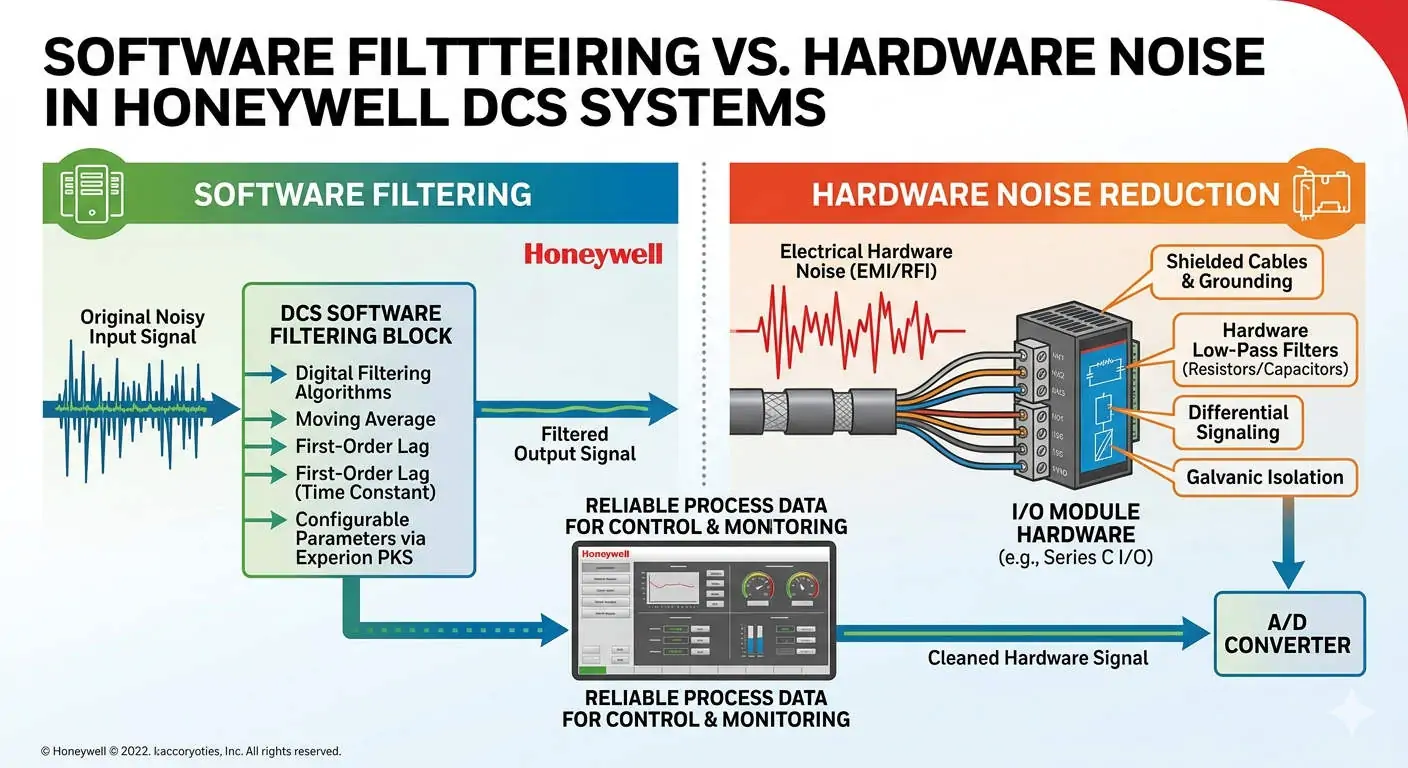
In heavy industrial sectors like petrochemicals and steel manufacturing, severe analog signal fluctuations frequently disrupt operations. Often, electromagnetic interference (EMI) or poor grounding causes these erratic readings. While software filtering within a Distributed Control System (DCS) improves signal stability for control logic, it rarely addresses the root cause of electrical noise. Therefore, engineers must view software filtering as a final optimization tool rather than a primary solution for hardware deficiencies.
Understanding the Filter Time Constant and Loop Dynamics
A longer filter time constant smooths rapid fluctuations effectively. However, this process inherently introduces signal lag into the system. For fast-acting control loops, such as flow or pressure control, excessive filtering causes significant delays and potential oscillations. Conversely, slow-moving variables like tank levels benefit from higher filtering without impacting process dynamics. In my experience with Honeywell Experion systems, setting filters above two seconds on fast loops often triggers operator complaints regarding sluggish system response.
The Impact of DCS Scan Rates on Signal Aliasing
Software filtering effectiveness relies heavily on the interaction between sampling rates and controller execution cycles. If noise frequency aligns closely with the DCS scan frequency, aliasing occurs. As a result, software filters become virtually ineffective at removing specific interference patterns. In older Honeywell C200 or C300 controllers, mismatched scan configurations often allow intermittent spikes to bypass digital filters. This technical oversight can lead to false alarms and misleading diagnostic data for plant operators.
Hardware Limitations and Signal Resolution Realities
Digital filtering cannot compensate for poor A/D conversion quality at the hardware level. Low-resolution analog input modules tend to amplify the impact of environmental noise. Furthermore, failing shields or ground loops introduce variations that appear as legitimate process changes. If raw signals fluctuate beyond ±1% of the span due to interference, software alone will not meet IEC 61326 compliance standards for industrial electromagnetic compatibility.
Strategic Maintenance: Prioritizing Physical Layer Integrity
Engineers should prioritize hardware noise suppression before adjusting DCS parameters. Use shielded twisted pair cables and ensure single-point grounding to minimize interference. In addition, maintain a minimum 300 mm separation between signal wiring and high-power cables. Field data suggests that over 70% of “jumping signals” result from improper shielding rather than incorrect software configuration. Consequently, physical inspections often yield better results than digital tuning.
Conservative DCS Configuration and Commissioning Tips
When applying software filters, always start with conservative values between 0.5 and 1.0 seconds. Gradually increase the constant while monitoring real-time process stability. Over-filtering during the commissioning phase is a common pitfall. It often masks underlying process instabilities, leading to incorrect PID tuning decisions. Therefore, always validate filter changes under actual operating conditions rather than relying solely on simulation environments.
PLC Pioneer’s Expert Commentary
“Software filtering is an essential secondary defense, but it is not a ‘magic wand’ for poor installation. In the age of high-frequency VFDs and dense wireless networks, physical signal isolation has become more critical than ever. My recommendation is to always solve the electrical problem at the source. A clean signal requires less processing, which ultimately results in a more responsive and safer control system.” — PLC Pioneer
- ✅ Verify Shielding: Ensure all analog shields are grounded at the DCS cabinet end only.
- ⚙️ Signal Isolation: Use hardware isolators for loops prone to ground potential differences.
- 🔧 Damping Functions: Utilize built-in transmitter damping before applying DCS-level software filters.
- 📊 Standard Compliance: Align your noise suppression strategies with IEC 61000-4 standards for robust EMC performance.
Industrial Automation FAQ
How do I distinguish between process noise and electrical interference?
Observe the signal while the final control element (like a pump or valve) is static. If the signal continues to jump erratically without any mechanical movement, you are likely dealing with EMI or grounding issues rather than process turbulence.
Can I use software filtering to fix a flickering HMI reading?
While it smooths the visual display, filtering does not fix the underlying data quality. If the fluctuation triggers safety interlocks, software filtering might actually create a dangerous delay in emergency shutdowns. Hardware stabilization is the only safe path forward.
Why does my filtered signal still show occasional large spikes?
This is usually caused by “impulse noise” that exceeds the filter’s mathematical bounds or a scan rate that is too slow to capture the noise peak. In these cases, hardware surge protection or signal conditioners are required to clip the spikes before they reach the DCS input.
Solution Scenario: Petrochemical Flow Stabilization
In a recent refinery project, a magnetic flowmeter exhibited 15% fluctuations due to a nearby high-voltage motor. Initial attempts to use a 5-second DCS filter caused the control valve to “hunt,” leading to unstable production. By replacing the standard cable with high-quality shielded pairs and adding a dedicated signal isolator, the noise dropped to 0.5%. This allowed the team to reduce the software filter to 0.8 seconds, restoring precise control and system responsiveness.
If you require high-performance analog modules or expert guidance on suppressing interference in your control architecture, explore our technical resources and hardware solutions.
For professional hardware support and technical components, visit: PLC Pioneer Limited