Virtual PLC vs. Traditional Hardware: Can SoftPLC Reliably Control Real Machines?
Traditional hardware PLCs often struggle with inflexibility and high lifecycle costs in modern industrial automation. Virtual PLC software, commonly known as SoftPLC, addresses these limitations by running control logic on industrial PCs (IPCs) or virtualized environments. This shift enables faster deployment, seamless scaling, and superior integration with existing IT infrastructures. However, successful implementation depends on hardware interfaces and real-time performance rather than just the software itself.
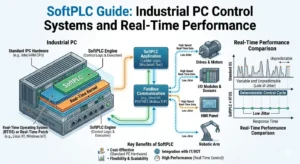
The Necessity of Real-Time Determinism in SoftPLC Environments
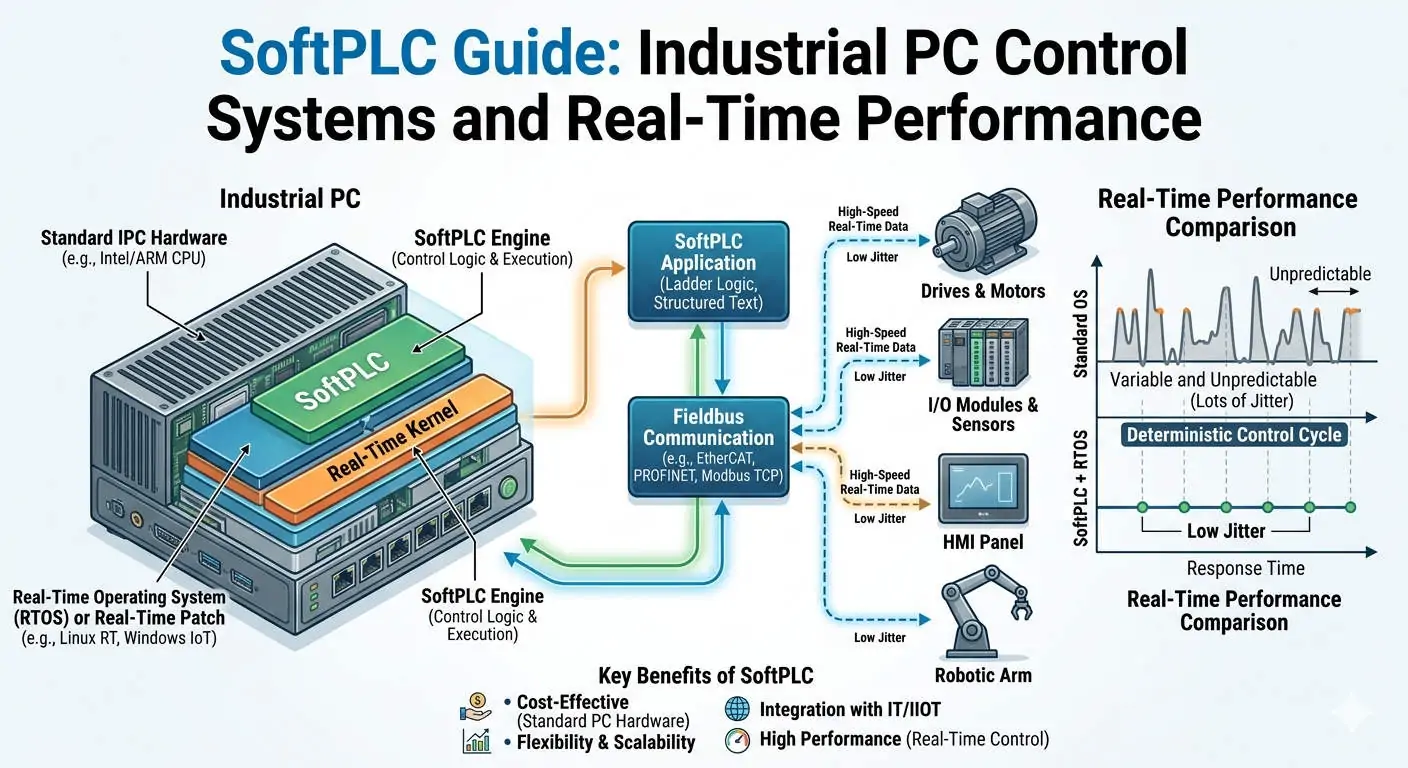
Standard hardware PLCs guarantee deterministic scan cycles, typically ranging from 5ms to 20ms with minimal jitter. In contrast, SoftPLC performance relies heavily on the host operating system. Standard Windows environments often introduce cycle jitter that destabilizes high-speed interlocking or motion control. For instance, a 10ms variation in a packaging line can cause significant misalignment or product rejects. Therefore, engineers must utilize real-time Linux (PREEMPT_RT) or dedicated hypervisors to ensure system stability.
Bridging the Gap with Fieldbus and I/O Interfaces
A SoftPLC lacks physical I/O terminals and must communicate through external interfaces like EtherCAT, PROFINET, or Modbus TCP. The choice of protocol dictates the system’s latency and synchronization accuracy. While EtherCAT excels in high-speed motion, Modbus remains suitable for slower process control tasks. Moreover, compatibility varies across platforms. Some SoftPLC versions require specific licenses for master functionality. Without a robust I/O interface module, the software cannot directly interact with sensors or actuators.
Evaluating Hardware Reliability and Environmental Resilience
Unlike ruggedized PLCs designed for extreme conditions, SoftPLCs run on IPCs or servers. These devices are generally more sensitive to temperature fluctuations, vibrations, and electromagnetic noise. In my experience at PLC Pioneer, I have seen SoftPLC systems fail in non-conditioned cabinets due to thermal throttling. To prevent random shutdowns, facilities must implement forced ventilation and isolated power supplies. Industrial-grade IPCs with high MTBF (Mean Time Between Failures) ratings are essential for harsh industrial settings.
Best Practices for Installation and System Maintenance
To achieve industrial-grade reliability, avoid using standard desktop OS configurations for control tasks. You should disable unnecessary background services to eliminate latency spikes during commissioning. In addition, designing a robust I/O architecture is vital. Many oil and gas applications pair SoftPLCs with remote I/O panels to reduce electrical noise and simplify wiring. Furthermore, always install industrial UPS systems and surge protection devices (SPD) to protect sensitive network interface cards from power disturbances.
Author Insights from PLC Pioneer
“The industry is moving toward software-defined automation. While SoftPLC offers incredible flexibility for digital twins and non-critical processes, it is not a ‘one-size-fits-all’ replacement. In 2026, the most successful architectures I see are hybrid models. These systems use traditional PLCs for safety-critical logic while leveraging SoftPLCs for data-intensive processing and SCADA integration.” — PLC Pioneer
Technical Implementation Checklist
- ✅ OS Selection: Use real-time Linux or a real-time patch to ensure deterministic scheduling.
- ⚙️ I/O Verification: Confirm your SoftPLC platform supports the specific master protocol of your field devices.
- 🔧 Environmental Shielding: House IPCs in climate-controlled enclosures if ambient temperatures exceed 50°C.
- 📊 Code Portability: Ensure your logic adheres to IEC 61131-3 standards for easier migration from legacy systems.
Frequently Asked Questions (FAQ)
Q: Is SoftPLC capable of handling SIL-rated safety functions?
Most standard SoftPLC platforms are not certified for safety-critical tasks. You should typically use a dedicated Safety PLC for emergency stops and light curtains. However, some specialized software-defined controllers now offer SIL 2/3 certification when paired with specific safety-rated I/O hardware.
Q: How do licensing costs compare between SoftPLC and hardware PLCs?
SoftPLC often has a lower initial entry price, but costs can rise with communication drivers and runtime licenses. Hardware PLCs include the runtime in the purchase price. For large-scale deployments with hundreds of nodes, SoftPLC generally offers a better ROI through centralized management.
Q: Can I reuse my existing Ladder Logic in a SoftPLC environment?
Yes, if the SoftPLC supports the IEC 61131-3 standard. However, you must manually reconfigure hardware-specific addressing and I/O mapping. Vendor-specific instructions (like those found in older Siemens or Rockwell systems) may require custom function blocks to work correctly.
Solution Scenario: The Digital Twin Integration
A large-scale chemical plant recently implemented a SoftPLC system to mirror its primary DCS. This “shadow” controller runs the same logic as the real plant but connects to a simulated environment. This allows engineers to test firmware updates and logic changes in real-time without risking physical equipment. As a result, the plant reduced commissioning downtime by nearly 30% during their last major overhaul.
If you are ready to explore the flexibility of software-defined control or need hardware that supports high-speed fieldbus protocols, our team is here to help. Discover the latest in industrial computing and automation components today.
For professional technical support and industrial hardware solutions, visit: PLC Pioneer Limited