Strategic Safety: Why SIS and DCS Independence Defines Chemical Plant Reliability
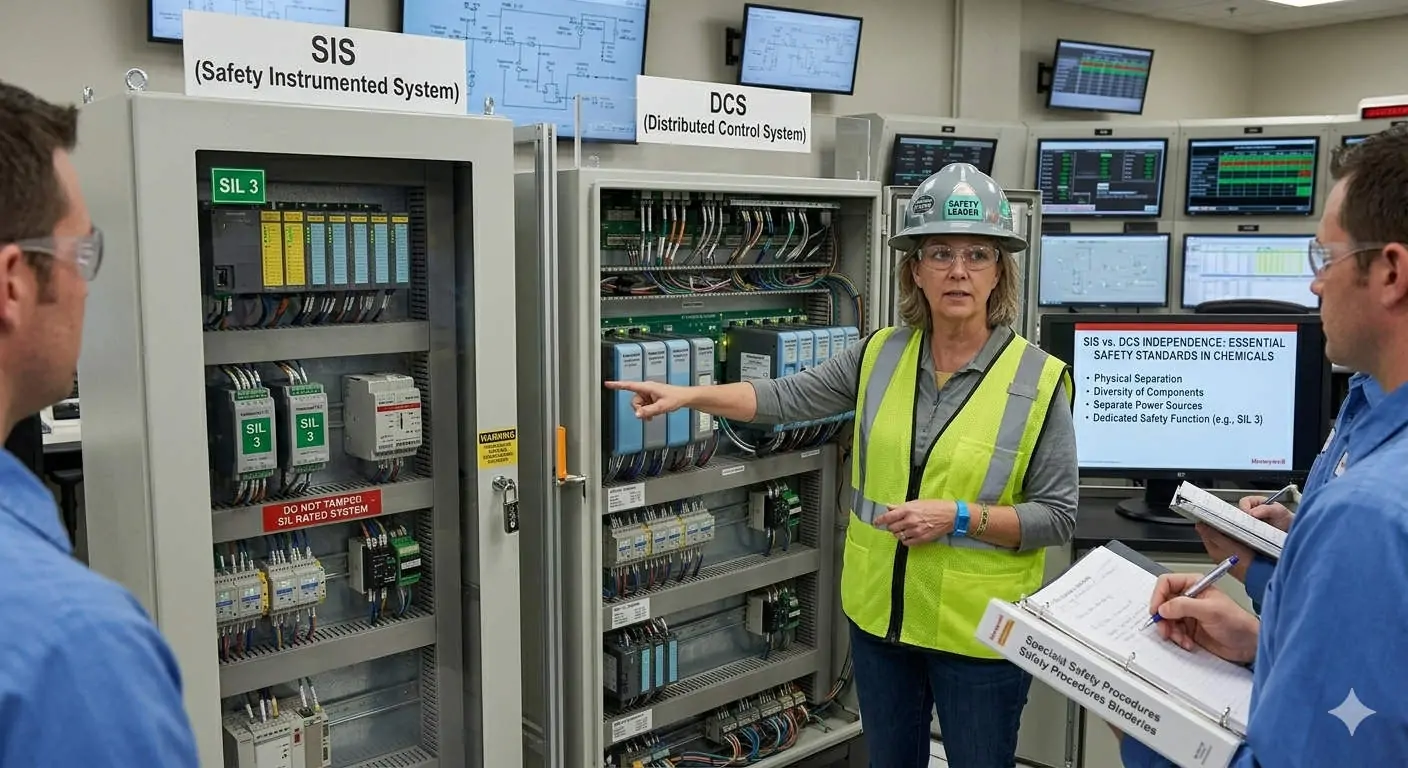
In high-risk chemical environments, the relationship between the Safety Instrumented System (SIS) and the Distributed Control System (DCS) is critical. Deciding whether to physically isolate these systems involves managing “Common Cause Failure” (CCF) risks. While a DCS manages daily operations, the SIS serves as the final protective layer. Therefore, it must execute emergency shutdowns independently if the DCS fails or an operator makes an error.
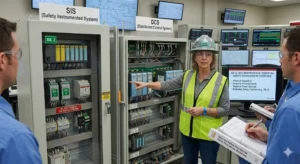
Understanding Safety Integrity Levels and Functional Independence
Adhering to the IEC 61511 standard requires the SIS to meet specific Safety Integrity Levels (SIL2 or SIL3). If the SIS shares power supplies, communication gateways, or controllers with the DCS, its independence is compromised. As a result, the SIL calculation becomes invalid during safety audits. At PLC Pioneer, we often see projects fail certification because they used “soft isolation” like VLANs instead of true physical separation.
Optimizing System Response Time for High-Risk Processes
A Safety Instrumented System must respond within milliseconds to prevent catastrophic events. However, routing safety signals through a DCS introduces unnecessary communication latency or packet loss risks. In exothermic reactors, even a small delay might allow temperatures to exceed safe limits. Consequently, engineers should prioritize direct hard-wired I/O connections over software-based protocols like Modbus TCP for critical interlocks.
Secure Communication and Protocol Gateways
While SIS and DCS must exchange data, they require “controlled interfaces” to prevent interference. Best practices involve using one-way data diodes or read-only OPC servers. Moreover, the DCS should never have permission to write logic into the SIS. For modern architectures, I recommend choosing safety PLCs with Black Channel certification, such as PROFIsafe, to ensure communication integrity without sacrificing system independence.
Physical Installation and Maintenance Best Practices
Independent design extends to the electrical infrastructure of the plant. A robust SIS requires its own redundant UPS and a dedicated grounding system to avoid interference. Furthermore, critical signals should use high-quality safety relays or isolation modules. In corrosive chemical environments, using spring-loaded terminals and surge protection devices (SPD) significantly reduces intermittent signal failures during long-term operation.
Avoiding the Common Pitfall of Network-Only Isolation
Many project managers mistakenly believe that different IP segments constitute true isolation. However, safety auditors typically reject this approach because it does not eliminate systemic software risks. A truly isolated safety architecture must include independent controllers, dedicated power paths, and separate physical networks. This “Defense in Depth” strategy ensures that a cyber-attack or network storm on the DCS does not disable the emergency shutdown functions.
Technical Implementation & Safety Checklist
- ✅ Power Autonomy: Use a dedicated, independent UPS for all SIS controllers and safety-related I/O.
- ⚙️ Logic Locking: Ensure the SIS programming environment is password-protected and locked after safety commissioning.
- 🔧 Hardware Segregation: Avoid sharing remote I/O stations or marshaling cabinets between safety and control functions.
- 📊 Audit Compliance: Maintain a strict Change Management (MOC) log for all SIS software modifications to satisfy SIL requirements.
PLC Pioneer’s Expert Commentary
“In my years of field experience, the most resilient plants are those that treat the SIS as a sacred, untouchable entity. While the industry is moving toward ‘integrated safety’ for better data visibility, the core logic execution must remain physically and functionally distinct. If your DCS and SIS share a single point of failure, you don’t have a safety system—you have a liability.” — PLC Pioneer
Expert FAQ: Safety System Integration
Q: Is it permissible for the SIS and DCS to share the same operator HMI?
Yes, they can share a visualization platform for monitoring purposes. However, the command path for safety overrides must be strictly controlled, and the underlying controllers must remain independent to prevent a single HMI failure from affecting safety logic.
Q: Why is “Hard-Wiring” still preferred over industrial Ethernet for safety?
Hard-wiring provides the highest level of reliability and is immune to network congestion or software crashes. In a “fail-safe” design, a broken wire naturally triggers the safe state, whereas a network timeout might leave the system in an uncertain condition.
Q: Can a standard PLC be used for an SIS application if the logic is simple?
No. Standard PLCs lack the internal diagnostics and hardware redundancy found in certified Safety PLCs. Without a third-party SIL certification (such as TÜV), a standard PLC cannot legally or safely perform SIS functions in regulated industries.
Solution Scenario: Reactor Overpressure Protection
In a pressurized chemical reactor, the DCS monitors pressure to adjust feed valves. If a sensor fails and pressure spikes, the independent SIS detects the threshold via a separate pressure transmitter. It then instantly closes the main feed valve and opens the vent, bypasssing the DCS entirely. This dual-track approach ensures the plant remains safe even if the DCS software freezes.
If you are planning a system upgrade or need hardware that meets strict SIL2/SIL3 standards, our engineering team can provide the right components to secure your facility. Explore our range of certified safety modules and industrial controllers today.
Find professional automation hardware and technical support at: PLC Pioneer Limited