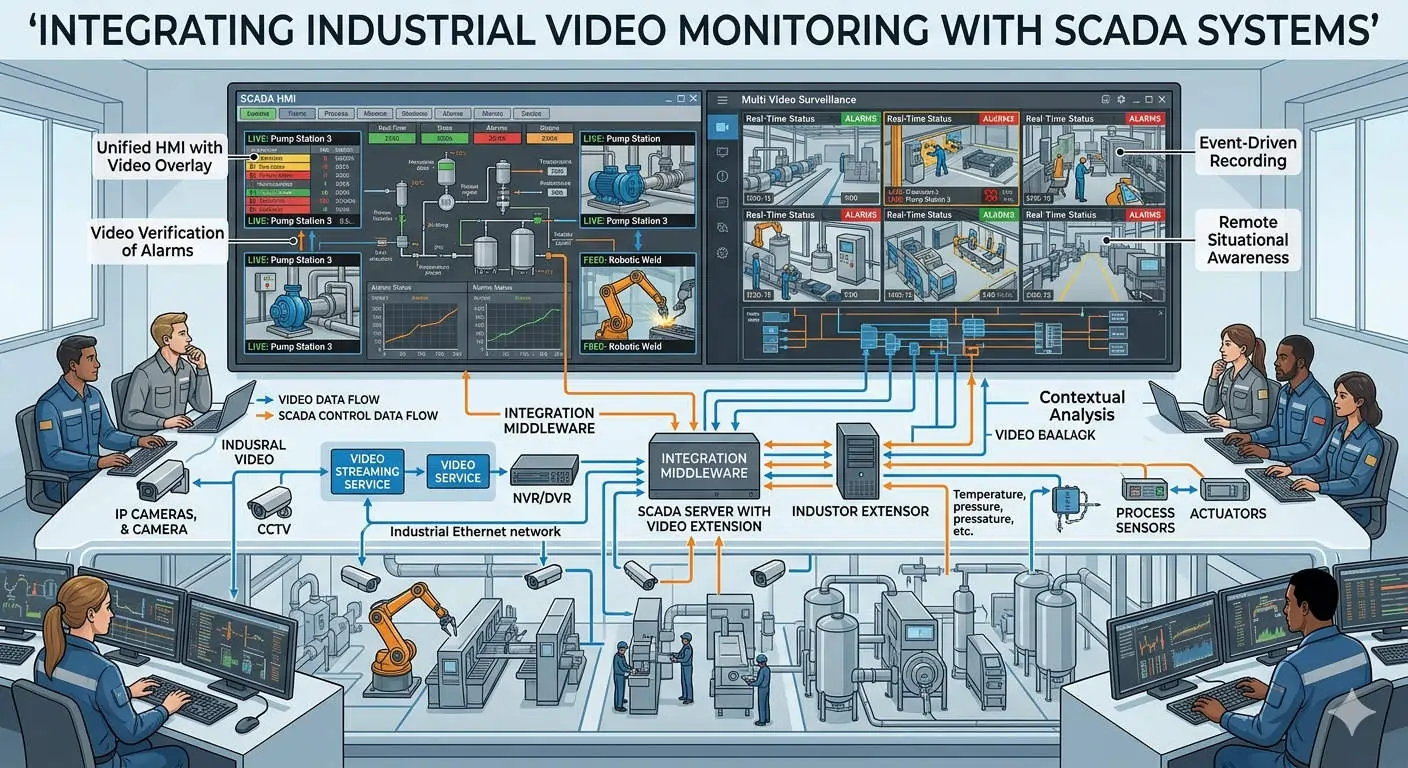
Maximizing Situational Awareness: Integrating Video Monitoring into SCADA Systems
Modern industrial automation is evolving beyond simple data points. Integrating camera-based video monitoring into SCADA systems has become a standard requirement for high-reliability environments. This fusion provides visual context to traditional process data. Consequently, operators can verify alarms and detect physical abnormalities in real-time. However, successful implementation requires precise engineering of protocols, networks, and hardware durability.
The Core Value of Visual Data in Industrial Automation
Video surveillance adds a critical layer of verification to SCADA interfaces. While a sensor might report a pressure drop, a camera reveals if a pipe is leaking or a valve is stuck. In high-risk sectors like oil and gas or chemical processing, this correlation improves incident traceability. Moreover, it significantly reduces the occurrence of false alarms. Operators gain the ability to see exactly what is happening before deploying field technicians into potentially hazardous zones.
Technical Insights: Navigating Protocols and Middleware
Most industrial cameras utilize ONVIF or RTSP for streaming high-definition video. Conversely, SCADA systems typically operate on OPC UA or DA protocols. Bridging these two worlds often requires specialized middleware or a Video Management System (VMS). In Honeywell Experion PKS environments, for instance, engineers usually embed video via HMIWeb displays. Therefore, selecting hardware that supports open standards is essential for long-term system stability and interoperability.
Managing Network Bandwidth and Latency Constraints
Video streams demand significantly higher bandwidth than standard PLC or DCS signals. A single 1080p stream can consume up to 6 Mbps, while process data typically uses only a few kilobytes. To prevent video traffic from delaying critical control signals, engineers must implement strict network segmentation. We recommend using dedicated VLANs for video traffic. As a result, the control network remains responsive and free from congestion during high-activity events.
Hardware Durability and Environmental Standards
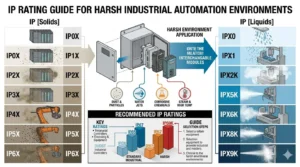
Industrial environments subject equipment to extreme temperatures and corrosive substances. Standard commercial cameras fail quickly under these conditions. Industrial-grade cameras should meet IP66 or IP67 ingress protection standards according to IEC 60529. These units often operate in ranges from -40°C to +70°C. Investing in ruggedized enclosures ensures that your monitoring system survives the harsh realities of the factory floor or offshore platforms.
Best Practices for Installation and Maintenance
Field experience shows that Electromagnetic Interference (EMI) frequently distorts video signals in motor control centers. To mitigate this, always use shielded twisted pair (STP) Ethernet cables. Additionally, ensure proper grounding at one end to prevent ground loops. In outdoor installations, external surge protectors are mandatory for both power and data lines. Finally, in high-vibration areas near compressors or turbines, anti-vibration mounts prevent mechanical failure and intermittent signal loss.
Strategic Buyer’s Guide: VMS vs. Native SCADA
A common question is whether SCADA should handle video directly. Most SCADA platforms are not designed as full-scale recorders. Therefore, we recommend using a professional VMS like Milestone or Genetec. You can then integrate the VMS into the SCADA HMI via web widgets. This approach ensures high-performance recording and analytics without taxing the SCADA server’s primary control functions.
Technical Checklist for Success
- ✅ Protocol Check: Verify RTSP/ONVIF support for all new camera hardware.
- ⚙️ VLAN Separation: Isolate video traffic from critical PLC/DCS control loops.
- 🔧 EMI Mitigation: Utilize STP cabling and maintain distance from high-current power lines.
- 🛡️ Surge Protection: Install protectors on all external network and power entry points.
Expert Commentary by PLC Pioneer
“In my years of field engineering, the most frequent failure point isn’t the software; it’s the network architecture. Treating video as ‘just another tag’ is a recipe for system instability. At PLC Pioneer, we view video as a coordinated subsystem. When properly engineered, it transforms a reactive monitoring setup into a proactive safety tool. Always prioritize network integrity over raw resolution to ensure your control system remains the top priority.” — PLC Pioneer
Frequently Asked Questions (FAQ)
Q: How do I handle video integration with a legacy SCADA that doesn’t support web components?
In legacy environments, the best approach is often a separate hardware terminal or a web-based dashboard running parallel to the HMI. Avoid trying to force high-resolution streams into old network cards, as this can cause the HMI software to crash or lag during critical operations.
Q: Is there a risk of cybersecurity breaches through integrated cameras?
Yes, cameras are frequent targets for network intrusions. Always change default passwords, disable unused services, and keep firmware updated. Isolating cameras within a secure VLAN with restricted access to the SCADA network is a fundamental security requirement.
Q: Does higher resolution always mean better monitoring?
Not necessarily. While 4K sounds appealing, the increased bandwidth can cripple a factory network. For most industrial verification tasks, 1080p at a stable frame rate is far more valuable than a high-resolution stream that suffers from frequent buffering or latency.
Solution Scenario: Remote Tank Farm Monitoring
Consider a remote tank farm where sensors detect a high-level alarm. Without video, an operator might assume a sensor fault or risk a spill. By integrating ruggedized thermal cameras into the SCADA system, the operator can instantly verify fluid levels and surface temperatures. This integration allows for immediate decision-making, potentially saving thousands in environmental cleanup costs and preventing equipment damage.
If you are planning to enhance your facility with integrated monitoring or need help selecting compatible hardware for your control system, we are here to help.
Explore our full range of industrial automation solutions and technical resources at: PLC Pioneer Limited