Ensuring SCADA Data Continuity: Strategies to Prevent Industrial Network Gaps
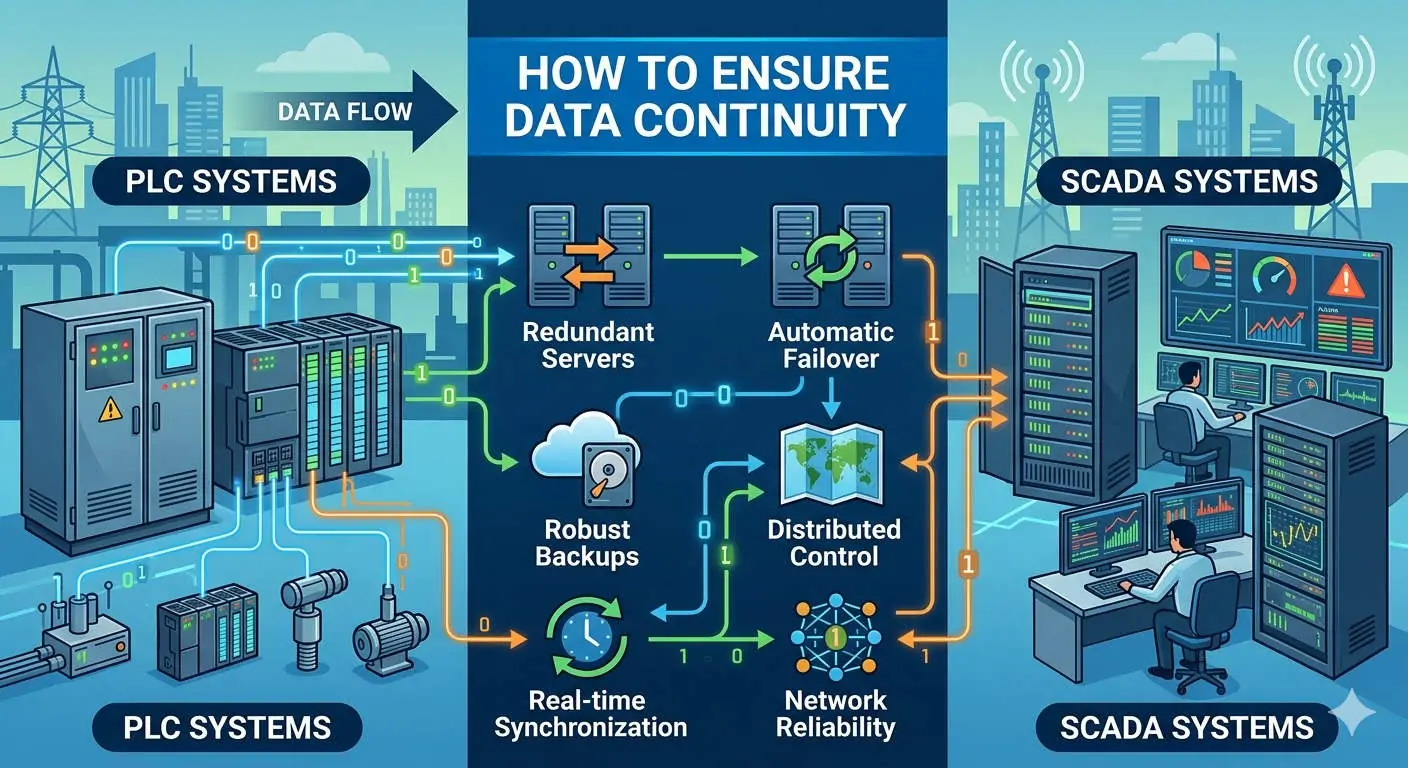
Intermittent network failures do more than just trigger alarms; they threaten the very integrity of your production history. In highly regulated sectors like pharmaceuticals and oil & gas, even a momentary communication drop creates dangerous “blind spots.” These gaps can compromise quality traceability and jeopardize regulatory compliance. However, a robust SCADA architecture can mitigate these risks through intelligent buffering and redundant paths.
The Critical Role of Local Buffering and Store-and-Forward
Local data buffering serves as the first line of defense against network instability. When a PLC or edge gateway detects a lost connection to the SCADA server, it must temporarily store process values locally. Without this “Store-and-Forward” capability, critical batch records are lost forever during an outage. Therefore, implementing local storage ensures that once the link is restored, the system automatically backfills missing data. This approach is essential for meeting FDA 21 CFR Part 11 and ISA-95 standards.
Choosing the Right Communication Protocol for Resilience
Not all industrial protocols handle disconnections with the same level of sophistication. For instance, Modbus TCP is a stateless protocol that lacks inherent data recovery mechanisms. In contrast, OPC UA (IEC 62541) supports session persistence and retransmission, significantly improving reliability. Choosing a modern protocol reduces the manual labor required for data reconciliation after a failure. As a result, engineers can focus on optimization rather than fixing broken data logs.
Optimizing Network Redundancy and Recovery Latency
Network recovery time is a vital metric for control stability. In a standard single-network setup, recovery often requires manual IT intervention. Conversely, a redundant ring topology using protocols like MRP (Media Redundancy Protocol) or RSTP can recover within milliseconds. Fast failover prevents the “alarm floods” that often overwhelm operators when a connection is re-established. Moreover, it maintains the stability of closed-loop control systems that rely on high-speed feedback.
Best Practices for Industrial Network Installation
- ✅ Deploy Edge Data Logging: Do not rely solely on the central SCADA server. Use industrial gateways with at least 24–72 hours of local storage capacity.
- ⚙️ Segment Control Traffic: Use VLANs to separate factory floor traffic from office IT networks. This prevents congestion-related dropouts.
- 🔧 Harden Physical Infrastructure: Install industrial-grade switches and shielded cables. Always include a UPS to protect against voltage dips caused by heavy motor starts.
PLC Pioneer’s Expert Commentary
“In my years of field commissioning, I have found that SCADA data loss is rarely a software bug. Instead, it is almost always a system design flaw. Many engineers overlook the physical layer or the protocol limitations until a major outage occurs. My advice: Treat your network as a critical utility, just like electricity or compressed air. If the network isn’t deterministic, your data isn’t reliable.” — PLC Pioneer
Industrial FAQ: Expert Insights
Q: My PLC has limited memory. How can I implement long-term buffering?
If your legacy PLC lacks internal storage, the most cost-effective solution is adding an Industrial IoT Gateway. These devices sit between the PLC and SCADA, acting as a high-capacity buffer that supports Store-and-Forward without requiring a full PLC upgrade.
Q: Why do I see data “bursts” after a network reconnection?
This occurs when the SCADA system tries to ingest all the buffered data at once. To prevent system lag, configure your SCADA bandwidth throttling. This ensures that historical backfilling does not interfere with real-time monitoring traffic.
Q: Can wireless networks (Wi-Fi/LTE) be used for critical SCADA links?
Wireless is viable but requires much more aggressive buffering. Due to the high probability of packet loss in metal-heavy environments, we recommend using MQTT with ‘Quality of Service’ (QoS) Level 1 or 2 to ensure every message is acknowledged.
Solution Scenario: Pharmaceutical Batch Tracking
In a recent pharmaceutical project, the client experienced frequent SCADA disconnects due to a shared office network. By implementing OPC UA and a local edge logger, we ensured that 100% of the temperature and pressure data remained intact during a 4-hour network failure. The system automatically synced the data back to the central database, preventing the loss of a batch worth over $50,000.
To ensure your automation system is built on a foundation of reliability, you need the right hardware and technical expertise. From high-performance PLCs to resilient network gateways, we provide the tools to keep your data flowing.
Explore our full range of industrial solutions and technical resources at: PLC Pioneer Limited