PLC vs. SCADA: Elevating Small-Scale Industrial Automation for Maximum Efficiency
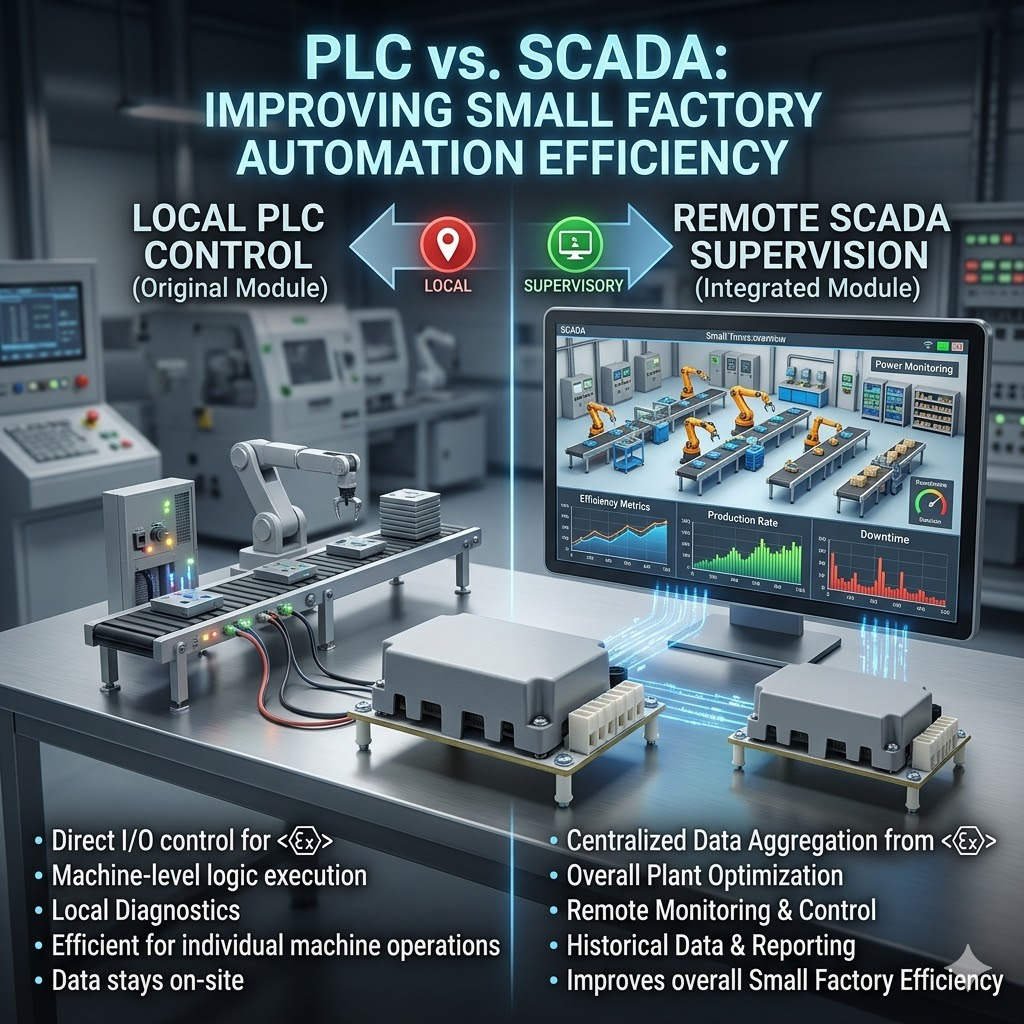
While a Programmable Logic Controller (PLC) serves as the reliable “brain” for individual machines, relying solely on hardware-level control often leaves plant managers in the dark. Modern industrial automation demands more than just execution; it requires visibility. Integrating a Supervisory Control and Data Acquisition (SCADA) system transforms isolated equipment into a cohesive, data-driven production environment.

The Strategic Shift from Local Control to System-Wide Visibility
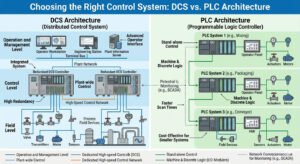
In sectors like food processing and light manufacturing, a PLC handles the immediate logic of motors and sensors. However, it lacks the capacity for long-term data logging or centralized supervision. By adding a SCADA layer, operators gain real-time monitoring and historical trend analysis. Consequently, small factories can achieve high-level operational transparency without the prohibitive costs of a full Distributed Control System (DCS) architecture.
Technical Synchronization: Balancing Scan Rates and Network Load
One critical technical nuance involves the disparity between PLC scan times and SCADA polling rates. While a PLC might execute logic every 10 ms, the SCADA system typically polls data at intervals of 250 ms to 2 seconds. In my experience at PLC Pioneer, setting a polling rate of approximately 500 ms offers the best equilibrium. This speed ensures operators detect pressure spikes or faults quickly without overloading the CPU of older PLC models or congesting the industrial network.
Interoperability and the Power of Open Protocols
A common pitfall in factory automation is “vendor lock-in.” While many low-cost PLCs rely on Modbus RTU, modern SCADA systems act as universal bridges using OPC UA or EtherNet/IP. Adhering to the IEC 62541 standard for OPC UA not only improves scalability but also strengthens cybersecurity. Transitioning to open standards ensures that your shop floor can eventually integrate with higher-level MES or ERP systems.
Data Integrity: Moving Beyond Temporary Buffers
PLCs possess limited onboard memory, often overwriting critical data within minutes. SCADA systems solve this by utilizing structured SQL databases or cloud storage. For industries governed by FDA 21 CFR Part 11, such as pharmaceuticals, this archival capability is non-negotiable for audit trails. From a troubleshooting perspective, having access to six months of motor vibration trends turns guesswork into precise, predictive maintenance.
Hardening the Infrastructure: Network and Power Stability
Field observations show that the weakest link in SCADA deployment is often physical infrastructure. Standard office-grade cables frequently fail in high-interference industrial environments. Therefore, we recommend using industrial-grade shielded CAT6 cables and managed switches. Furthermore, SCADA servers are far more sensitive to power “brownouts” than ruggedized PLCs. Implementing a dedicated UPS and external surge suppressors is a fundamental requirement for maintaining 99.9% uptime.
Optimizing the Human-Machine Interface (HMI) Experience
A common mistake among junior engineers is “alarm flooding.” If every minor fluctuation triggers a notification, operators suffer from alarm fatigue and may miss a catastrophic failure. To prevent this, prioritize safety-critical alarms and implement delay timers for transient signals. Effective SCADA design is not about showing the most data, but rather showing the most actionable data.
—
Implementation Checklist & Technical Insights
- ✅ Standardize Protocols: Always verify if your hardware supports OPC UA or Modbus TCP before procurement.
- ⚙️ Network Isolation: Separate your control network from the office IT network to prevent broadcast storms.
- 🔧 Power Redundancy: Deploy a double-conversion UPS for the SCADA host PC to prevent database corruption during outages.
- 📊 Scalability Check: Ensure your SCADA license allows for easy “tag count” upgrades as you add more machines.
—
PLC Pioneer’s Expert Commentary
“As an industry observer, I’ve seen many small enterprises hesitate to adopt SCADA due to perceived complexity. However, the ‘PLC-only’ approach often costs more in the long run through hidden downtime and manual data entry errors. In 2026, the barrier to entry for SCADA has never been lower, and the move toward ‘Unified Namespace’ architectures means your data is your most valuable asset. Don’t leave it locked inside a PLC register.” — PLC Pioneer
Frequently Asked Questions
Q: Can I integrate a new SCADA system with 10-year-old PLCs?
Yes, though it often requires a protocol gateway or a firmware update. Most legacy hardware communicates via serial Modbus, which can be converted to Ethernet-based protocols to bridge the gap to modern SCADA software.
Q: How do I handle “Alarm Fatigue” in a rapidly expanding plant?
We recommend following the ISA-18.2 standard for alarm management. This involves categorizing alarms by severity and ensuring that only conditions requiring immediate human intervention generate an audible alert.
Q: Is cloud-based SCADA secure for small manufacturing units?
Cloud SCADA is increasingly viable, provided you use outbound-only MQTT connections and robust encryption. For high-speed critical control, we still recommend a “Local SCADA, Cloud Analytics” hybrid approach to maintain low latency.
Application Scenario: The Packaging Line Upgrade
Imagine a bottling plant with four independent PLCs. Without SCADA, a jam on Machine 3 might go unnoticed until the buffer on Machine 2 overflows. By implementing a centralized SCADA node, the entire line auto-syncs speeds based on downstream capacity, reducing waste by an estimated 15% and allowing a single operator to manage the entire hall.
If you are looking to upgrade your current control logic or require specialized hardware to bridge your shop floor to the management office, explore our curated selection of high-performance automation components.
Visit our official resource center for technical guides and hardware support: PLC Pioneer Limited