Will PLCs Disappear? The Future of Industrial PCs in Factory Automation
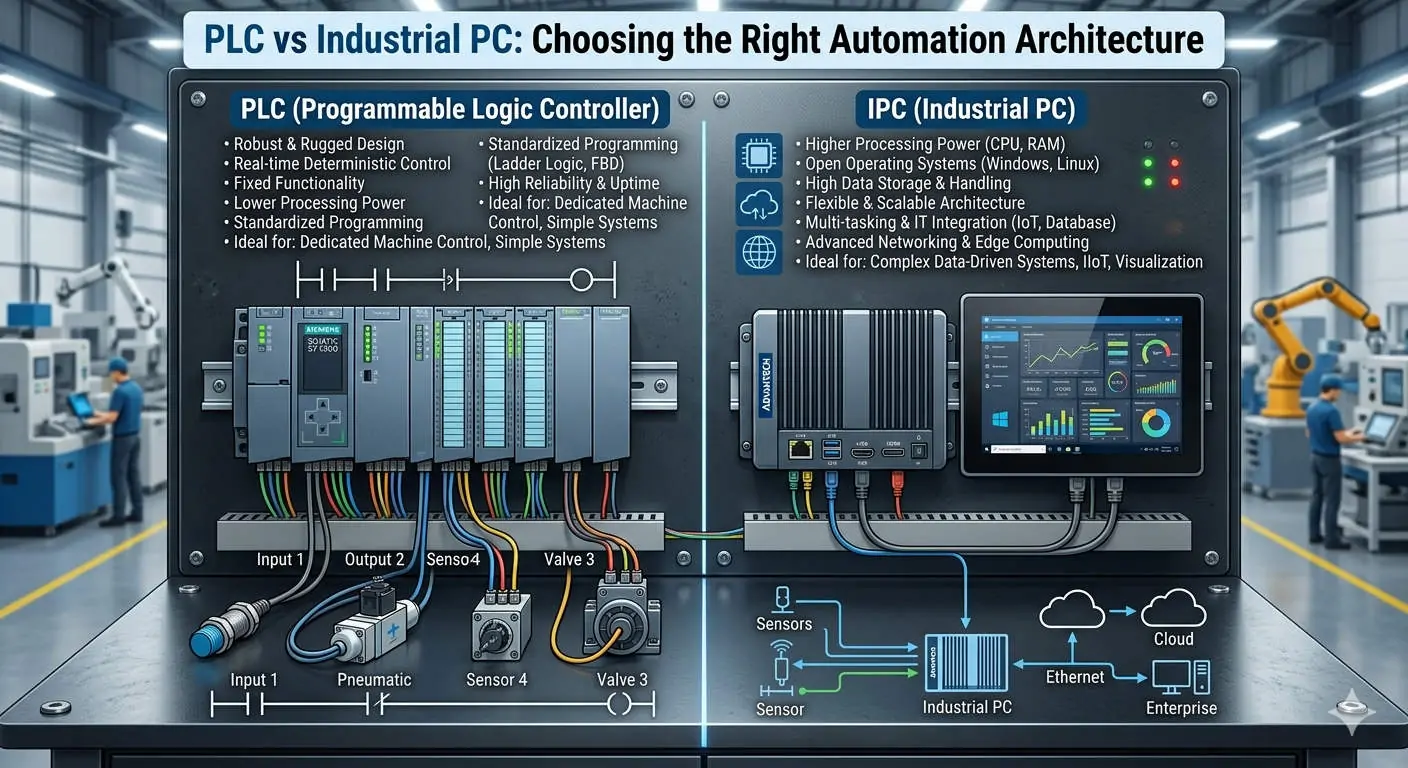
The industrial automation world frequently debates whether Industrial PCs (IPCs) will eventually render Programmable Logic Controllers (PLCs) obsolete. This discussion centers on the balance between deterministic reliability and computational flexibility. While IPCs offer superior processing power, PLCs remain the gold standard for real-time, mission-critical tasks in harsh environments. At PLC Pioneer, we believe the future lies in hybrid architectures rather than total replacement.
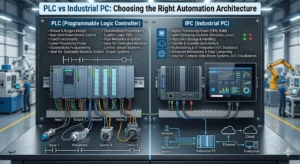
The Necessity of Real-Time Determinism in Control Systems
PLCs excel at “hard” real-time control with predictable scan cycles, typically ranging from 1 to 10 milliseconds. This consistency ensures that logic executes accurately regardless of the system’s secondary processing load. In contrast, IPCs may experience latency jitter due to background OS tasks or driver interruptions. For high-speed packaging or turbine regulation, even a microsecond drift can cause mechanical misalignment or safety shutdowns.
Industrial Grade Durability: Surviving Harsh Environments
Engineers design PLCs to meet rigorous standards like IEC 61131-2 and IEC 61000 for electromagnetic compatibility. These devices operate reliably between -20°C and +60°C while resisting high vibration and electrical noise. Most IPCs require expensive specialized enclosures to achieve similar resilience. In a refinery or offshore platform, a standard PLC often lasts 15 years, whereas IPC hardware typically requires a refresh every 5 years.
IT/OT Convergence and Protocol Interoperability
Modern IPCs serve as excellent bridges between the factory floor and IT infrastructure. They natively support OPC UA, MQTT, and REST APIs for seamless cloud integration. Meanwhile, PLCs provide robust field-level communication via EtherNet/IP, Profinet, or Modbus TCP. Consequently, the most effective systems use IPCs for data aggregation and AI analytics, while keeping PLCs for direct sensor and actuator control.
Critical Power Protection and Hardware Stability
IPCs are significantly more sensitive to voltage fluctuations than traditional controllers. In petrochemical sites, sudden voltage dips can corrupt IPC databases or interrupt runtime environments. Therefore, you must install IEC 61643 compliant surge protection and a dedicated UPS for any IPC deployment. Isolating these power feeders from high-load industrial equipment prevents costly system crashes and hardware degradation.
Software Lifecycle and Cybersecurity Management
Managing an IPC requires constant OS patching and antivirus updates, which can inadvertently break automation runtimes. For pharmaceutical GMP environments, we recommend “freezing” the OS version once validated. In contrast, PLC firmware is more static and less vulnerable to standard IT-based cyberattacks. Always test software updates in a staging environment before applying them to a live production line.
Expert Commentary by PLC Pioneer
“The industry is not witnessing the death of the PLC, but rather its evolution. We are seeing a move toward ‘Edge Controllers’ that combine the determinism of a PLC with the openness of an IPC. As a professional in the industrial sector, I advise against replacing proven PLC logic with PC-based control for safety-critical interlocks. Use the IPC to empower your data, but let the PLC keep your machines running safely.” — PLC Pioneer
Technical Implementation Checklist
- ✅ Verify Determinism: Use PLCs for any loop requiring a scan time stability of <10ms.
- ⚙️ Environmental Hardening: Ensure IPCs use Solid State Drives (SSD) and fanless cooling in high-dust areas.
- 🔧 Power Security: Always deploy a double-conversion UPS for IPC-based visualization stations.
- 📊 Protocol Bridging: Use industrial gateways to connect legacy Modbus PLCs to modern MQTT brokers.
Frequently Asked Questions
Q: Can an IPC handle the safety requirements of a chemical plant?
While IPCs are powerful, they rarely carry the same SIL (Safety Integrity Level) certifications as dedicated Safety PLCs. For emergency shutdown systems, the industry still relies on redundant, hardware-validated controllers to ensure zero-fail performance.
Q: Why is the hardware lifecycle of a PLC so much longer than an IPC?
PLCs use proprietary, long-availability chipsets designed for decades of service. IPCs rely on commercial-off-the-shelf components that follow the rapid refresh cycles of the computer industry, leading to faster obsolescence.
Q: Is it difficult to integrate legacy PLCs into a new IPC-based data network?
It is manageable but requires careful planning. You must validate whether the legacy PLC’s CPU can handle the increased polling frequency from the IPC without affecting its primary control logic timing.
Application Scenario: Hybrid Architecture in Action
In a modern water treatment facility, PLCs manage the valve timing and chemical dosing with absolute precision. Simultaneously, an IPC gathers data from these controllers to run an AI model that predicts pump failure based on vibration patterns. This hybrid approach ensures that even if the IPC crashes or requires a reboot, the primary water treatment process remains uninterrupted and safe.
If you are planning to modernize your control architecture or need high-reliability hardware for your next project, explore our extensive technical resources and product catalog.
Discover advanced automation solutions at our official site: PLC Pioneer Limited