Open-Source SCADA in Industrial Automation: Balancing Flexibility with Operational Risk
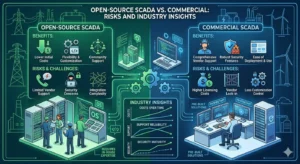
Open-source SCADA platforms offer an appealing alternative to traditional, high-cost proprietary systems. They provide unparalleled flexibility, vendor independence, and a lower initial entry cost for factories and chemical plants. However, long-term operation in mission-critical environments often reveals hidden complexities. For industries like pharmaceuticals and oil & gas, system validation and uptime are not just preferences; they are mandatory requirements for safety and regulatory compliance.
The Critical Reality of Protocol Stability and Interoperability
Many open-source tools claim universal support for industrial protocols like Modbus TCP and OPC UA. In practice, the robustness of these implementations varies significantly across different community versions. PLC Pioneer has observed instances where Modbus polling cycles collapsed once tag counts exceeded 5,000 points. Such failures lead to intermittent data loss and delayed alarms in critical dosing systems. Without certified compliance with the IEC 62541 (OPC UA) standard, you risk serious interoperability issues with mainstream PLC or DCS hardware.
Performance Latency and the Absence of Deterministic Control
Commercial SCADA systems undergo rigorous optimization for deterministic behavior. Conversely, open-source solutions often run on general-purpose Linux or Windows environments without real-time kernel guarantees. In a high-speed packaging line, a 500ms refresh delay can be catastrophic. Operators might react too late to a conveyor jam, directly increasing downtime by nearly 8%. Furthermore, these platforms rarely include native failover mechanisms, shifting the burden of redundancy design entirely onto your internal engineering team.
Cybersecurity Challenges and the IEC 62443 Framework
Security in open-source software relies heavily on community-driven patches. This model often diverges from industrial cybersecurity frameworks like IEC 62443. I have encountered legacy systems where critical OpenSSL vulnerabilities remained unpatched for months because no formal update pipeline existed. Unpatched SCADA servers create a vulnerable bridge between the IT office network and the sensitive PLC control network. Without a dedicated vendor, accountability for security incidents remains a significant gap in your risk management strategy.
Essential Infrastructure: Network Segmentation and Power Protection
Deploying open-source SCADA requires a “Hardened Infrastructure” mindset to succeed. Engineers must implement strict VLAN segmentation and industrial firewalls to isolate the SCADA layer. A robust Demilitarized Zone (DMZ) architecture is essential, particularly for remote monitoring in the oil and gas sector. Additionally, standard industrial PCs lack the ruggedized protection of high-end HMIs. Therefore, you must install double-conversion UPS systems to prevent power dips from corrupting your SCADA databases, which often leads to costly system rebuilds.
Expert Commentary by PLC Pioneer
“In the world of industrial automation, cost is never just about the license fee; it is about the total cost of ownership (TCO). Open-source SCADA isn’t inherently ‘bad,’ but it shifts the risk from the vendor to your engineering team. If your plant lacks a 24/7 software DevOps capability, the savings on licensing will quickly be erased by a single afternoon of unexplained production downtime. Always evaluate the cost of a ‘black box’ failure against your initial budget savings.” — PLC Pioneer
- ✅ Validation Check: Ensure the software supports FDA 21 CFR Part 11 if operating in the pharmaceutical sector.
- ⚙️ Redundancy Strategy: Use virtualization and VM snapshots to manually simulate the failover features missing from the base code.
- 🔧 Hardware Hardening: Never run critical SCADA on consumer-grade hardware; always utilize fanless, industrial-grade PCs.
Frequently Asked Questions (FAQ)
Q: Is open-source SCADA a viable option for a GAMP 5 regulated environment?
Rarely. While the code is flexible, the cost of validating an open-source platform to meet GAMP 5 or FDA standards often exceeds the price of a pre-certified commercial license. Most open-source projects lack the necessary documentation for rigorous audit trails.
Q: Can I use open-source SCADA as a secondary data visualization layer?
This is actually an excellent strategy. By using open-source tools for non-critical “read-only” dashboards while keeping a commercial system for primary control, you can leverage modern web tech without risking plant safety.
Q: How does the “community support” model work during a midnight system crash?
This is the primary risk. Without a Service Level Agreement (SLA), you are dependent on forum responses or your own staff’s expertise. For 24/7 operations, this lack of immediate accountability is often a deal-breaker for plant managers.
Application Scenario: Wastewater Management
In a recent municipal wastewater project, we deployed a hybrid model. We utilized a manual hot-standby VM cluster to host the SCADA environment. By adding custom scripts for database synchronization, we simulated high-availability features usually found in expensive DCS systems. This approach saved on upfront costs but required 120+ additional engineering hours to stabilize—a trade-off every buyer must consider.
If you are navigating the complexities of modern control systems or need reliable hardware to bridge your automation gaps, our team provides the technical expertise you need. Discover our range of industrial solutions and expert guides designed for today’s engineers.
Explore more technical resources and industrial hardware at: PLC Pioneer Limited