Optimizing Modern Industrial Automation: A Deep Dive into Control Room Hardware
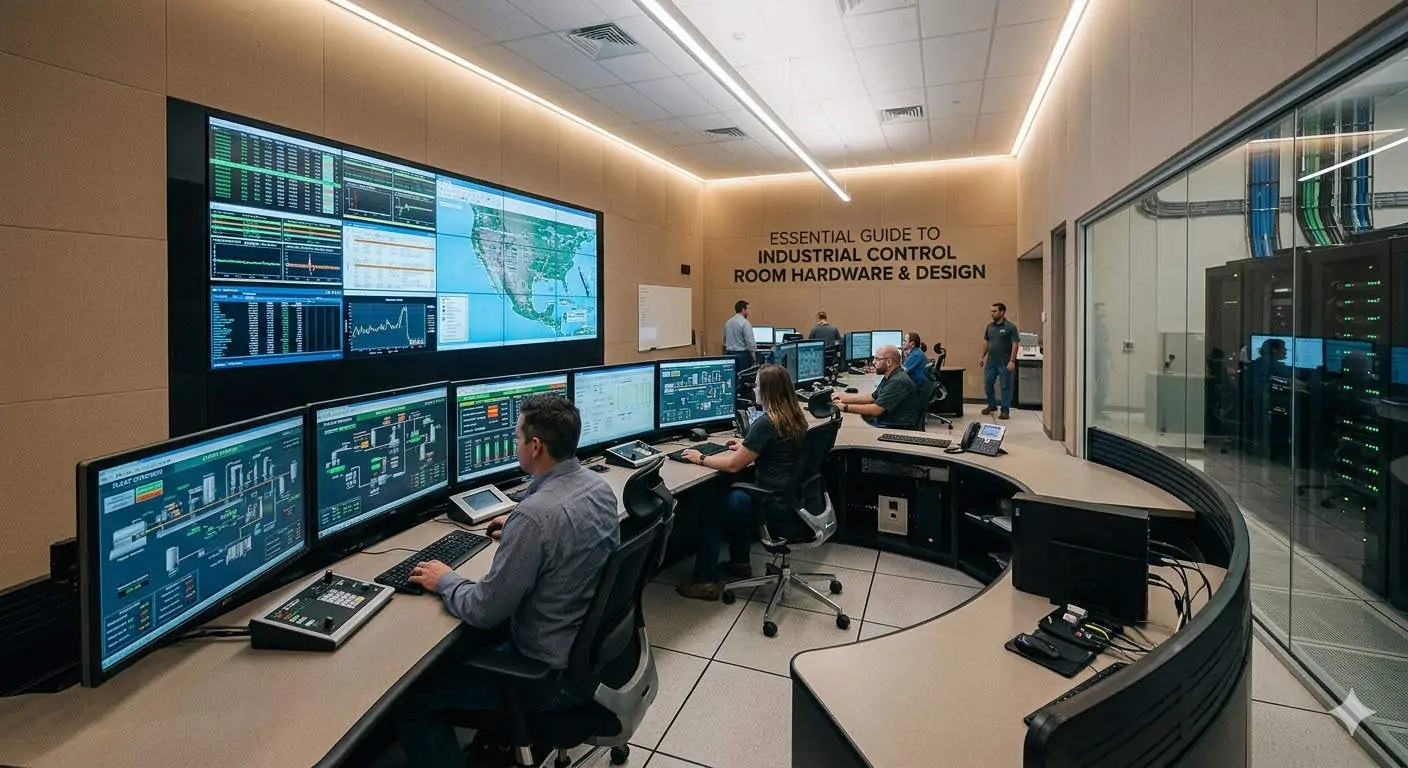
The Central Control Room (CCR) serves as the high-tech nerve center for any sophisticated industrial automation system. It functions as a unified hub where operators oversee, manage, and fine-tune production cycles in real time. By integrating data from field instruments, PLCs, and DCS platforms, the CCR empowers teams to make data-driven decisions while mitigating risks during abnormal process conditions.
The Strategic Value of Centralized Command
In high-stakes sectors like oil and gas or power generation, a centralized control room removes the inefficiencies of manual field intervention. It provides a holistic view of the plant floor, which effectively resolves issues like process drift and delayed emergency responses. Furthermore, a high-quality CCR design ensures full compliance with international safety standards, including IEC 61511 for functional safety and ISA-101 for HMI ergonomics.
Technical Insights: Mastering Latency and System Response
System latency measures the time data takes to travel from field sensors to the operator’s screen. In high-speed chemical reactions or turbine management, delays exceeding 200 ms can compromise safety. Interestingly, hardware performance rarely causes these bottlenecks. Instead, overloaded SCADA servers or unmanaged network switches are usually the culprits. Therefore, we recommend implementing Industrial Ethernet with VLAN segmentation to ensure deterministic, low-latency communication across the facility.
Environmental Resilience and Hardware Longevity
Industrial hardware such as servers and engineering stations must withstand harsh conditions. Sustained ambient temperatures above 35°C can drastically shorten the lifespan of high-end IPCs. We frequently observe retrofit projects where equipment fails because of inadequate HVAC systems near the production zone. To protect your investment, maintain a climate-controlled environment (20–25°C) and utilize UPS systems with isolation transformers to neutralize voltage spikes and harmonics.
Protocol Compatibility in the Industry 4.0 Era
A modern control room must act as a bridge between legacy hardware and futuristic software. While older PLCs might rely on proprietary serial links, modern systems prioritize OPC UA for its platform-independent security. However, scaling a system often requires careful planning to avoid data silos. If your existing infrastructure uses Modbus or PROFIBUS, you must integrate robust protocol gateways to ensure seamless data flow into your MES or ERP layers.
Best Practices for Installation and Maintenance
- ✅ Advanced Grounding: Use single-point grounding for all control cabinets to eliminate ground loops and signal interference.
- ⚙️ Network Redundancy: Abandon simple daisy-chain setups in favor of Ring Topologies using protocols like MRP or RSTP.
- 🔧 Future-Proofing: Always leave 20–30% of rack space available for future expansion and module upgrades.
- 🛡️ Cybersecurity: Isolate the control network from the office IT network using industrial firewalls to prevent external breaches.
PLC Pioneer’s Expert Commentary
“In my years of field experience, I’ve noticed that engineers often over-invest in server CPUs while neglecting the physical layer. A control room is only as strong as its cables and grounding. As we move deeper into 2026, the focus is shifting toward ‘Human-Centric Design’—ensuring that the hardware supports the operator’s mental workload, not just the machine’s data throughput.” — PLC Pioneer
Control Room Hardware Checklist
A comprehensive automation hub requires a synergy of the following components:
- Operator Workstations: High-performance HMI/SCADA clients for daily monitoring.
- DCS/SCADA Servers: The backbone for data processing, alarm management, and history logging.
- Industrial Networking: Managed switches and routers designed for high-EMI environments.
- Visualization Walls: Large-scale displays for enhanced situational awareness.
- Communication Gateways: Hardware used to translate between Modbus, EtherNet/IP, and OPC UA.
Industrial Automation FAQ
Q: My HMI screens are lagging during peak production. Is this a hardware or software issue?
Usually, it is a network congestion issue. Check the polling rates of your SCADA tags. If the network utilization is above 60%, consider segmenting your traffic with a managed switch to prioritize critical control data over background historian logging.
Q: Can I mix different brands of PLCs in a single control room?
Yes, provided you use a vendor-neutral protocol like OPC UA or an industrial gateway. However, keep in mind that diagnostic capabilities might be more limited compared to using a single-brand ecosystem.
Q: How often should we update firmware on control room servers?
Firmware should follow a strict ‘test-then-deploy’ cycle. Never update live production systems without a backup. We suggest a bi-annual review of security patches, focusing specifically on vulnerabilities identified in your communication protocols.
Solution Scenario: Chemical Plant Modernization
A mid-sized chemical plant recently upgraded its control room by replacing isolated PLC panels with a centralized SCADA server and managed industrial ring. By standardizing on shielded CAT6 cabling and redundant UPS power, they reduced intermittent communication drops by 95%. This transition allowed for centralized alarm management, preventing a major pressure excursion event during their first month of operation.
If you need to source high-reliability components or require expert guidance on your next system upgrade, our team is ready to assist with industry-leading hardware solutions.
Discover more technical resources and premium hardware at: PLC Pioneer Limited