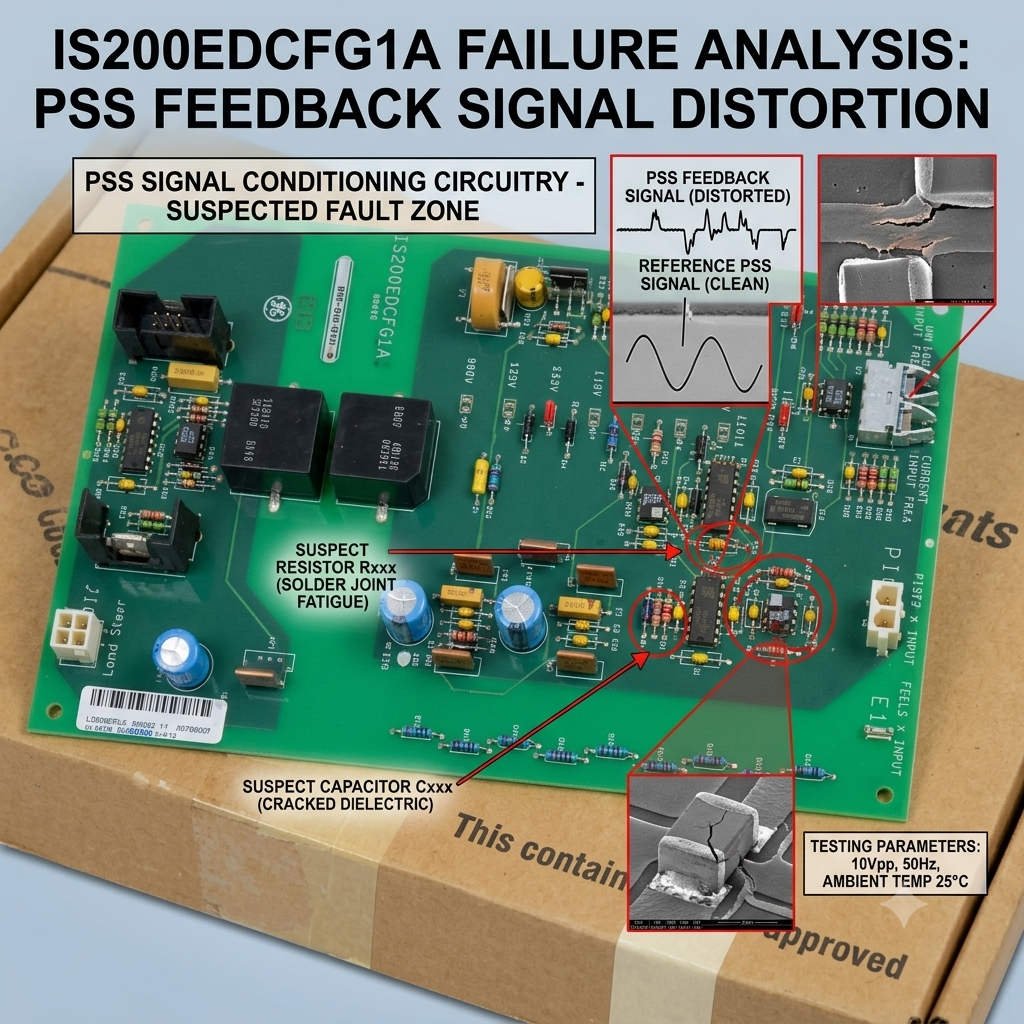
How IS200EDCFG1A Filter Board Capacitor Aging Distorts PSS Feedback Signals
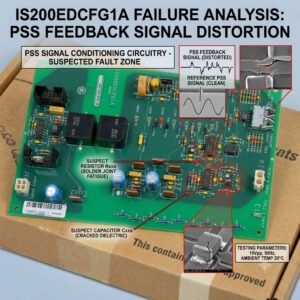
In GE EX2100 excitation systems and Mark VIe control platforms, signal precision dictates turbine stability. However, engineers frequently overlook a critical hardware vulnerability: capacitor degradation on the IS200EDCFG1A DC Coupling/Filter Board. When these components lose capacitance, they alter the active analog filtering matrix. Consequently, this silent decay introduces harmonic distortion into the Power System Stabilizer (PSS) feedback loop.
The Critical Role of Signal Conditioning in Excitation Systems
The IS200EDCFG1A board serves as a front-end signal conditioner within the generator control framework. It filters unwanted high-frequency electrical noise while preserving raw generator feedback dynamics. In large-scale power generation and petrochemical cogeneration plants, a reliable PSS loop dampens low-frequency grid oscillations. Therefore, maintaining filter integrity prevents erratic voltage swings and catastrophic generator hunting.
Altering Frequency Response and Corner Cutoff Points
Aging capacitors inevitably shift the analog filter network corner frequency upward. As a result, the board loses its ability to suppress high-frequency line noise. This component degradation allows high-frequency ripple to infiltrate the core control systems algorithm. Operators then witness ghost fluctuations because the excitation regulator calculates damping factors using corrupted signal inputs.
Phase Shift Impedance and the Breakdown of Damping Logic
Effective power system stabilization relies entirely on precise phase synchronization between rotor movement and electrical feedback variables. Unfortunately, a failing capacitor alters circuit impedance and injects unexpected phase lag. This delay causes the control loop to misidentify or late-detect critical system oscillations. Ultimately, the excitation system fails to provide adequate counter-torque, threatening grid compliance standards like IEEE 1110.
Thermal Degradation and the Mystery of Invisible Failures
Industrial control cabinets operating above 50°C suffer from accelerated electrolyte evaporation. This thermal stress drives up Equivalent Series Resistance (ESR) while driving down total capacitance. In my fieldwork at PLC Pioneer, I frequently see aged capacitors that pass visual inspection without bulging or leaking. Nevertheless, their internal electrical properties have degraded far past acceptable OEM manufacturing tolerances.
Implementing Preventative Maintenance Protocols During Plant Outages
Relying on standard software diagnostics will not expose physical circuit deterioration. Maintenance teams must execute comprehensive bench testing during scheduled plant shutdowns. You must utilize dedicated LCR meters to measure both true capacitance and ESR value. Moreover, establishing a thermal imaging schedule for the control panel helps identify hotspot areas before components fail completely.
Selecting Reliable Replacements and Navigating Vendor Lock-in
When refurbishing the IS200EDCFG1A filter board, circuit component matching remains absolutely vital. Substituting generic commercial-grade capacitors can compromise the specialized low-pass filtering performance. Always ensure that replacement parts match original engineering specifications regarding temperature ratings and tolerance limits. Additionally, cross-reference your specific control system firmware version to confirm total hardware interoperability.
—
Engineering Checklist for Signal Integrity Optimization
- ✅ Verify Component ESR: Measure internal resistance during every major turnaround to catch early-stage failures.
- ⚙️ Enforce Cabinet Airflow: Clean cooling fans and check heat exchangers to prevent localized heat accumulation.
- 🔧 Isolate Analog Circuits: Verify that shielding and grounding follow standard industrial automation wiring guidelines.
- 📊 Log Oscillation Trends: Track unexplained voltage ripple changes within your DCS historian database.
—
PLC Pioneer’s Technical Insight and Commentary
“Throughout years of auditing power plant control systems, I have observed teams spend weeks adjusting software tuning parameters when the real culprit was simply a worn-out analog filter circuit. As factory automation moves toward more sensitive, high-speed architectures in 2026, understanding hardware-level degradation is paramount. Do not blame your control algorithm when your sensor data is fundamentally skewed by a dry electrolytic capacitor.” — PLC Pioneer
Frequently Asked Questions
Q: Can tuning software parameters compensate for a degraded analog filter circuit?
No, software calibration cannot fix physical phase lag or high-frequency noise infiltration caused by faulty hardware. Attempting to tune past hardware component flaws often destabilizes other operating points across your generator performance curve.
Q: Why do these specific filter boards degrade faster in continuous load cycling operations?
Continuous load cycling creates thermal expansion cycles within the control enclosure. This repetitive thermal cycling accelerates the breakdown of the capacitor dielectric material, raising ESR values much faster than steady-state baseline operations.
Q: What is the optimal replacement interval for boards deployed in high-temperature environments?
If cabinet temperatures consistently exceed 45°C, we advise benchmarking component health every 3 to 5 years. Total board refurbishment or proactive replacement prevents unexpected tripping during critical peak-load production periods.
—
Real-World Scenario: Resolving Chronic Voltage Fluctuations
A combined-cycle power plant experienced intermittent megawatt oscillations that baffled their engineering team for months. Traditional PLC and DCS troubleshooting paths revealed no software anomalies. After extracting the filter board, bench testing confirmed that three critical capacitors had lost 40% of their original capacity. Replacing the board completely restored loop stability, preventing a costly forced shutdown.
If you are experiencing persistent loop instability or require certified hardware solutions to keep your industrial control infrastructure running efficiently, explore our extensive inventory of field-tested components.
Discover expert technical support and premium hardware replacements at our hub: PLC Pioneer Limited