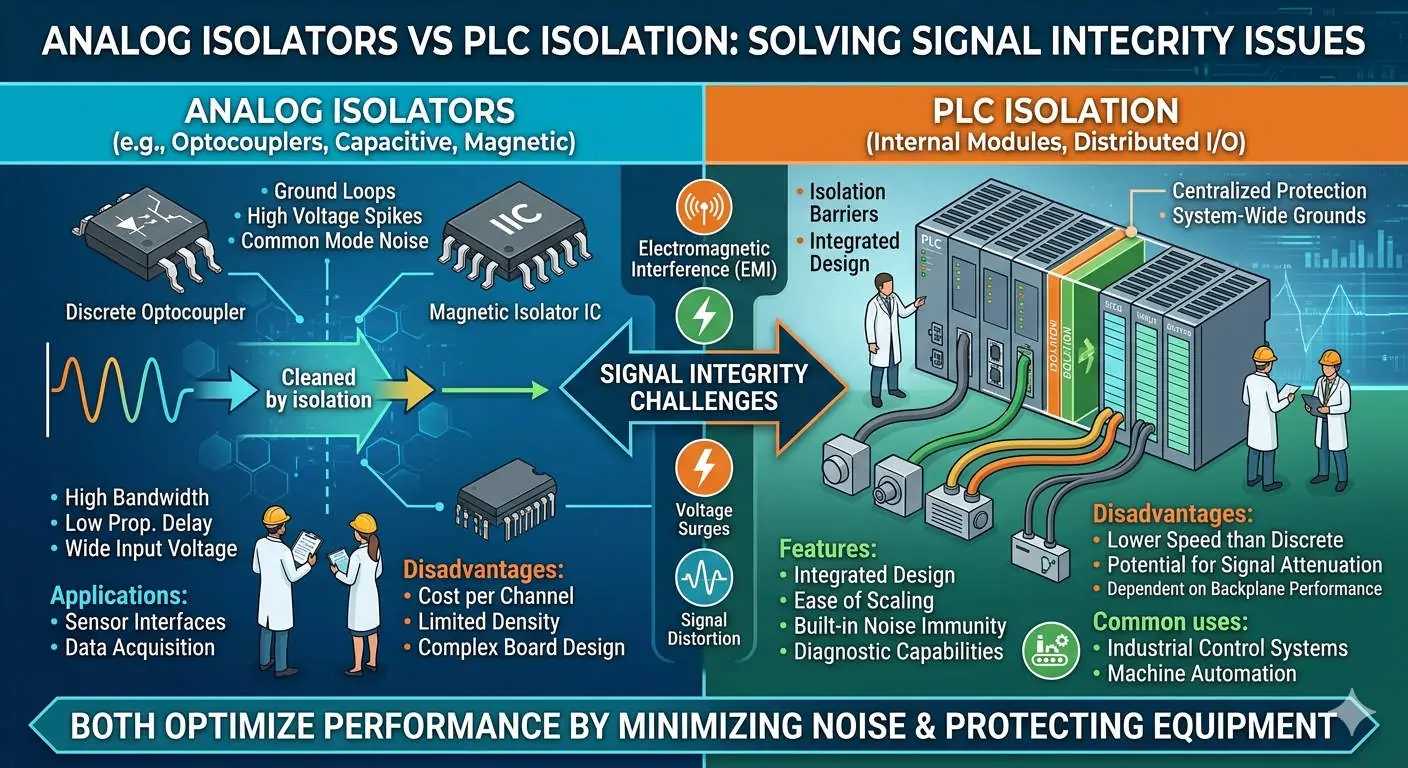
Optimizing Signal Integrity: External Analog Isolators vs. PLC Internal Isolation
Reliable signal transmission is the backbone of modern industrial automation. While many engineers rely solely on the built-in protection of a Programmable Logic Controller (PLC) or Distributed Control System (DCS), complex environments often demand more. External analog signal isolators and internal PLC isolation address different layers of electrical interference. Choosing the right combination ensures system stability and prevents costly downtime in demanding sectors like oil and gas or chemical processing.
The Vital Role of High Isolation Voltage
Isolation voltage measures the electrical stress a device withstands between its input, output, and power circuits. In large-scale refineries or plants with distributed grounding, potential differences between the field and the control room can reach dangerous levels during a fault. PLC internal isolation usually protects the backplane or module-level circuits rather than the specific field wiring. Therefore, adding an external isolator with a rating of 2.5kV or higher creates a robust barrier. This prevents transient surges from causing analog input drift or permanent hardware destruction.
Managing Response Time for Precision Control
Response time dictates how fast a signal travels from the sensor to the controller. While a 10ms delay rarely impacts slow processes like tank levels, it can destabilize high-speed flow control loops. PLC Pioneer notes that cumulative lag is a common hidden issue. When engineers daisy-chain multiple signal conditioners, the resulting delay may trigger PID loop oscillations. For critical dosing systems, you should prioritize isolators with response times under 1ms to maintain tight process synchronization.
Ensuring Accuracy and Reducing Thermal Drift
Precision is mandatory in pharmaceutical and batch manufacturing. Unlike internal PLC circuits that focus on protection, external signal conditioners often provide active linearization and filtering. High-quality isolators minimize temperature drift, ensuring the 4–20 mA signal remains accurate across varying ambient conditions. Without these components, hidden calibration errors can lead to out-of-spec production batches. Investing in superior hardware from brands like Phoenix Contact or Weidmüller often pays for itself through reduced maintenance and higher yield.
Strategic Grounding and Surge Protection
Even the best hardware fails if the grounding strategy is flawed. You must implement single-point grounding for signal shields to avoid ground loops. Field experience shows that intermittent fluctuations in 200m cable runs are almost always traced back to multiple grounding points. Furthermore, internal PLC specs for “isolated inputs” rarely account for lightning transients. In outdoor installations, always pair your isolators with dedicated Surge Protection Devices (SPD) compliant with IEC 61643 standards to safeguard against atmospheric electrical strikes.
Reliable Wiring in High-Vibration Zones
Mechanical reliability is just as important as electrical specs. In environments with rotating equipment, traditional bare-wire connections often loosen over time. We recommend using spring-clamp terminals or ferrules combined with proper cable strain relief. This simple step prevents signal loss caused by vibration. Periodically checking terminal torque is a best practice that prevents the “intermittent signal” headaches that plague many industrial sites.
PLC Pioneer’s Engineering Perspective
In my experience at PLC Pioneer, I have seen countless modules fried because “internal isolation” was treated as a total solution. It is not. Internal isolation is a last line of defense for the CPU; external isolators are your frontline infantry. For any cable run exceeding 30 meters or systems operating near high-EMI sources like Variable Frequency Drives (VFDs), the external barrier is a technical necessity, not an optional add-on.
Key Technical Requirements Checklist
- ✅ Isolation Rating: Minimum 2.5kV for hazardous or outdoor areas.
- ✅ Signal Compatibility: Ensure impedance matching between active and passive loops.
- ✅ Standards Compliance: Verify IEC 61010 and IEC 61326 certifications.
- ✅ Response Speed: Aim for <1ms for high-speed PID applications.
- ✅ Physical Protection: Use IP20 rated enclosures with spring terminals in high-vibration zones.
Application Scenario: Chemical Dosing Pump Control
In a recent chemical plant upgrade, the 4–20 mA feedback from a flowmeter was erratic whenever the primary 50HP motor started. Although the PLC module was “isolated,” the ground potential shift was too great. By installing an external 4-way isolator near the PLC cabinet and utilizing a single-point shield ground, the signal noise was eliminated instantly. This setup protected the expensive PLC analog card and ensured the dosing accuracy remained within 0.1%.
Frequently Asked Questions (FAQ)
Q: Can I use a signal isolator to convert signal types simultaneously?
Yes. Many modern conditioners are multifunctional, allowing you to input a 0–10V signal and output a 4–20 mA loop to the PLC. This simplifies inventory and provides the necessary electrical barrier.
Q: Why does my PLC show a “Channel Error” after adding an isolator?
This usually stems from an impedance mismatch or a power loop conflict. Ensure you aren’t trying to “double-power” a loop where both the PLC card and the isolator are providing excitation voltage.
: Is it worth the cost to isolate every channel?
For critical safety loops and long-distance field runs, yes. However, for digital inputs or short-range signals within the same cabinet, module-level isolation is typically sufficient.
Looking for high-performance automation components or expert technical advice? Visit PLC Pioneer Limited to explore our full range of industrial control solutions and legacy hardware support.