Optimizing Industrial Precision: A Deep Dive into PLC Analog Module Resolution
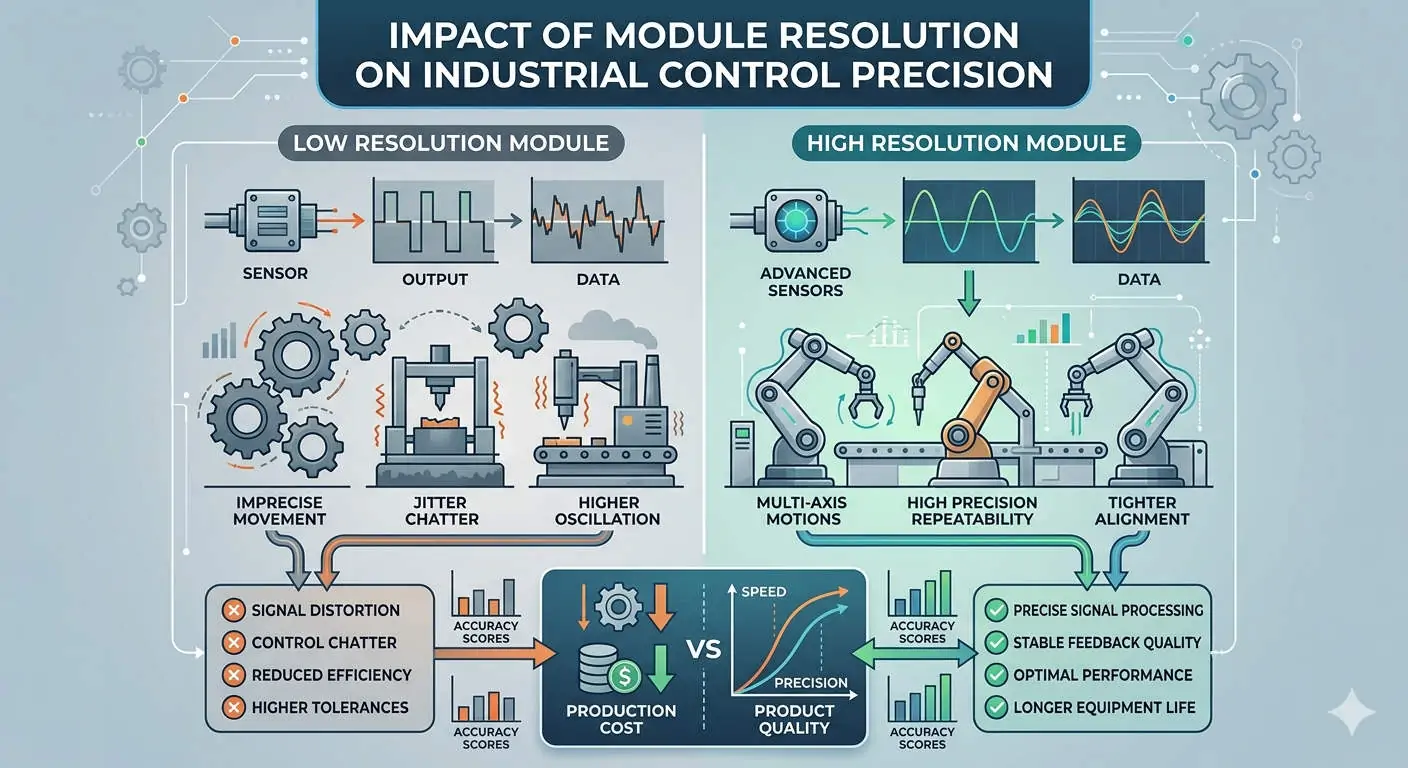
In the world of industrial automation, the resolution of analog input and output modules dictates how accurately a system interprets physical reality. Whether you are measuring pressure, temperature, or flow, the bit depth—12-bit, 14-bit, or 16-bit—determines the granularity of the digital signal. Higher resolution enables tighter PID control and improved product consistency, which is vital for high-yield manufacturing in pharmaceutical and chemical sectors.

Understanding Bit Depth and Effective Measurement Accuracy
Resolution represents the number of discrete steps a module can recognize. A 12-bit module offers 4,096 steps, while a 16-bit module provides a massive 65,536 steps. In a standard 0–10V signal range, this translates to a jump from 2.44 mV per step down to just 0.15 mV. However, theoretical precision often clashes with real-world constraints. If your field sensors only offer ±0.5% accuracy, a 16-bit module cannot magically improve the raw data quality. Therefore, you must match your module specifications to your instrument capabilities.
The Hidden Relationship Between Resolution and Noise Sensitivity
A common misconception is that higher resolution always results in a better signal. In fact, 16-bit modules are significantly more sensitive to electromagnetic interference (EMI). In heavy industrial environments, electrical noise from variable frequency drives (VFDs) can cause 16-bit signals to jitter. While a 12-bit module might appear stable because it ignores micro-fluctuations, a high-resolution module will capture every bit of noise. Consequently, 16-bit systems require superior engineering, including shielded cables and dedicated signal isolators.
Enhancing PID Control Loop Performance
Beyond simple measurement, resolution profoundly affects control smoothness. Low-resolution modules often introduce “step-like” behavior in actuators. For example, in a thermal reactor loop, 12-bit control may cause noticeable valve stepping, leading to mechanical wear. Conversely, 16-bit systems allow for finer tuning and smoother modulation. As a result, you achieve longer equipment life and reduced process oscillation, especially in slow-acting loops like temperature regulation.
Critical Installation Standards for High-Precision Systems
Improper grounding remains the most frequent cause of failure in 14-bit and 16-bit deployments. At PLC Pioneer, we often see ground loops caused by shielding grounded at both ends. This interference can render a high-resolution upgrade useless. To ensure stability, ground your shields at the control cabinet side only. Additionally, maintain a distance of at least 20 cm between analog signal lines and high-voltage power cables to prevent crosstalk.
Strategic Selection: Avoiding Over-Specification
In harsh environments like steel mills, a 12-bit module is often the more reliable choice. Installing high-precision modules without proper signal conditioning usually leads to frequent maintenance complaints. If your process does not require surgical precision, stick to robust 12-bit or 14-bit hardware. For long cable runs exceeding 30 meters, always prioritize 4–20 mA current loops over voltage signals to leverage better noise immunity.
PLC Pioneer’s Expert Commentary
“Many engineers fall into the trap of ‘spec-chasing’ by choosing 16-bit modules for every application. However, true expertise lies in understanding the entire signal chain. A perfectly grounded 12-bit system will consistently outperform a poorly shielded 16-bit installation. In 2026, the focus should be on signal integrity and E-E-A-T principles—ensuring that your data is not just precise, but trustworthy.” — PLC Pioneer
Expert Troubleshooting & FAQ
Q: Why does my 16-bit input value fluctuate even when the process is steady?
This is likely due to common-mode noise or ground loops. High-resolution ADCs pick up millivolt-level interference that lower-bit modules ignore. Check your cable shielding and consider adding a low-pass filter in your PLC logic to stabilize the reading.
Q: Will upgrading to a 16-bit module require rewriting my PLC program?
Yes, typically. The scaling registers will change (e.g., 0–4095 vs. 0–65535). You must update your scaling blocks, alarm setpoints, and HMI tags to reflect the new data range to avoid calculation errors.
Q: Can I use 16-bit modules with standard unshielded wiring?
It is highly discouraged. Unshielded wires act as antennas for factory noise. For 16-bit precision, you must use high-quality twisted-pair shielded cables to maintain the effective number of bits (ENOB).
Solution Scenario: Precision Chemical Dosing
- ✅ The Challenge: A chemical plant struggled with inconsistent pH levels due to “chunky” additive dosing.
- ⚙️ The Fix: We replaced 12-bit output cards with 16-bit modules and implemented 4–20 mA signal isolators.
- 🔧 The Result: Dosing valve resolution improved by 16x, reducing chemical waste by 8% and stabilizing the pH curve.
For more technical insights or to source high-performance analog hardware for your next project, visit our resource center.
Explore our full range of automation solutions: PLC Pioneer Limited