
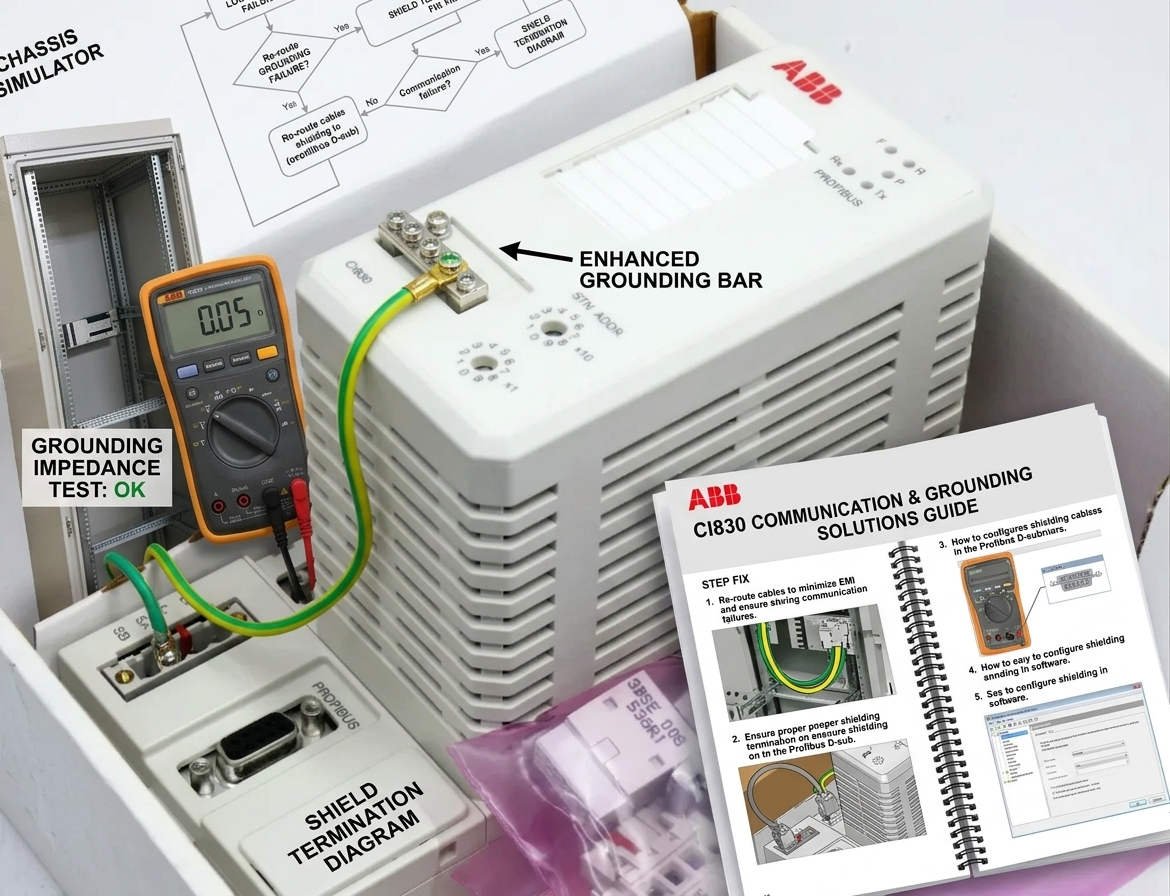
Troubleshooting ABB CI830 Timeout Errors: Practical Field Solutions for CS31 Networks
The ABB CI830 communication interface module connects the ABB AC 800M control system to the CS31 remote I/O network. However, site technicians frequently encounter persistent Timeout Errors on this module. This communication failure disrupts data exchange between the master controller and remote units. As a result, operators experience signal refreshing delays, interlocking failures, or even unexpected plant shutdowns.

The Operational Impact of Communication Failures in Continuous Processes
In continuous manufacturing sectors like petrochemicals, pharmaceuticals, and water treatment, CS31 fieldbuses often span hundreds of meters. These environments contain heavy interference sources like Variable Frequency Drives (VFDs) and high-power switching gear. Therefore, communication timeouts directly threaten system availability. Engineers must understand that a Timeout Error usually signals a physical layer problem rather than a faulty hardware module.
Mitigating Signal Reflection Through Correct Termination Resistance
The CS31 fieldbus relies on differential transmission, which requires precise impedance matching. When engineers expand or repair a network, they often misconfigure termination resistors. Missing resistors cause signal reflection at the end of the bus line. This reflection distorts data frames and increases CRC verification failures. Consequently, the master station triggers intermittent Timeout Errors, particularly during peak electrical load periods.
Field Experience on Bus Impedance in S500 I/O Expansions
During a recent chemical plant expansion, contractors added two new S500 I/O stations and extended the bus by 300 meters. However, the installation team forgot to relocate the termination resistor to the true end of the line. The system ran smoothly during day shifts but threw massive Timeout Errors at night when large VFDs started up. At PLC Pioneer, we resolved the issue immediately by placing the resistors correctly.
Handling Electromagnetic Interference with Proper Grounding Standards
While ABB designs the CI830 with robust electromagnetic compatibility, poor field wiring easily compromises system integrity. Common errors include floating shields, multiple-point grounding, and terminating the shield to the instrument ground instead of the protective earth (PE). These mistakes allow common-mode noise from contactors and UPS systems to penetrate the communication lines, causing elusive, intermittent errors that defy easy diagnosis.
Implementing the Ideal Shielding Policy for Long-Distance B2B Networks
Engineers should follow the IEC 61000 standards and use shielded twisted-pair cables for all CS31 networks. Maintain shield continuity across all junction boxes and implement a single-ended grounding strategy at the control cabinet side. This approach effectively prevents harmful ground loop currents. However, if your factory automation network exceeds 500 meters, you must perform a comprehensive equipotential bonding assessment rather than blindly copying standard rules.
Understanding the Correlation Between Polling Cycles and Control Quality
The CI830 utilizes a fixed polling mechanism to refresh data from remote I/O nodes. When physical layer quality degrades, the system increases its communication retry count. This extension of the effective refresh cycle eventually triggers the timeout threshold. For critical applications like PID regulation loops and safety interlocks, increased latency reduces control accuracy and delays valve responses, turning minor communication drops into operational hazards.
Practical Installation and Maintenance Checklist
- ✅ Verify Resistor Locations: Ensure termination resistors sit only at the physical start and end of the CS31 network.
- ⚙️ Enforce Cable Separation: Keep communication cables at least 300mm away from 380V power lines and 500mm away from VFD outputs.
- 🔧 Perform Orthogonal Crossings: Route communication and power cables at 90-degree angles if they must intersect.
- 📊 Combat Ground Oxidation: Clean PE copper bars and tighten shielding clamps during annual maintenance shutdowns to eliminate oxidation.
PLC Pioneer’s Expert Commentary
“Many field engineers instinctively replace the CI830 module when troubleshooting persistent communication timeouts. In our extensive field experience, however, over 70% of these errors stem from simple physical layer oversights like ground degradation or missing termination. In 2026, as industrial control systems demand higher data throughput, maintaining physical layer integrity is far more cost-effective than repeatedly changing perfectly good hardware.” — PLC Pioneer
Industrial Automation Hardware FAQ
Q: Why does a CS31 network that ran perfectly for five years suddenly start throwing timeout alarms?
This phenomenon usually points to environmental degradation rather than hardware failure. Over several years, protective earth copper bars oxidize and shielding clamps loosen due to machine vibration. This increases ground impedance and allows electrical noise to corrupt the signal data. Annual physical inspection prevents these seasonal communication drops.
Q: Can we upgrade the main PLC processor without replacing the old fieldbus cabling infrastructure?
You can retain the existing CS31 architecture if the cable testing records show healthy insulation resistance. However, aging cables and brittle terminal blocks often become the weakest link in upgraded systems. We highly recommend mapping out a long-term network migration plan alongside your processor upgrade to guarantee reliability.
Q: What is the fastest method to verify total bus health using basic diagnostic tools?
Power down the entire network and measure the resistance across the differential data lines using a standard multimeter. A properly configured CS31 network should read approximately 60 ohms, representing two 120-ohm termination resistors in parallel. Any reading near 120 ohms or below 40 ohms indicates a critical termination error.
Application Scenario: Resolving Intermittent Faults in a Pumping Station
A water treatment plant experienced random CI830 drops whenever the main effluent pumps ramped down. Technicians originally blamed the communication module software. A detailed physical audit revealed that the communication cable ran parallel to the pump power lines inside a shared cable tray. Separating the runs by 400mm and installing a managed industrial switch eliminated the timeout errors permanently, restoring 100% network availability.
If you are experiencing persistent network instability or require high-reliability components to optimize your legacy industrial networks, discover our technical support solutions and ruggedized fieldbus modules.
Visit our official resource center for technical guides and hardware support: PLC Pioneer Limited