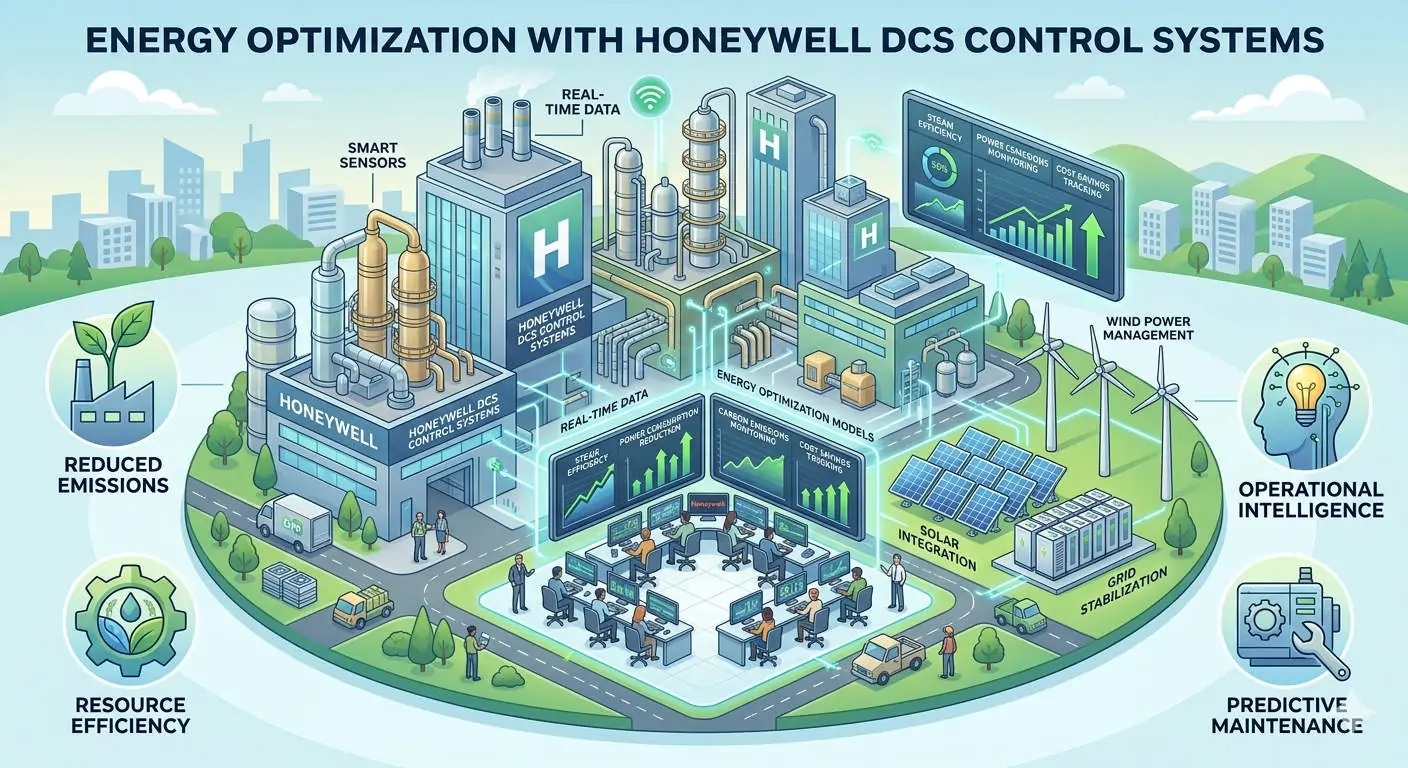
Honeywell DCS: Transforming Process Control into an Energy Intelligence Platform
In the current era of strict carbon neutrality targets, the role of a Distributed Control System (DCS) has evolved. Modern Honeywell DCS solutions now function as comprehensive energy management platforms. These systems integrate load optimization and process control to reduce industrial waste. Consequently, facilities in the oil, gas, and chemical sectors can meet sustainability goals while maintaining production stability.
Strategic Integration for High-Energy Industrial Sectors
Petrochemical and pharmaceutical plants face immense energy demands. A unified control architecture allows operators to correlate energy consumption directly with process variables. Therefore, management can make data-driven decisions rather than reactive adjustments. This integration provides a clear pathway to operational excellence and significant cost savings.
Technical Precision: Scan Times and Energy Data Accuracy
Energy optimization requires high-speed data acquisition. Typically, a Honeywell DCS utilizes scan times between 100 and 500 ms. Fast cycles are essential because steam flow and electricity loads fluctuate rapidly. In my experience at PLC Pioneer, slow scan configurations often miss transient peaks. As a result, factories may struggle with inaccurate energy baselines and flawed optimization strategies.
Seamless Connectivity through Protocol Compatibility
Effective energy management depends on integrating diverse subsystems like VFDs, boilers, and power meters. Leading DCS platforms support various protocols, including Modbus, OPC UA, and EtherNet/IP. However, legacy equipment often lacks support for secure standards like OPC UA. I recommend verifying that all field devices support time-stamped data to ensure the integrity of your energy reports.
Maximizing Uptime via System Redundancy
Continuous data tracking is vital for long-term carbon compliance. Honeywell DCS architectures prioritize availability through redundant controllers and historian servers. Without this redundancy, a single fault can cause gaps in energy records. During one refinery project, a lack of historian redundancy led to a three-day data loss, which complicated regulatory reporting significantly.
Best Practices for Installation and Grounding
Installation errors often undermine energy management projects. For instance, incorrect grounding of power meters frequently causes signal noise. I suggest using a single-point grounding scheme to isolate signal grounds from power grounds. Moreover, proper network segmentation via VLANs prevents data congestion during peak production hours, ensuring real-time dashboard accuracy.
Hardening the System with Surge Protection
Many energy meters operate in electrically harsh environments. If your DCS I/O modules do not include built-in protection, install external Surge Protection Devices (SPD) compliant with IEC 61643. Maintenance teams should check SPD status indicators regularly. Often, protection failure remains invisible until hardware damage occurs, leading to costly downtime.
Core Technical Checklist
- ✅ Verify CPU Load: Ensure controller utilization remains below 70% before adding new energy data points.
- ⚙️ Standard Compliance: Align your historian and analytics setup with ISO 50001 energy management standards.
- 🔧 Secure Integration: Prioritize OPC UA for all new equipment to enhance cybersecurity and data reliability.
- 📊 Infrastructure Check: Use industrial-grade managed switches to segment energy traffic from process traffic.
Expert Commentary by PLC Pioneer
“Transitioning a DCS from a simple control tool to an energy intelligence hub is no longer optional. At PLC Pioneer, we observe that the most successful plants are those that treat energy as a raw material rather than an overhead cost. By leveraging the advanced analytics of systems like Experion PKS, engineers can finally bridge the gap between the boiler room and the boardroom.” — PLC Pioneer
Frequently Asked Questions
Q: Can legacy Honeywell systems handle real-time carbon tracking?
While older systems can integrate via gateways, they often lack the processing power for advanced analytics. For comprehensive carbon compliance, we recommend upgrading to modern controllers that natively support secure data historians.
Q: How does network latency affect energy optimization?
High latency can delay the feedback loop between the energy meter and the control logic. This delay results in suboptimal load shedding and higher peak-demand charges. Dedicated network segments for energy data are highly recommended.
Q: Is it better to use a standalone EMS or a DCS-integrated solution?
DCS-integrated solutions are generally superior because they allow for direct “closed-loop” control. A standalone EMS can monitor waste, but a DCS can automatically adjust process setpoints to prevent it in real-time.
Solution Scenario: Steam Header Optimization
In a large chemical plant, fluctuating steam demand often leads to wasteful venting. By integrating the steam meters directly into the Honeywell DCS, the system can predict demand changes based on batch schedules. This proactive approach reduces steam waste by 12% and significantly lowers the facility’s carbon footprint.
For more technical insights and high-quality automation hardware to support your energy goals, visit our resource center.
Explore our solutions here: PLC Pioneer Limited