Optimizing Lithium Battery Coating: Motion PLC vs. Dedicated Motion Controllers
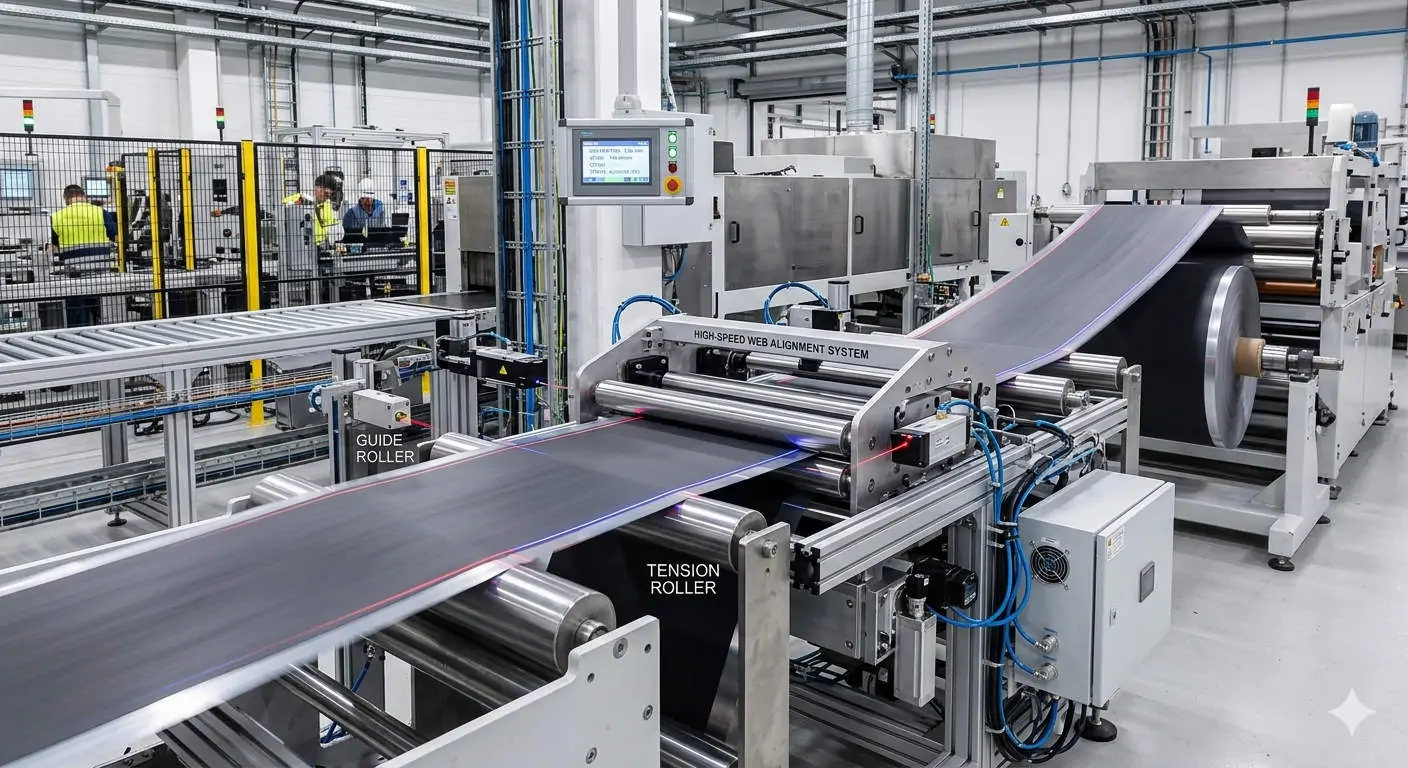
In the high-stakes world of EV battery manufacturing, web alignment precision dictates overall yield and cell consistency. Choosing between a motion-control PLC and a dedicated motion controller is a pivotal technical decision. This choice balances system integration ease against the need for ultra-high-speed synchronization in industrial automation environments.
The Critical Role of Control Cycle Time in High-Speed Coating
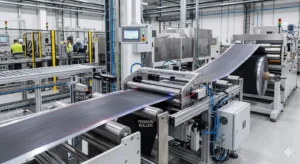
Standard motion-control PLCs typically operate within a 1ms to 4ms cycle time range. However, dedicated motion controllers achieve sub-millisecond or microsecond-level responses. When line speeds exceed 80 meters per minute, even a slight delay causes edge drift or misalignment. Therefore, high-speed lines require the tighter coordination that only a dedicated controller can provide effectively.
Advanced Multi-Axis Synchronization for Superior Coating Quality
Uniform coating thickness requires perfect synchronization between unwinding, coating heads, and rewinding sections. While modern PLCs handle basic motion tasks, dedicated controllers excel in complex electronic camming and interpolation. Moreover, any synchronization jitter directly introduces micro-wrinkles or uneven thickness. This mechanical harmony is essential for meeting rigorous energy storage and electric vehicle process standards.
Communication Protocols and Sensor Feedback Latency
Most industrial control systems now utilize EtherCAT, PROFINET, or Modbus TCP for data exchange. Dedicated motion controllers often optimize internal buses specifically for EtherCAT to minimize sensor feedback latency. Consequently, integrating high-speed CCD or ultrasonic edge sensors becomes more reliable. However, engineers must verify compatibility when retrofitting legacy lines to avoid complex gateway failures.
Mitigating Signal Interference and Mechanical Vibration
Lithium battery plants house high-power drying ovens and heavy motors that generate significant electromagnetic interference. As a result, poor grounding often causes edge deviation oscillation rather than controller logic errors. Additionally, mechanical resonance in encoder brackets can simulate control instability. We recommend using shielded twisted-pair cables and flexible couplings to ensure signal integrity across the factory floor.
Ensuring Power Quality and Surge Protection
Precision motion hardware is highly sensitive to voltage fluctuations and power surges. If your chosen controller lacks built-in protection, installing an external Surge Protective Device (SPD) is mandatory. Furthermore, utilizing an industrial-grade UPS for control circuits prevents data corruption during unexpected outages. Protecting your hardware investment is just as important as the code running on it.
Implementation Checklist for Alignment Systems
- ✅ Protocol Audit: Confirm if your sensors and drives support EtherCAT for sub-millisecond synchronization.
- ⚙️ Grounding Precision: Implement single-point grounding to eliminate high-frequency noise in alignment signals.
- 🔧 Mechanical Stability: Inspect encoder brackets for resonance to prevent false feedback readings.
- 📊 Network Segregation: Keep motion bus traffic isolated from general factory IT data to maintain deterministic timing.
PLC Pioneer’s Expert Commentary
“In my professional experience, the most common mistake in battery line upgrades is underestimating protocol mismatch. A motion PLC is often sufficient for retrofits where ease of maintenance is king. However, for new Tier-1 EV production lines, the ‘precision ceiling’ of a dedicated controller is a necessary investment. At PLC Pioneer, we advocate for choosing the platform that aligns with your 5-year production target, not just today’s speed.” — PLC Pioneer
Frequently Asked Questions
Q: How do I identify if my alignment issues are electrical or logical?
Perform a ‘static run’ test. If the edge position fluctuates while the web is stationary but the motors are energized, the culprit is likely electromagnetic interference (EMI) or poor grounding rather than your PID loop settings.
Q: Can a Motion PLC handle closed-loop Tension + EPC integration?
Yes, provided the line speed remains moderate. For speeds under 60m/min, the processing power of a modern high-end PLC is usually enough to manage both tension control and Edge Position Control (EPC) simultaneously.
Q: What is the biggest risk when replacing an old controller with a newer model?
Firmware architecture changes. Even within the same brand, newer motion blocks may handle acceleration ramps differently, which can snap fragile battery foils during startup if not meticulously tuned.
Application Scenario: The EV Battery Foil Solution
Consider a high-speed anode coating line experiencing ±0.5mm deviation. By transitioning from a standard PLC to a dedicated EtherCAT motion controller, the manufacturer reduced jitter to ±0.1mm. This upgrade improved coating consistency and significantly lowered the scrap rate during high-volume production runs.
To optimize your battery production line or source high-precision motion modules for your next project, explore our technical archives and hardware inventory.
Find the right automation hardware and technical support here: PLC Pioneer Limited