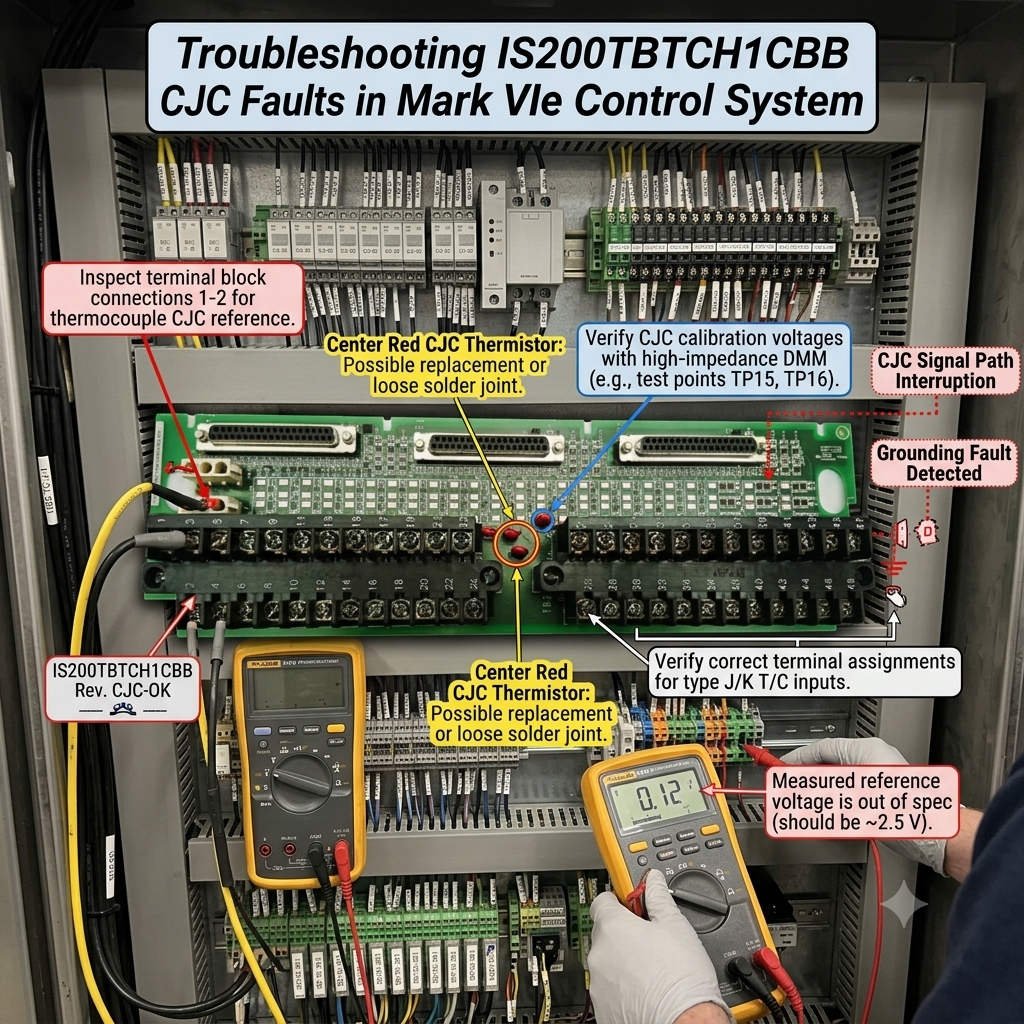
Troubleshooting IS200TBTCH1CBB CJC Sensor Faults in GE Mark VIe Control Systems
The GE Mark VIe control platform relies heavily on the IS200TBTCH1CBB thermocouple terminal board for precise temperature data acquisition. This critical component manages heavy-duty thermocouple signals and provides cold junction compensation (CJC) across gas turbine and generator systems. However, a sudden breakdown in the onboard reference circuit can compromise critical thermal protection loops and cause severe operational instability.
Understanding the Critical Role of Cold Junction Compensation
Thermocouples naturally evaluate relative voltage differentials rather than absolute temperature values at the point of measurement. Therefore, the control system requires an accurate local baseline temperature to determine the true process variables. When the reference circuit on the IS200TBTCH1CBB breaks down, it introduces a systematic measurement error across all connected sensors. Consequently, plants may experience false exhaust temperature trips, unstable combustion tuning, or unexpected hardware shutdowns.
Analyzing Controller Diagnostic Behavior and Firmware Dependencies
The distributed control system (DCS) continuously interrogates the input board to evaluate hardware health and channel integrity. When a hardware failure damages the onboard sensor chip, the system transmits error logs to the central controller. However, the system does not utilize a single, universal alarm code across all automation platforms. The exact identifier depends strictly on your firmware revision, ToolboxST software release, and your specific I/O pack configuration.
Identifying Common ToolboxST System Alarms in the Field
Field engineers frequently encounter diverse alarm texts when an integrated circuit fails on an active hardware module. ToolboxST typically flags these issues under descriptions such as “Cold Junction Compensation Fault” or “CJC Temperature Out Of Range.” Moreover, you may observe “Analog Input Hardware Fault” or generic board diagnostic mismatches within your controller station. To pinpoint the issue, engineers must cross-reference live input statuses against active software database definitions.
Field Verification: Thermocouple vs. Reference Board Failures
During routine maintenance or urgent troubleshooting, you must quickly distinguish individual probe failures from systemic circuit defects. A single broken thermocouple typically disrupts only one specific input channel on the terminal strip. In contrast, a degraded baseline sensor impacts every connected channel simultaneously, causing a uniform temperature drift. Our engineering team at PLC Pioneer highly recommends using a calibrated handheld millivolt simulator to isolate these faults rapidly.
Preventative Maintenance Strategies for High-Interference Environments
Harsh industrial environments often expose sensitive electronic components to high humidity, corrosive chemicals, and extreme ambient temperatures. Over time, moisture ingress accelerates terminal oxidation and weakens the delicate conformal coating on the printed circuit board. Therefore, plant operators must ensure adequate cabinet ventilation, clean air filters, and robust electrical grounding. Furthermore, installing dedicated surge suppressors shields the control hardware from destructive voltage spikes.
—
Maintenance Checklist & Technical Insights
- ✅ Verify System Offsets: Compare multiple thermocouple readouts simultaneously to check for uniform mathematical drift.
- ⚙️ Examine Physical Paths: Inspect terminal strips regularly for signs of severe corrosion or chemical oxidation.
- 🔧 Control Cabinet Climate: Maintain internal enclosure temperatures well within the original equipment design specifications.
- 📊 Confirm Suffix Compatibility: Always verify hardware revision suffixes against the official replacement matrix before swapping modules.
—
PLC Pioneer’s Expert Commentary
“In our extensive field experience with GE speedtronic and excitation systems, technicians frequently waste valuable hours replacing healthy thermocouples when the real culprit is a drifting reference sensor. In 2026, maintaining rigid spare parts compatibility is more critical than ever. Swapping a terminal board without cross-checking the firmware baseline in ToolboxST often triggers unexpected communication mismatches. Always isolate your hardware before executing a replacement.” — PLC Pioneer
Frequently Asked Questions
Q: How do we diagnose an intermittent reference problem before it triggers a full turbine trip?
We recommend setting up historical trend logging for the internal cabinet temperature alongside the average thermocouple readings. If the calculated baseline values begin to fluctuate independently of actual room conditions, the reference chip is likely degrading and requires immediate replacement.
Q: Can we calibrate out a minor temperature variation directly inside the software configuration?
No, attempting to apply software offsets to a physically failing reference component violates standard power generation safety guidelines. A damaged integrated circuit behaves non-linearly over time, which eventually leads to unpredictable control loops and unsafe protection logic.
Q: Does the replacement process require a complete application download to the active controller?
The terminal board itself is a passive wiring interface with embedded sensors, meaning it does not store application logic. However, you must power down the associated I/O packs before replacing the card to prevent electrical arcing and diagnostic synchronization errors.
—
Application Scenario: Combined Cycle Power Plant Overhaul
During a recent gas turbine commissioning project, an operator noticed that twelve exhaust thermocouples suddenly jumped by twenty degrees during base-load operations. Initial inspections found no defects along the field wiring or individual probe assemblies. By utilizing ToolboxST diagnostics, our team traced the error directly to an overheated cabinet housing an uncooled terminal card. Resolving the ventilation issue stabilized the reference circuit, preventing an expensive forced outage.
If you need to source authentic replacement components or require expert technical support for your heavy-duty industrial control platforms, our global distribution network is ready to assist your engineering teams.
Visit our official resource center for technical guides and hardware support: PLC Pioneer Limited