
IS200DSPXH1D: How GE DSP Boards Execute High-Frequency Control Algorithms
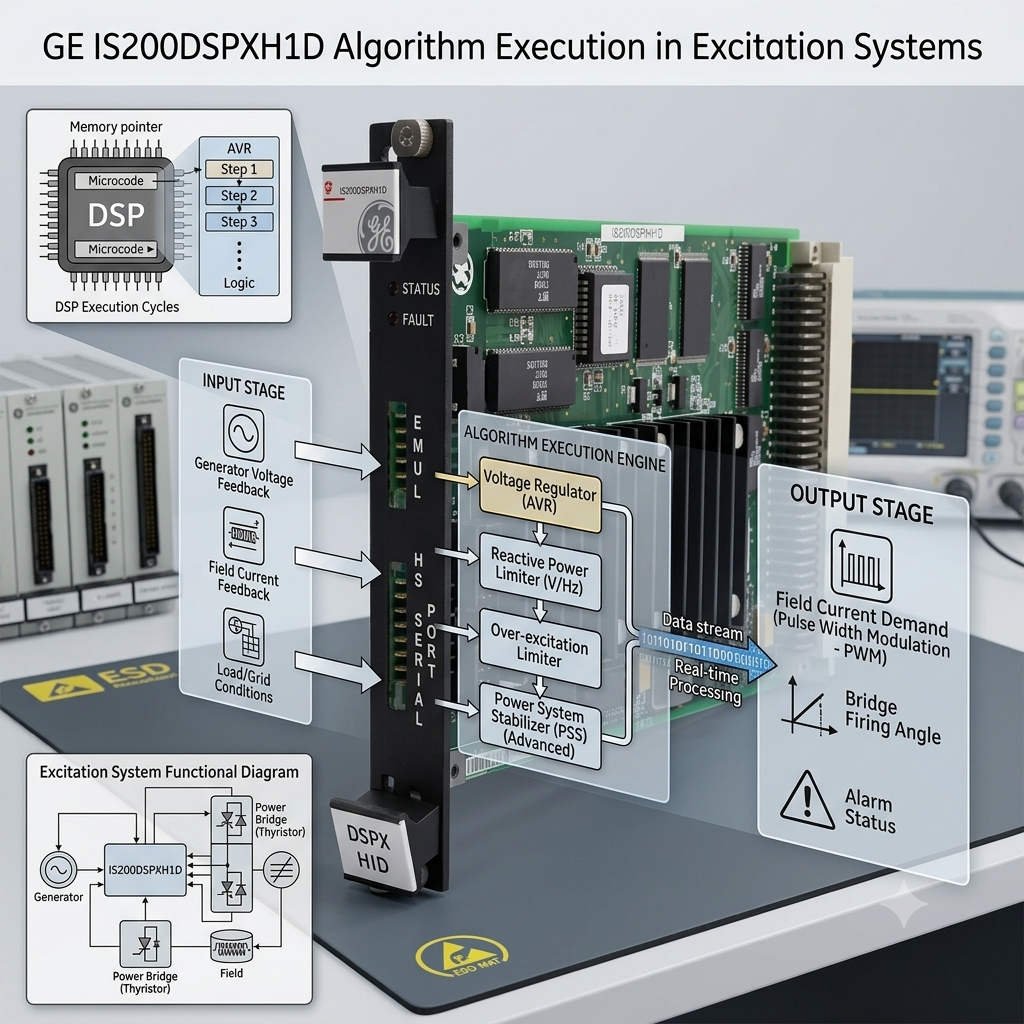
The GE Mark VI and EX2100 control systems rely on specific hardware to process complex electrical equations. The IS200DSPXH1D, IS200DSPXH1DBD, and IS200DSPXH1DBC digital signal processor (DSP) boards fulfill this computational role. These modules handle high-speed power electronics algorithms that maintain generator excitation. Consequently, they ensure voltage stability under rapidly changing grid conditions.
Modern power generation, oil and gas, and petrochemical plants require rapid response times during grid disturbances. Standard industrial automation controllers like traditional DCS or PLC units lack the determinism for microsecond-range calculations. Therefore, the specialized DSP board executes specialized firmware to prevent turbine tripping and equipment damage.
The Mechanics of High-Speed PWM Control Loops
The primary duty of the IS200DSPX board involves generating precise Pulse Width Modulation (PWM) signals. These signals directly dictate the thyristor firing sequences within the bridge rectifier assembly. Accurate firing angles stabilize generator terminal voltage and optimize reactive power control performance. Moreover, precise switching minimizes total harmonic distortion (THD) across the system.
The controller continually recalculates firing vectors based on actual field measurements. According to IEEE 421.5 standards for excitation systems, timing precision remains paramount for network stability. In my engineering experience at PLC Pioneer, even a minor microsecond deviation can induce thermal stress in thyristors. This jitter often originates from noisy potential transformer feedback rather than a hardware defect.
Executing Complex Closed-Loop Calculations in Real Time
The IS200DSPX architecture handles multiple critical calculations simultaneously to protect the generator. It processes Automatic Voltage Regulator (AVR) steps alongside reactive power and power factor control loops. Additionally, the software monitors field current limitations to enforce over-excitation and under-excitation protection boundaries. The processor executes these complex tasks within deterministic control cycles.
Fast processing loops correct voltage anomalies before they affect broader factory automation networks. As a result, heavy industrial facilities maintain strict compliance with local grid codes during sudden load shifts. This immediate computational feedback loop prevents voltage sags that could drop out critical plant motor starters.
Advanced Signal Processing and Mathematical Filtering
The DSP board constantly monitors multi-phase voltage vectors and generator stator current loops. It processes field current signals and external synchronization references via high-speed analog inputs. The module applies digital filtering, Root Mean Square (RMS) calculations, and phase angle tracking. Furthermore, it utilizes coordinate transformations to isolate fundamental frequencies from system noise.
Advanced filtering allows the system to distinguish genuine grid faults from transient electrical noise. Consequently, the control systems avoid nuisance trips and improve overall plant operational reliability. For facilities running generators near capacity, clean data processing prevents unnecessary fluctuations that accelerate rotor wear.
Installation Guide: Firmware Verification and Compatibility
The IS200DSPXH1D, IS200DSPXH1DBD, and IS200DSPXH1DBC share identical architecture but use distinct firmware versions. You must confirm system software compatibility with your specific Mark VI or EX2100 platform before hot-swapping hardware. Always consult official GE documentation to verify engineering changes and parameters. Revision mismatches frequently cause backplane communication validation errors during system booting.
Mitigating Grounding Issues and High-Frequency Noise
Industrial DSP cards handle highly sensitive analog measurements alongside high-frequency digital switching circuits. Therefore, engineers must maintain total cabinet grounding integrity to avoid signal corruption. You should isolate low-voltage control lines from high-current power cables in the panels. In plants utilizing heavy factory automation drives, proper shielding prevents phantom faults on the excitation bus.
Thermal Management Protocols for Excitation Systems
High-performance processors generate intense thermal loads within compact control enclosures during continuous operation. Maintenance teams must inspect ventilation fans and clean air filters during scheduled power plant outages. Ensure that ambient enclosure temperatures always remain within original equipment manufacturer guidelines. Excessive thermal cycling accelerates component degradation and reduces the lifespan of power supplies.
Procurement Strategy: Identifying Genuine Board Failures
Plant managers often struggle to diagnose whether a control fault resides within the DSP card itself. True hardware failures usually manifest as repeated diagnostic errors or a total loss of firing pulses. However, technicians should eliminate faulty feedback transducers and power supply fluctuations first. Many components returned for repair actually function correctly when tested under isolated laboratory conditions.
—
Best Practices for Commissioning & Maintenance
- ✅ Firmware Audit: Record the existing software version from the Toolbox programmer before removing old boards.
- ⚙️ Shield Grounding: Ensure the instrumentation drain wires terminate at the designated single-point ground bus.
- 🔧 Clearing Debris: Clean dust accumulations from the backplane connectors with residue-free electronic solvents.
- 📊 Parameter Verification: Reload the calibration constants to the EEPROM after completing any board replacement.
—
PLC Pioneer’s Expert Commentary
“In the field, I often observe technicians rushing to replace the main IS200DSPX processor the moment an excitation fault appears. However, our field data at PLC Pioneer reveals that over sixty percent of these system alarms stem from external cable degradation or failing terminal boards like the TBAX. Before procuring an expensive replacement, analyze the pulse train using an oscilloscope to verify if the gate pulse distortion happens before or after the DSP output.” — PLC Pioneer
Frequently Asked Questions
Q: What causes the EX2100 system to reject a new IS200DSPXH1D board during startup?
This issue usually points to a mismatch between the core software configuration and the board revision. The control system runs an automated compatibility check upon power-up, and if the firmware configuration does not match the hardware index, communication halts entirely.
Q: Can an issue on the DSP card cause the generator to trip on over-excitation?
Yes, if the DSP executes corrupted firing logic or experiences calculation delays, the thyristor gating pulses can lock at maximum conduction. This failure mode bypasses the standard AVR software loops and triggers backup hardware protection devices immediately.
Q: How do environmental factors affect the mathematical accuracy of these processors?
Ambient temperature fluctuations do not alter the digital calculations themselves, but extreme heat shifts the calibration of surrounding analog-to-digital converter circuits. This thermal drift introduces slight errors into the voltage feedback loop, making the algorithm respond to inaccurate values.
—
Application Scenario: Restoring a Critical Chemical Plant Exciter
During a localized lightning strike near an industrial facility, an emergency generator failed to sustain terminal voltage because of high-frequency noise on the synchronization bus. The main control panel registered multiple firing abnormalities. By utilizing advanced filtering profiles within the processor board, engineers isolated the transient surge data and stabilized the system. This optimization saved the refinery from a costly total shutdown.
If you need to optimize your turbine control infrastructure or source genuine replacement modules for your excitation panels, explore our technical inventory today. We provide thoroughly tested components to keep your heavy power systems operating reliably.
Visit our official resource center for technical guides and hardware support: PLC Pioneer Limited