
Optimizing Mining Safety: The Role of Intrinsically Safe Barriers in DCS Architectures
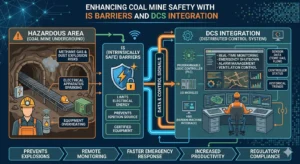
In underground coal mining, the risk of methane and coal dust explosions is a constant reality. Consequently, Intrinsically Safe (IS) barriers within a Distributed Control System (DCS) are more than just components; they serve as the primary defense mechanism. These devices strictly limit the electrical energy entering hazardous zones. Therefore, they prevent sparks or heat from becoming ignition sources, ensuring both personnel safety and regulatory compliance.
Understanding Energy Limitation Parameters (Uo, Io, Po)
The core function of an IS barrier involves capping the voltage (Uo), current (Io), and power (Po) sent to field instruments. These parameters must remain significantly lower than the ignition threshold of a methane-air mixture. However, many engineers overlook the stored energy in long cable runs. Cable capacitance and inductance can store enough charge to invalidate safety calculations. At PLC Pioneer, we always recommend verifying the total loop entity parameters to ensure the entire circuit remains safe.
Maintaining Signal Integrity and Loop Response Time
IS barriers introduce impedance that can potentially distort signals. This is particularly critical for real-time control loops, such as conveyor variable speed drives or automated pump systems. Poorly selected barriers may cause measurement drift in 4-20 mA analog signals. As a result, gas sensors might provide inaccurate readings. Choosing high-quality barriers ensures that safety monitoring remains both fast and precise.
Choosing Between Zener Barriers and Galvanic Isolators
Zener barriers are cost-effective but require a high-integrity, low-resistance ground (typically <1 ohm). Conversely, galvanic isolators provide electrical separation without a direct grounding dependency. In the damp and corrosive environments of underground mines, maintaining a perfect ground is difficult. Therefore, galvanic isolators have become the industry standard for modern DCS upgrades due to their superior reliability and lower maintenance needs.
Critical Grounding and Installation Standards
Grounding integrity is non-negotiable for Zener-based systems. Corrosion in humid mine shafts often increases resistance, which compromises the barrier’s protection capability. To mitigate this risk, maintenance teams must use dedicated IS grounding bars and conduct periodic resistance tests. Furthermore, engineers must physically segregate IS and non-IS wiring. Mixing these cables in the same conduit allows for electromagnetic coupling, which can bypass the safety barrier entirely.
Mitigating Risks in Long-Distance Cable Runs
Coal mines often feature massive distances between the control room and the face sensors. These long lines are susceptible to transient overvoltages and surges. Since many standard IS barriers lack internal surge protection, adding certified IS-compatible surge protectors is essential. This prevents external electrical interference from propagating into hazardous areas and damaging sensitive DCS input cards.
- ✅ Parameter Match: Ensure Uo, Io, and Po are lower than the field device’s safety ratings.
- ⚙️ Isolation Preference: Use galvanic isolators in areas with unstable or wet grounding conditions.
- 🔧 Wiring Discipline: Color-code all IS wiring with blue insulation to follow IEC international standards.
- 📊 Loop Validation: Perform a comprehensive loop calculation before every commissioning phase.
PLC Pioneer’s Expert Commentary
“While modern DCS and PLC systems offer incredible control power, they are only as safe as their interface with the hazardous area. We are seeing a significant shift toward ‘smart’ galvanic isolators that support HART pass-through. This allows for remote calibration of sensors from the surface, which reduces the time technicians spend in high-risk zones. In my view, investing in high-end isolation is the most effective way to reduce long-term operational risk in mining automation.” — PLC Pioneer
Frequently Asked Questions (FAQ)
Q: Can I replace a Zener barrier with a galvanic isolator without changing my DCS hardware?
In most cases, yes. However, you must check the voltage drop across the new isolator. Some legacy PLC or DCS analog input cards have high internal resistance. The additional drop from the isolator might cause the loop to fail if the power supply voltage is too low.
Q: Why is the blue color coding for cables so strictly enforced in IS systems?
This is a requirement of the IEC 60079-14 standard. It ensures that any technician, regardless of their experience level, can immediately identify a safety-critical circuit. Mixing IS and non-IS cables is one of the leading causes of safety audits failing in mining operations.
Q: Do IS barriers protect against lightning strikes on the surface?
Standard IS barriers are designed for energy limitation, not heavy lightning protection. If your DCS connects to surface equipment, you must install dedicated surge arresters designed for IS loops to prevent high-energy transients from entering the underground mine.
Solution Scenario: Conveyor Gas Monitoring
Imagine a 2-kilometer conveyor belt requiring methane sensors at every 200-meter interval. By utilizing galvanic isolators integrated into a DCS, the mine avoids the need for a complex copper grounding grid across the entire tunnel. The isolators maintain a clean 4-20 mA signal even with the high electromagnetic interference generated by the conveyor motors, ensuring the system can trigger an emergency shutdown the moment gas levels rise.
Reliable automation starts with the right hardware. For more technical insights into safety barriers and DCS components, explore the solutions offered by the experts at PLC Pioneer Limited.
Discover high-performance automation components here: PLC Pioneer Limited