The Evolving Landscape of Factory Automation
Factories worldwide face growing challenges. Labor shortages, increasing operational costs, and demanding delivery schedules put immense pressure on manufacturers. Traditional industrial automation systems, while effective, often involve high costs, fixed structures, and significant workflow disruption. These rigid characteristics historically favored only large enterprises. Collaborative robots, or cobots, now present a compelling alternative. These specialized robots collaborate safely with human operators. Cobots are compact, intrinsically safe, and highly adaptable to dynamic production needs. They make sophisticated factory automation accessible to small and mid-sized manufacturers, democratizing the field.
Surging Growth and Market Momentum in Robotics
The global cobot market is experiencing rapid expansion. In 2023, cobots represented a substantial percentage of all new robot installations. Reports show global sales reaching approximately 508,200 units, with a total market valuation of $923.7 million. Analysts project a remarkable Compound Annual Growth Rate (CAGR) between 18.9% and 36.47% through 2030.
This vigorous growth directly reflects critical factors: persistent labor shortages, ongoing cost-control pressures, and the maturity of core technology. Today’s cobots can handle complex, high-payload tasks, moving far beyond simple, light-duty applications.
Why Manufacturers Choose Cobots Today
Affordability for All
Traditional automation requires massive capital investment for custom integration, specialized safety fencing, and often results in months of production downtime. Cobots significantly lower these barriers. For example, a lightweight Dobot CR3A or desktop MG400 can be deployed and operational in just days. They automate repetitive tasks at a far lower cost than traditional systems, enabling smaller firms to compete effectively against industry giants.
Safety by Design (ISO/TS 15066 Compliance)
Cobots like the Dobot CR5A, especially when equipped with features like SafeSkin, integrate built-in sensors and proprietary safety protocols. These systems comply with the ISO/TS 15066 standard for safe human-robot collaboration. Cobots can work alongside human operators without requiring extensive, bulky safety barriers. As a result, technicians can focus on quality control and exceptions while the cobot handles monotonous tasks such as fastening or picking.
Flexibility for Modern Production
Modern manufacturing often involves high-mix, low-volume production runs, demanding strategic agility. The Dobot CRA Series, featuring intuitive, user-friendly interfaces, allows for rapid task switching. A manufacturer can reprogram a cobot to move from CNC machine tending to kitting tasks in a matter of hours. This inherent flexibility aligns production capabilities with volatile and dynamic market demands.
Expanding Cobot Applications on the Factory Floor
Cobots are no longer limited to niche, light-duty roles; they are becoming essential components in diverse production environments.
End-of-Line Packaging and Palletizing
Tasks at the end of the production line, such as palletizing, are often repetitive, fatiguing, and prone to human error. The Dobot CR10A (with its 10 kg payload and 1,300 mm reach) efficiently stacks boxes with high repeatability (±0.03 mm). Operators can therefore focus on value-added tasks like labeling and final inspection, improving overall workflow and reducing physical strain injuries.
Precision Assembly and Pick-and-Place
In the electronics or light assembly sectors, precision is paramount. Models like the Dobot CR3AS/CR5AS (with 3 kg and 5 kg payloads, respectively, and ±0.02 mm repeatability) excel in close collaborative environments. Equipped with SafeSkin, they handle precise component placement while operators manage assembly exceptions or high-level quality checks.
Machine Tending and Welding
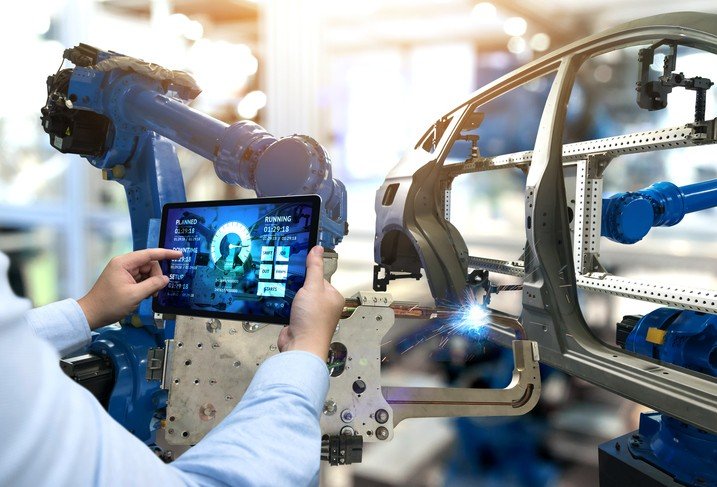
Cycle-intensive tasks, essential in many industries, benefit immensely from higher-payload cobots. The Dobot CR20A (20 kg payload, 1,700 mm reach) and the standard CRA Series can reliably tend CNC machines or perform semi-automated welding tasks. This strategic deployment allows human operators to shift their focus from repetitive loading to process oversight and optimization.
Quality Inspection with Vision Systems
Integrating cobots with sophisticated vision systems drastically improves quality control. Paired with the Dobot VX500 Smart Camera (5 MP resolution, ±0.26 mm positioning accuracy), cobots can perform consistent, high-volume inspections. This frees specialized engineers to concentrate on data analysis, process optimization, and complex issue resolution.
The Positive Workforce Impact of Collaboration
Cobots are reshaping the nature of human work, not replacing it entirely. They remove the “4D” tasks: dull, dirty, dangerous, and difficult jobs. This strategic shift moves human operators into process management, oversight, and skill-intensive roles. Consequently, workplace safety improves dramatically. Many forward-thinking facilities are investing in training programs to develop their existing workforce into certified cobot technicians. This emphasis on new skill development significantly enhances employee retention and creates clear, modern career pathways.
Choosing the Right Collaborative Robot for Your Operation
Selecting the correct cobot model is key to successful deployment. Here is a simplified guide:
⚙️ Dobot Model Selection Guide:
The Future of Connected Manufacturing
The road ahead for industrial automation is increasingly connected and data-driven. Cobots, with their integrated sensing and analytics capabilities, will become key elements in this smart manufacturing ecosystem. The data they generate supports predictive maintenance strategies and helps optimize overall equipment effectiveness (OEE). High-capability models like the CR20A and the robust CRA-IP68 will continue to expand cobots into handling harsher, heavier-duty tasks. This evolution ensures consistent, high-quality output and maintains competitive operational costs, supporting global supply chain reshoring efforts.
To explore specific technical details, application case studies, or specialized control systems for cobot integration, please visit the resource hub at PLC Pioneer Limited.
Frequently Asked Questions (FAQ)
- Q1: How much production downtime should I budget for implementing my first cobot?
- A: Based on our experience, initial deployment for a simple task like box stacking using a standard cobot (e.g., Dobot CR10A) rarely requires more than a few days of downtime, if any. Traditional robots often demand weeks for custom safety cage fabrication and system integration. Cobots are designed for quick setup, often involving a simple guided teach-and-play sequence, allowing you to minimize production disruption dramatically.
- Q2: Will a cobot replace the need for an expensive PLC/DCS system in my small manufacturing plant?
- A: No, a cobot primarily replaces a repetitive manual task. The PLC (Programmable Logic Controller) or DCS (Distributed Control System) is the master brain of the entire production line. It manages the interlocks, coordinates I/O with other machines (like conveyors or sensors), executes complex logic, and handles high-level data logging. The cobot is an actuator within the automation cell, managed and monitored by the central control system. You will still need a robust PLC for comprehensive system management.
- Q3: How do we ensure our existing team accepts and adopts the new collaborative robot technology?
- A: Adoption hinges on transparency and training. We advise manufacturers to position the cobot as a “co-worker” that eliminates the least desirable tasks, not as a replacement. Crucially, involve the human operator who previously performed the task in the cobot’s initial programming and teaching phase. Training them as the “Cobot Supervisor” or “Automation Technician” enhances their skill set, provides career development, and builds immediate trust and ownership.