DCS vs. PLC + SCADA: Evaluating Stability in Modern Industrial Automation
In high-stakes sectors like oil and gas or pharmaceuticals, system uptime directly impacts safety and profitability. Engineers often debate whether a Distributed Control System (DCS) is inherently more stable than a PLC + SCADA architecture. While DCS offers integrated redundancy, a well-engineered PLC system can match its performance in specific applications. Ultimately, the choice depends on your process complexity and maintenance discipline.
Inherent Redundancy: High Availability by Design
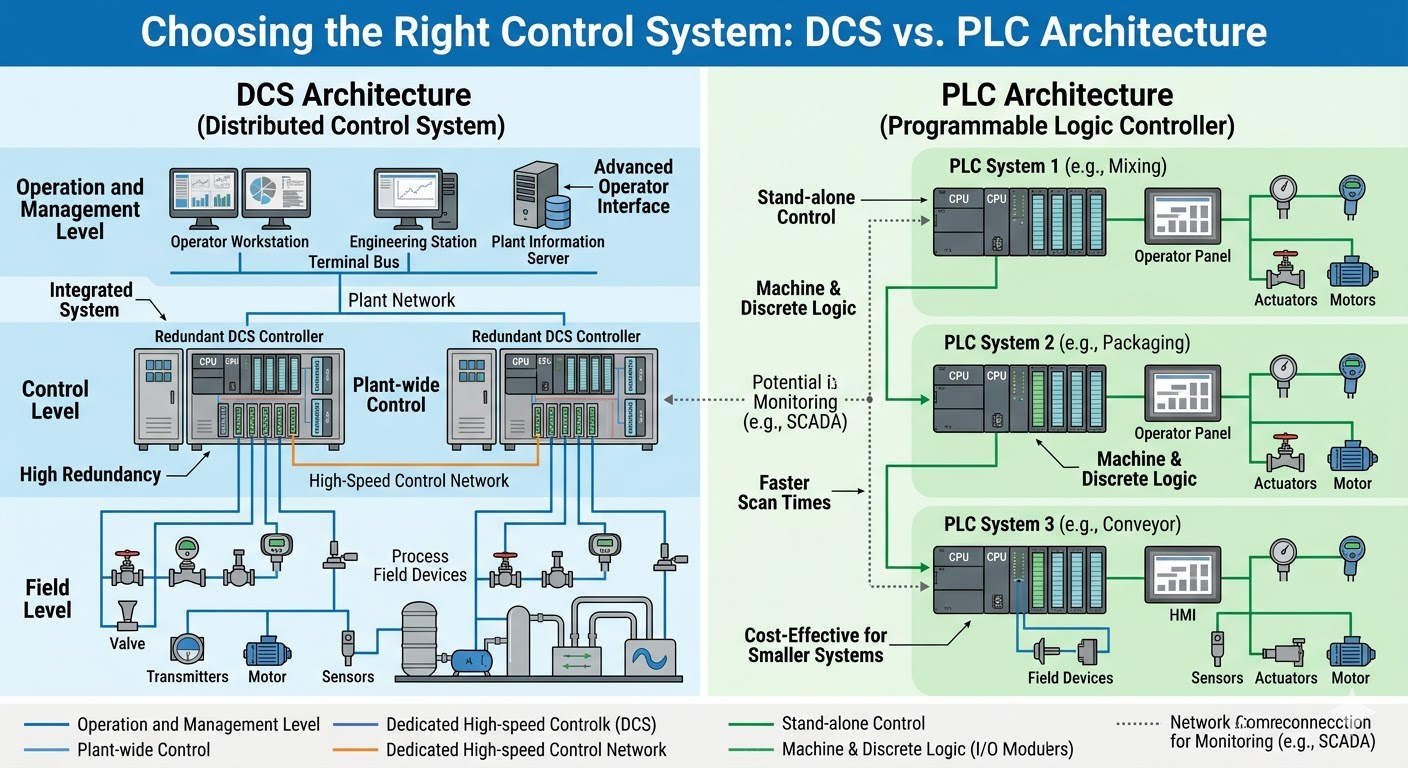
DCS platforms provide “out-of-the-box” redundancy for controllers, power supplies, and networks. These systems handle failover tasks in milliseconds, ensuring continuous operation without manual intervention. Conversely, PLC + SCADA setups require manual redundancy engineering. You must synchronize CPUs and configure server clusters yourself. Therefore, while both systems achieve high availability, DCS simplifies the path to 99.99% uptime through standardized hardware cycles.
Control Loop Precision and Deterministic Logic
Continuous process industries rely heavily on Proportional-Integral-Derivative (PID) loops. DCS environments prioritize these complex calculations, offering deterministic scan times that prevent oscillations in chemical reactions. In contrast, PLCs excel at high-speed discrete tasks like packaging or motion control. However, scaling a PLC system to handle hundreds of synchronized loops can introduce latency. As a result, DCS remains the gold standard for large-scale refineries requiring steady-state precision.
Unified Databases vs. Multi-Vendor Integration
A primary advantage of DCS is its unified global database. The HMI, historian, and controllers share a single data source, which reduces configuration errors. PLC + SCADA systems often utilize mixed protocols like Modbus TCP, OPC UA, or EtherNet/IP. While these open standards offer flexibility, they also increase integration risk. Protocol mismatches or misconfigured OPC servers frequently cause intermittent communication drops in non-integrated systems.
Engineering Insights: Maintaining Infrastructure Integrity
Stability often fails at the physical layer rather than the software layer. In mixed vendor environments, improper grounding can introduce electromagnetic interference (EMI) that disrupts sensitive signals. We recommend using shielded cables grounded at a single point to prevent ground loops. Additionally, many cost-effective PLCs lack robust surge protection. Consequently, installing external Surge Protection Devices (SPD) is essential for systems located in volatile electrical environments.
The Importance of Real-World Failover Testing
Experience shows that many “redundant” systems fail during actual emergencies because they were never tested under load. At PLC Pioneer, we advocate for live failover simulations during commissioning. You should physically disconnect a primary controller or pull a network cable while the process is running. This validates that the historian continues logging and the control valves maintain their positions without a “bump” in the process.
- ✅ Standardized Grounding: Follow IEEE 1100 standards to ensure communication stability across multi-vendor hardware.
- ⚙️ Network Segmentation: Utilize VLANs to isolate control traffic from corporate IT data to prevent broadcast storms.
- 🔧 Validation Protocols: Conduct periodic redundancy drills to ensure failover logic remains functional after software updates.
PLC Pioneer Expert Commentary
“The industry is seeing a convergence where high-end PLCs now mimic DCS functionality. However, the ‘human factor’ remains the biggest variable. A DCS is harder to break because it is a closed ecosystem, whereas a PLC + SCADA system is only as stable as the integrator who built it. If you have a small team, the ‘designed-in’ stability of a DCS often justifies the higher initial CAPEX.” — PLC Pioneer
Frequently Asked Questions
Q: Can a PLC + SCADA system truly replace a DCS in a chemical plant?
It is possible for modular plants (skid-based manufacturing), but it requires rigorous adherence to IEC 61131-3 programming standards and high-end redundant hardware to ensure the same level of safety and loop stability found in a native DCS.
Q: Why do protocol mismatches happen so often in PLC systems?
Usually, this occurs when different hardware generations are mixed. For example, linking a legacy serial Modbus device to a modern Ethernet/IP network via a cheap gateway can introduce “jitter,” which destabilizes real-time monitoring.
Q: Is DCS maintenance more expensive than PLC maintenance?
While the initial hardware cost is higher, DCS often reduces long-term “hidden” costs. Because the environment is unified, troubleshooting takes less time compared to a PLC + SCADA system where you might need three different software tools to find a single fault.
Solution Scenario: Upgrading a Continuous Batch Reactor
Consider a pharmaceutical batch process where temperature precision is critical for product yield. By moving from a legacy standalone PLC to a modern integrated control architecture, the facility can implement Advanced Process Control (APC). This synchronization reduces temperature deviation by 20%, significantly lowering the risk of rejected batches and improving regulatory compliance with FDA audit trail requirements.
To optimize your factory floor with the most reliable hardware and expert guidance, explore our full range of solutions at the official resource center.
Discover high-performance automation components and technical support: PLC Pioneer Limited