
Understanding the Role of Proximity Sensing in Factory Automation
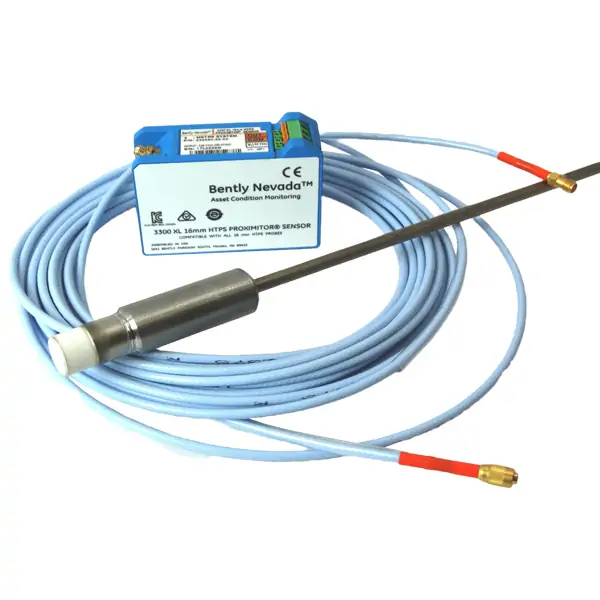
Proximity sensing is vital in factory automation. These systems monitor the position and vibration of rotating machinery. Specifically, the Bently Nevada 3300 NSv Metric Probe is a non-contact sensor. It works with a Proximitor Sensor to measure the distance to a machine shaft. This setup is crucial for predictive maintenance programs. We use it extensively in both PLC and DCS environments. The correct setup ensures reliable machine protection. Industrial automation relies on this precise data.
Key Components: 3300 NSv Probe and Proximitor Sensor
The 3300 NSv Metric Probe serves as the antenna. It transmits and receives a high-frequency signal. The Proximitor Sensor is the conditioning electronic module. It converts the probe’s signal into a voltage output. This voltage is directly proportional to the gap distance. This system is a cornerstone of effective machine monitoring. It provides continuous data to control systems. Proper component matching is essential for accuracy.
Connection Procedure: Wiring the Probe to the Proximitor
Connecting the two devices is straightforward but requires care. The Proximitor Sensor has three main connection points. These are usually labeled as TIP, COMMON, and POWER. The 3300 NSv probe cable connects to the TIP and COMMON points. The probe’s center conductor goes to the TIP terminal. Its outer shield or braid connects to the COMMON terminal. Therefore, always follow the manufacturer’s exact wiring diagram. Incorrect wiring can lead to signal loss. Moreover, ensure all connections are tight. This prevents intermittent signals or noise interference.
System Configuration and Calibration: Ensuring Accuracy
After physical wiring, the system needs configuration. Calibration is critical for accurate measurements. The Proximitor Sensor must be set for the correct probe type. A metric probe uses a specific set of parameters. This involves adjusting the gap voltage. The typical gap voltage is -10 Vdc to -24 Vdc power supply. This voltage range determines the sensitivity of the system. In addition, always verify the probe’s physical gap. Use a feeler gauge to confirm the distance. Accurate calibration is key for industrial automation reliability.

Integration with Control Systems (PLC/DCS): Author’s Insight
The Proximitor output signal is typically a voltage signal. It can be a 4-20 mA current loop in some configurations. This signal feeds directly into your PLC or DCS input cards. These control systems then use the data for condition monitoring. I have observed many sites overlook proper grounding. Grounding integrity is vital to minimize electrical noise. Noise drastically affects the vibration signal quality. As a result, always ensure a solid earth ground connection. Reliable data input is the foundation of effective machine diagnostics.
Application Scenario: Turbo-Compressor Monitoring
Consider a large turbo-compressor application. The 3300 NSv Probes monitor shaft radial vibration. These probes report data back to the DCS. High vibration readings trigger an alarm. If readings escalate, the PLC may initiate a shutdown sequence. This preemptive action prevents catastrophic failure. Such proactive maintenance is the ultimate goal of factory automation. This precise monitoring extends equipment life.

Boosting Your Automation Efficiency
The proper implementation of Bently Nevada probes is essential. It directly impacts your operational efficiency and safety.
To explore top-tier solutions for integrating your vibration monitoring data into robust PLC and DCS infrastructures, and to find high-quality automation components, please visit PLC Pioneer Limited