
Optimizing 4-20mA Analog Signal Conversion for Modern PLC and DCS Systems
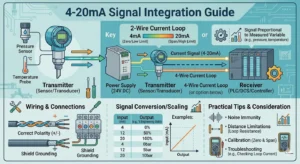
In the era of Industrial IoT, legacy equipment often still relies on 4–20 mA analog signals. However, modern DCS and PLC architectures require high-precision digital data for advanced analytics. By implementing robust Analog Input (AI) modules or A/D converters, plants can bridge this gap. This integration enables remote diagnostics, improved data visualization, and more responsive control loops.
The Strategic Importance of High-Precision Signal Conversion
In continuous process industries like oil, gas, and pharmaceuticals, signal conversion is more than a technicality. It directly impacts control accuracy and overall process safety. Reliable conversion ensures compliance with SIL (Safety Integrity Level) standards. Therefore, selecting the right interface determines whether your system merely “reads data” or truly optimizes production.
Technical Insights: Resolution and Its Impact on Control
Engineers often overlook bit depth when selecting A/D converters. A 12-bit module offers roughly 4,096 steps, which might suffice for simple level monitoring. However, 16-bit or 24-bit modules provide the granularity needed for precision chemical dosing. In my experience at PLC Pioneer, insufficient resolution often causes “valve hunting.” This constant oscillation shortens hardware lifespan and destabilizes the process.
Mitigating Accuracy Drift and Linear Errors
Standard accuracy ratings of ±0.1% or ±0.05% FS (Full Scale) are vital for cost-sensitive applications. If an aging sensor already exhibits a ±0.5% drift, a low-quality AI module will amplify these errors. This cumulative inaccuracy can lead to significant financial losses in energy metering or batching systems. Consequently, I recommend modules with Auto-Calibration features for all critical control loops.
The Vital Role of Electrical Isolation and Grounding
Ground loops and Electromagnetic Interference (EMI) frequently plague industrial sites. Without proper 1500V or 2500V isolation, signals may fluctuate or trigger false DCS alarms. This issue is particularly common in refineries where equipment spans large distances. As a result, using isolated signal conditioners is mandatory when crossing from hazardous areas to the main control room.
Best Practices for Field Installation and Maintenance
Poor wiring choices often undermine even the most expensive hardware. Always use shielded twisted pair (STP) cables and ground the shield at the control room side only. Maintain at least 30 cm of clearance from high-voltage power lines to avoid 50Hz/60Hz noise. Furthermore, verify whether your loop is two-wire or four-wire. Insufficient loop voltage (less than 12V) can “compress” your signal and lead to flat-lined data.
Protecting Against Surge and Environmental Hazards
Outdoor instruments in chemical plants are highly susceptible to lightning strikes and power surges. If your AI module lacks built-in protection, adding a dedicated Surge Protective Device (SPD) is essential. A single surge can destroy both the remote transmitter and the expensive PLC input card. Therefore, investing in signal isolators with integrated surge suppression provides a critical layer of insurance.
Technical Implementation Checklist
- ✅ Verify Bit Depth: Choose at least 16-bit resolution for flow control and precision dosing.
- ⚙️ Shielding Integrity: Ensure STP cables are grounded at a single point to prevent ground loops.
- 🔧 Loop Power Check: Confirm the power supply provides at least 24VDC to account for line voltage drops.
- 📊 Calibration Routine: Schedule annual checks for analog modules to compensate for thermal drift.
PLC Pioneer’s Expert Commentary
“Converting a 20 mA signal to a digital value seems like a basic task, but the industrial floor is a harsh teacher. The difference between a successful startup and a week of troubleshooting often comes down to isolation and grounding. If you are integrating a Honeywell Experion DCS or an Allen-Bradley PLC, never treat the signal interface as an afterthought. Designing for stability on day one is always cheaper than a post-commissioning fix.” — PLC Pioneer
Frequently Asked Questions
Q: My PLC already has an integrated AI card; do I still need an external signal isolator?
If your sensors are located far from the PLC or near high-power motors/VFDs, an external isolator is highly recommended. It protects your expensive PLC backplane from surges and eliminates common-mode noise that integrated cards might not filter effectively.
Q: How do I identify if my signal fluctuations are caused by EMI or a failing sensor?
Temporarily connect a calibrated signal generator directly to the AI module. If the reading stabilizes, the issue lies with the field wiring or the sensor. If the fluctuations persist, the problem is likely internal to the module or caused by a ground loop at the controller.
Q: Should I upgrade to digital Fieldbus (like HART or Profibus) instead of keeping 4-20mA?
For critical assets, upgrading to HART-enabled transmitters allows for remote asset management and multivariable data. However, for non-critical points, retaining 4-20mA with a high-quality isolator is a cost-effective way to maintain system performance without a full infrastructure overhaul.
Application Scenario: Chemical Dosing Accuracy
A fine-chemical facility struggled with inconsistent batch quality. Investigation revealed that their 12-bit AI modules could not resolve the small flow adjustments required for the catalyst. By upgrading to 24-bit isolated converters and implementing proper cable shielding, the plant improved dosing precision by 40%. This change resulted in a 5% reduction in raw material waste within the first quarter.
If you are planning a system migration or need to stabilize your current analog loops, our team provides the technical hardware required for seamless integration. We specialize in high-reliability modules compatible with major DCS and PLC brands.
Discover high-performance signal conversion solutions at our official site: PLC Pioneer Limited