

Understanding ABB S800 I/O: The Backbone of Modern Industrial Automation
The global industrial automation market heavily relies on robust I/O systems. Analysts estimate the analog output modules segment alone will reach approximately $4.2 billion by 2033, showing a strong upward trend fueled by Industry 4.0 adoption. ABB’s S800 I/O platform forms a critical, distributed, and modular system. It communicates with host controllers through standard fieldbuses. This open architecture allows integration with various ABB and third-party controllers (Source: Data Insights Market, MarketsandMarkets). Installing S800 I/O close to field devices drastically cuts cabling and overall installation expenses. It delivers precise, real-time data acquisition, which is essential for modern Distributed Control Systems (DCS) and Programmable Logic Controllers (PLC) environments.

The Resilience Enabler: Function and Principle of the SB822 Rechargeable Battery Unit
The SB822 serves a specialized but vital role. It is a rechargeable battery unit providing backup power for specific S800 I/O modules. The primary function is uninterruptible operation during main power fluctuations or failures. Its principle involves internal battery chemistry—typically NiMH or similar technology—that maintains a charged state during normal power. When AC power drops, the SB822 immediately supplies DC power to the connected modules. This ensures data integrity and continuous control execution. It is crucial in applications demanding high reliability.
⚙️ Key Features:
Provides seamless power transition.
Ensures volatile data preservation.
Supports controlled system shutdown.
High-Precision Data Acquisition: The AI825 and AI843 Analog Input Modules
Analog input modules convert real-world continuous signals into digital data for the controller. The AI825 and AI843 are core components for standard process measurements. Both receive signals like 4-20 mA or 0-10 V from field sensors.
AI825: A versatile, standard module suitable for general industrial applications. It offers high channel density and reliable signal conversion.
AI843: This module generally provides higher input integrity or specialized features, such as redundancy support or specific sensor interfaces.
Their principle is Analog-to-Digital Conversion (ADC). The input signal passes through conditioning circuits before the ADC chip digitizes it. The controller then processes this precise digital value. These modules are fundamental in chemical processing, power generation, and general manufacturing.

Critical Application Control: The AI880 for High-Integrity Systems
The AI880 stands apart as a High-Integrity Analog Input Module. It is specifically engineered for Safety Instrumented Systems (SIS) and critical applications. These include emergency shutdown (ESD) systems and fire and gas (F&G) detection.
Principle: The AI880 utilizes advanced diagnostics and often features internal redundancy (e.g., Triple Modular Redundancy or TMR architecture). This internal setup ensures extreme fault tolerance and high Mean Time To Failure (MTTF).
Application: Refineries, offshore platforms, nuclear facilities, and pharmaceutical plants rely on the AI880. Its certification to industry safety standards like IEC 61508 is paramount. This module’s role directly enhances overall plant safety.
Executing Commands: The AO815 Analog Output Module
The AO815 performs the opposite function of the AI modules. It takes a digital value from the controller and generates a corresponding analog signal. This signal drives field actuators.
Function: It directly controls continuous elements like control valves, variable speed drives (VSDs), and dampers.
Principle: It uses a Digital-to-Analog Converter (DAC). The module converts the controller’s digital command into a smooth 4-20 mA or 0-10 V output. The speed and accuracy of this conversion are vital for loop performance. Stable, quick-response output is mandatory for precise flow, temperature, or pressure control.
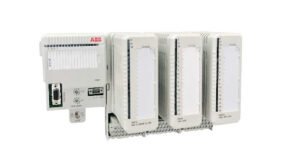
Selection Distinction: Choosing the Right S800 I/O Module
Selecting the correct S800 I/O module defines system performance and cost. These selection criteria highlight the functional differences:
| Feature | AI825 (Analog Input) | AI843 (Analog Input) | AI880 (High-Integrity AI) | AO815 (Analog Output) | SB822 (Battery Unit) |
| Primary Function | General measurement | Enhanced/Specialized measurement | Safety/Critical measurement | Actuator control | Power backup |
| Typical Signal | $\text{4-20 mA, 0-10 V}$ | $\text{4-20 mA, 0-10 V}$ | $\text{4-20 mA, RTD/TC}$ | $\text{4-20 mA, 0-10 V}$ | DC Power Supply |
| Application Focus | Process Monitoring | Standard Process Control | SIS, ESD Systems | Final Control Elements | High Availability Systems |
| Key Distinction | Cost-effective density | Versatility, specific sensor support | SIL-rated diagnostics/TMR | Continuous output drive | Uninterruptible Power |
PLC Pioneer’s Perspective: Engineers must prioritize the application requirement over cost alone. Use the standard AI825/AI843 for non-critical control loops. However, the AI880 is non-negotiable for safety applications where failure risk is intolerable. Furthermore, the SB822 provides cheap insurance against costly downtime. High availability systems justify this investment every time.
Application Scenarios and Advanced Solutions
ABB S800 I/O modules are ubiquitous in process and factory automation.
Refining and Chemical Plants: The AI880 monitors critical tank levels and pressure relief valves. The AO815 precisely modulates flow control valves for reaction processes.
Power Generation: AI825/AI843 modules read boiler temperature and steam pressure. The SB822 protects controller logic during sudden power dips.
Water/Wastewater Treatment: AO815 drives chemical dosing pumps. The AI modules monitor pH and flow rates.
Author’s Insight: The trend towards modular, remote I/O systems, validated by the Industrial I/O Modules Market CAGR of nearly 6% (Source: Technavio), reinforces the long-term value of the S800 platform. Its flexibility allows for seamless expansion into emerging IIoT applications, making it future-proof. Choosing a reliable supplier is crucial for lifecycle management.
Frequently Asked Questions (FAQ)
Q1: How does the AI880’s “High-Integrity” feature practically benefit my process?
A: High-Integrity means the module incorporates extensive internal diagnostics. It continuously checks itself for internal faults. If a fault is detected, it enters a pre-defined safe state. This prevents dangerous scenarios by ensuring a reliable “trip” or shutdown action when necessary. You avoid catastrophic failures and improve personnel safety.
Q2: Can I use the SB822 for an entire S800 I/O station?
A: No, the SB822 is designed to back up specific, low-power modules, typically the ModuleBus Communication Interface (BCI). It is not for the entire I/O system’s field power. It ensures communication integrity and critical module status during brief power interruptions. The main power supply manages heavy field load power.
Q3: What is the main operational difference between a standard analog input like the AI825 and a standard analog output like the AO815?
A: The AI825 reads data (e.g., temperature) from the field to the controller (input). The AO815 writes data (e.g., valve position) from the controller to the field (output). The input module is a “listener,” while the output module is a “talker,” executing control commands.
We invite you to explore the full range of ABB S800 I/O modules and industrial automation solutions by visiting PLC Pioneer Limited.
Our expertise supports your precise process control needs.